How to Write Plausible Multiple-Choice Distractors
Write wrong answer options that reveal real misconceptions without tricking learners, adding filler, or accidentally giving away the correct answer.
A plausible distractor is not simply an answer that sounds possible. It represents a specific way someone might misunderstand the evidence, apply the wrong rule, perform a step too early, or stop reasoning before the problem is complete.
That distinction matters because a multiple-choice response can do more than mark someone wrong. When each option corresponds to a meaningful reasoning path, the answer distribution can help an educator decide what to clarify, replay, practice, or rewrite.
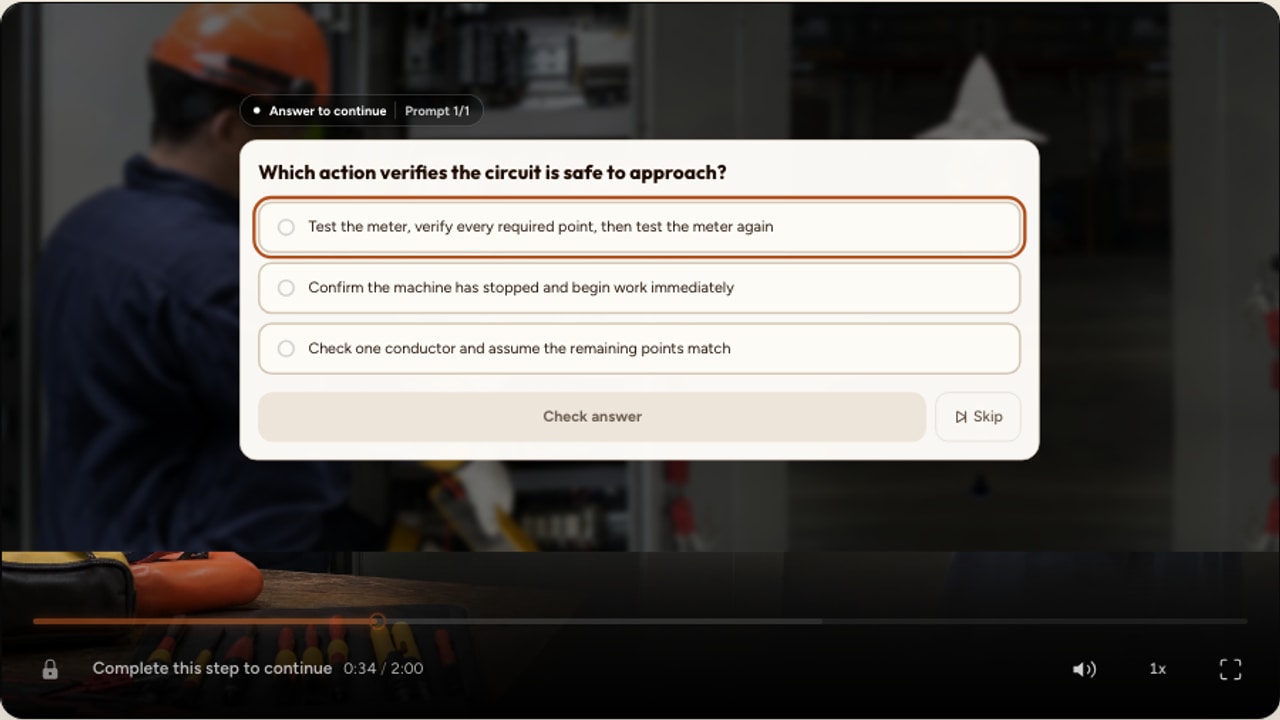
A distractor should diagnose, not decorate
Ask what the selected answer reveals: if a viewer chooses this option, what might that response mean? “They do not know” is too broad. A diagnostic answer sounds more like “They treated stopped motion as proof of zero stored energy” or “They reversed the final two steps.”
The diagnostic ladder
Judge an option by the evidence it can produce
- 01
Filler
Obviously unrelated, impossible, or written only to reach a target option count.
It tells you little when a learner rejects it.
- 02
Nearby error
Related to the topic, but not tied to a known reasoning path.
It may expose confusion, but the cause is uncertain.
- 03
Diagnostic distractor
Represents one named misconception, procedural error, or incomplete rule.
Selecting it points to a useful next teaching move.
Start with the mistake before writing the option
Begin with the learning objective and the evidence needed to answer. Then list the reasoning paths that lead away from the correct result. Convert only the most credible instructional paths into answer options.
Option-first drafting
Add a correct answer, then invent three wrong phrases that sound different.
Reasoning-first drafting
Name two or three likely errors, then express each one as a concise parallel option.
This reverses a common failure pattern. Instead of searching for enough wrong words to fill the card, you decide what evidence each response should produce. Some questions will support two strong distractors. Some will support three. The number follows the content.
Build a misconception ledger
Do not depend on memory when the same course, process, or concept will be assessed more than once. Keep a small ledger of observed learner errors, incorrect calculations, unsafe sequences, and confusing concept pairs. Record where each error came from and whether it was confirmed by a subject expert.
Observed action
The learner performs a correct step at the wrong time.
Turn the power back on before the verification test.
Incomplete rule
The learner remembers one condition but misses the limiting condition.
The reading is safe whenever the machine has stopped moving.
Nearby concept
The learner chooses a related measure that answers a different question.
Check current instead of verifying voltage at the required points.
Calculation pattern
The learner applies the right operation to the wrong quantity.
Use total time where the formula requires elapsed time per cycle.
Written responses are particularly useful raw material. Research on distractor development has shown how patterns in constructed responses can be converted into plausible wrong options after subject-matter review. The human review matters because frequent wording is not automatically a valid misconception.
Keep every option in the same family
Options are easier to compare fairly when they are the same kind of thing. If the question asks for the next action, every option should be an action. If it asks for a cause, do not mix causes, symptoms, and remedies in the same list.
Same kind of thing
All options are actions, quantities, diagnoses, causes, or definitions, not a mixture.
Similar construction
Grammar, specificity, and detail do not make the key visibly different.
One best answer
Every distractor is wrong under the conditions stated in the stem and video.
Parallel options reduce accidental clues and unnecessary reading effort. They also make the response more interpretable. When every option answers the same lead-in, choosing one says something clearer about the learner's reasoning.
Remove clues that reward test-taking tricks
Read the stem with each option separately. Grammar should work every time. Then compare length, specificity, qualification, and repeated vocabulary. A correct answer that is always longer or more carefully worded can be recognized without understanding the video.
- Avoid making the key the only option that repeats a phrase from the stem.
- Remove accidental grammar agreement that works only with the key.
- Do not use “always” or “never” as easy elimination cues unless the concept truly depends on absolutes.
- Avoid “all of the above” when it lets one known pair reveal the answer.
- Do not make a comic or reckless option the only obviously unserious choice.
Prefer two strong distractors to extra filler
More options do not automatically make a better question. Studies of teacher-written and professional assessments repeatedly find that many distractors are rarely selected. Research in health-science education has found that questions with two plausible distractors can perform as well as longer option sets, while weak filler adds writing flaws and little diagnostic value.
Do not apply a rigid three-option rule either. Use the options the problem genuinely supports. A question about four visible controls may naturally have four credible choices. A conceptual decision may have only two meaningful wrong paths. Quality and interpretability come before visual symmetry.
Use the video evidence to make options fair
In a video question, the timing and frame are part of the item. A distractor may be plausible only because the decisive evidence has not appeared yet, or because an important gauge, label, or action is hidden behind the question card.
Preview the normal playback path and pause at the authored timestamp. Confirm the viewer has seen everything the question expects, and that the interaction does not cover the evidence needed to compare options. Move the timestamp when the instructional sequence is incomplete.
Place the question after complete evidence
Choose timestamps after coherent explanations, examples, and demonstrations so wrong options test reasoning rather than missing context.
Write distractors for different learning jobs
The basis for a useful wrong answer changes with the task. A procedural question should expose sequencing or safety errors. A calculation should expose a known operation or unit error. A visual question should compare features that are actually present.
Five learning jobs
Match the distractor to the kind of reasoning the question is meant to reveal.
Procedure
Choose the next safe action
Diagnostic basis
A step that is required later, but is unsafe or premature now
Weak basis
An action unrelated to the procedure
Concept
Apply a rule under stated conditions
Diagnostic basis
The rule with one essential condition omitted
Weak basis
A definition from a different unit
Calculation
Select the correct result
Diagnostic basis
A result produced by a known sign, unit, or operation error
Weak basis
A random number near the correct answer
Visual evidence
Interpret what appears in the frame
Diagnostic basis
A visible feature that is real but does not answer the question
Weak basis
An object that is absent from the scene
Judgment
Choose the best response to a case
Diagnostic basis
A tempting action that solves the immediate symptom but ignores the cause
Weak basis
An obviously reckless or comic response
In Interakly, use multiple choice when one best option can be judged from the evidence. Use a poll when the prompt asks for an opinion, preference, or prediction without one correct answer. Do not create a false key only to force an open question into a graded format.
Match the interaction type to the evidence
Compare graded questions, polls, open responses, cards, and other supported video interactions before choosing a format.
Review option performance after publishing
After enough viewers respond, inspect the answer distribution in the available analytics. Treat it as a prompt for investigation, not a final diagnosis. A rarely selected distractor may be implausible, too easy to eliminate, or simply tied to an uncommon misconception. A dominant wrong answer may reveal a real teaching gap, but it may also expose ambiguous wording or an incorrect key.
- Nobody selects an option: check relevance, grammar, length, and whether the video makes it obviously impossible.
- One wrong option dominates: inspect the related instruction and verify the key with a subject expert.
- Answers split between two options: check whether both can be defended under the stem's conditions.
- Almost everyone answers correctly: decide whether the objective is basic confirmation or whether the item needs a more meaningful decision.
Revise one thing at a time when possible. If the stem, options, timing, and source explanation all change together, the next response pattern cannot tell you which correction helped.
Turn each meaningful wrong answer into useful feedback
Connect the selected reasoning path to evidence, an explanation, and a practical next move.
A practical distractor-writing workflow
Define the decision
Write what a correct response demonstrates and what evidence in the video supports it.
Collect real errors
Use learner responses, instructor observations, procedural mistakes, and subject-expert review to identify likely reasoning paths.
Name each misconception
Describe the error in a full sentence before reducing it to an answer option.
Choose the strongest paths
Keep only distinct errors that are plausible for the intended audience and useful for instruction.
Write options in parallel
Use the same grammatical shape, level of detail, category, and approximate length across the set.
Prove one best answer
Check every option against the exact conditions in the stem and verify the key with a knowledgeable reviewer.
Preview the evidence
Watch the approach to the timestamp, confirm the decisive information has appeared, and test the complete card on desktop and phone.
Review the distribution
Use real response patterns to investigate weak options, persistent misconceptions, ambiguous wording, and missing instruction.
Write the complete video question
Align the learning objective, evidence, stem, answer key, distractors, feedback, and timestamp before publishing.
The final option audit
Release audit
Can every option defend its place?
- Each wrong option maps to a named misconception, error, or incomplete rule.
- All options answer the same question and use parallel grammar.
- The correct answer is not consistently longer, more precise, or better qualified.
- No option relies on a joke, absurdity, absolute word, or grammatical mismatch as its main clue.
- The video supplies enough evidence to rule between the options fairly.
- Only one answer is best under the exact conditions in the stem.
- Every option remains readable at the maintained mobile player size.
- Feedback explains the reasoning represented by meaningful wrong answers.
Ask a subject expert to explain what each option means without seeing your notes. If they cannot identify the intended reasoning path, the distractor is unlikely to produce clear evidence for an educator or useful feedback for a learner.
Research sources
The guidance above draws on research and technical item-writing guidance about functioning distractors, option flaws, and the use of learner misconceptions. Useful starting points include:
- Tarrant, Ware, and Mohammed on functioning and non-functioning distractors
- Tariq and colleagues on distractor efficiency and item-writing flaws
- Gierl and colleagues on deriving distractors from written misconceptions
- The NBME item-writing guide and its option-analysis guidance
FAQ
What is a distractor in a multiple-choice question?
A distractor is an incorrect answer option. A useful distractor represents a believable error, misconception, incomplete rule, or wrong procedural choice. It should be attractive for a reason connected to the learning objective, not because the wording is confusing.
How many distractors should a multiple-choice question have?
Use as many strong distractors as the content supports. In many teacher-written questions, two plausible distractors are more useful than three or four options padded with obvious filler. The correct number depends on whether every option represents a distinct and credible reasoning path.
Where can I find ideas for plausible wrong answers?
Use previous learner responses, common calculation errors, steps performed in the wrong order, incomplete definitions, nearby concepts, and observations from instructors or subject experts. Start from a real mistake, then express it as a concise option.
Should distractors be partly true?
They can be true in the wrong context, incomplete, or based on a condition that does not apply. The question still needs one clearly best answer. Avoid options that become defensible under an unstated interpretation, because ambiguity measures guessing about the writer rather than knowledge of the subject.
How can I tell whether a distractor is working?
Review the answer distribution after enough people have responded. An option that nobody selects may be implausible or visibly different from the others. A wrong option selected very often may represent a genuine misconception, missing instruction, ambiguous wording, or even a faulty answer key. Review the complete question before deciding what to change.
Should humorous wrong answers be used in a video quiz?
Only when humor supports the learning purpose and the option remains credible. A joke answer usually gives viewers one option they can eliminate without thinking, so it reduces the evidence produced by the question. It may also make a safety, compliance, or high-stakes topic feel careless.
Build the complete video quiz workflow
Choose a source, add supported questions, configure feedback and scoring, preview every answer path, and publish.
Build questions from real reasoning
Start with a supported, embeddable public or unlisted YouTube video, or upload your own file. Add a focused multiple-choice question, write options from real misconceptions, preview every path, and review the response evidence.
Explore video interactions