25 Video Quiz Examples by Learning Objective
Adapt 25 practical video quiz questions for recall, interpretation, procedure, diagnosis, and transfer, with response types and feedback moves for each.
The best video quiz examples are not templates for changing a few nouns. They show how a question can collect the right evidence at the right moment. A useful prompt may ask a viewer to retrieve a term, interpret a graph, choose a next step, diagnose a cause, or apply an idea in a new setting.
The 25 examples below are organized by those learning jobs. Each one includes a response type, a complete prompt, the reason it works, and a feedback move you can adapt to your own video.
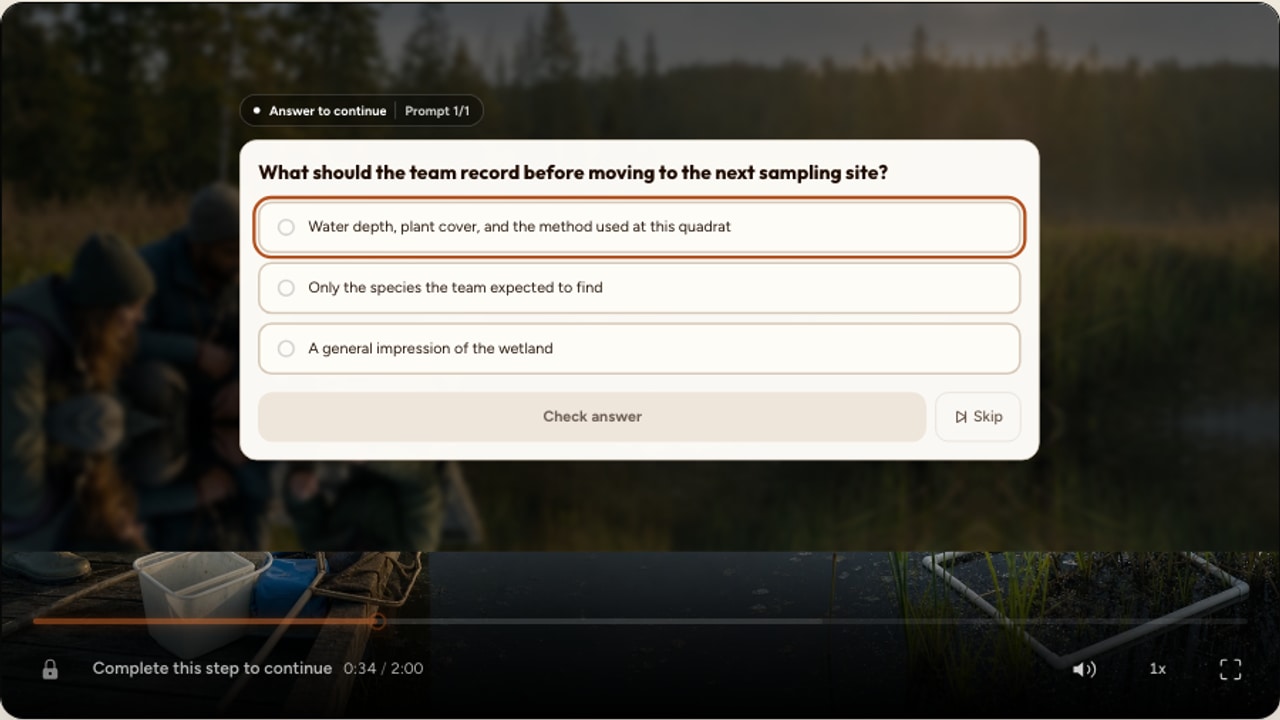
Choose the thinking before the format
Begin by finishing this sentence: “After this section, the viewer should be able to...” Use a visible verb such as name, calculate, compare, sequence, diagnose, explain, or apply. Then decide what response would let you make that claim with reasonable confidence.
The National Academies' evidence-centered assessment discussion starts with the claim you want to make, the observation that could support it, and the interpretation of that evidence. Its assessment chapter in How People Learn II is a useful reason to resist format-first question writing.
Five learning jobs
Pick the evidence first, then adapt a prompt
- 1
Recall and recognition
Examples 1 to 5
- 2
Interpretation and explanation
Examples 6 to 10
- 3
Procedure and decision
Examples 11 to 15
- 4
Diagnosis and evidence
Examples 16 to 20
- 5
Reflection and transfer
Examples 21 to 25
Build a complete video quiz
Follow the cross-source workflow for adding questions, answer keys, feedback, scoring, preview, and publishing.
How to adapt these examples
Preserve the thinking pattern, not the surface wording. Replace the context with a situation shown in your video. Replace every answer with a choice that is defensible or meaningfully wrong in that situation. Place the prompt only after the necessary evidence has appeared.
Name the learning job
Choose retrieval, interpretation, procedure, diagnosis, or transfer before selecting an interaction type.
Locate the evidence
Identify the exact sentence, demonstration, chart, or case detail the viewer needs to answer fairly.
Adapt one prompt structure
Keep the reasoning pattern and replace the subject-specific details with evidence from your video.
Write meaningful alternatives
Use real misconceptions, nearby observations, wrong steps, or incomplete explanations rather than joke options.
Explain the evidence
Write feedback that helps viewers confirm or correct their reasoning before you publish the question.
Recall and recognition examples
Use these when the learner needs to retrieve a term, fact, feature, or quantity without searching the video again.
Name the key term
Biology lesson after a cell membrane animation
Prompt
The movement of water across a selectively permeable membrane is called {{blank}}.
Answer or expected response
Osmosis.
Why it works
The missing term is precise, important, and has just been explained in context.
Feedback move
Osmosis is the movement of water across that membrane. Diffusion is the broader movement of particles down a concentration gradient.
Recognize the required control
Equipment orientation after the control panel is introduced
Prompt
Which control stops the machine immediately when normal shutdown is unsafe?
Choices or items
- A.The normal stop control
- B.The emergency stop control
- C.The reset control
Answer or expected response
B. The emergency stop control.
Why it works
Prepared options let the item contrast controls that look or sound similar.
Feedback move
The emergency stop interrupts operation immediately. The normal stop follows the standard shutdown sequence.
Retrieve a useful number
Finance training after a worked margin example
Prompt
If revenue is $8,000 and direct cost is $5,600, what is the gross margin percentage?
Answer or expected response
30%.
Why it works
The learner must recall the relationship and perform one focused calculation.
Feedback move
Gross profit is $2,400. Dividing that by $8,000 gives a gross margin of 30%.
Check one exact claim
History lesson after distinguishing primary and secondary sources
Prompt
A diary written during the event can be a primary source even when its account is biased.
Choices or items
- A.True
- B.False
Answer or expected response
A. True.
Why it works
The claim targets one common misconception without requiring a long option set.
Feedback move
True. Primary describes the source's relationship to the event, not whether the account is neutral or complete.
Match terms to meanings
Language lesson after four phrases are modeled
Prompt
Match each phrase with its purpose: ‘Could you clarify that?’, ‘I see it differently because...’, ‘So we agree on Friday?’, and ‘Could I come back to you this afternoon?’
Choices or items
- A.Clarify
- B.Disagree politely
- C.Confirm
- D.Request more time
Answer or expected response
Could you clarify that? = clarify; I see it differently because... = disagree politely; So we agree on Friday? = confirm; Could I come back to you this afternoon? = request more time.
Why it works
Matching checks several compact relationships without four separate interruptions.
Feedback move
Review the tone and function of each phrase, then replay the model conversation to hear them in context.
Interpretation and explanation examples
Use these when learners should connect evidence, explain meaning, compare viewpoints, or distinguish a claim from its support.
Interpret a graph
Climate lesson after a temperature and rainfall graph appears
Prompt
Across the four recorded months, which conclusion is best supported by both lines on the graph?
Choices or items
- A.Temperature and rainfall both increased each month
- B.Temperature rose while rainfall fell
- C.Rainfall stayed level while temperature fell
Answer or expected response
B. Temperature rose while rainfall fell.
Why it works
The options can represent common graph-reading errors, including using only one series.
Feedback move
The strongest conclusion must account for the temperature trend and the rainfall pattern, not either line alone.
Highlight supporting evidence
Documentary clip followed by a short transcript
Prompt
Select the sentence that most directly supports the speaker's claim about the policy's effect.
Choices or items
- A.Several residents described the old commute as frustrating.
- B.The transport board approved the policy last spring.
- C.Average weekday wait time fell from 18 to 11 minutes in the first quarter.
Answer or expected response
C. ‘Average weekday wait time fell from 18 to 11 minutes in the first quarter.’
Why it works
The learner must locate evidence rather than recognize a paraphrased answer.
Feedback move
That sentence reports the measured change. The surrounding sentences provide opinion and background rather than direct support.
Explain a cause
Science demonstration after gas forms in a reaction
Prompt
In one or two sentences, explain why the balloon expanded after the substances were mixed.
Answer or expected response
The reaction produced a gas. As the gas occupied more space, it pushed outward and expanded the balloon.
Why it works
The learner's wording reveals whether they connect gas production to increasing volume.
Feedback move
A complete explanation connects the reaction to gas formation, then connects that gas to the balloon's expansion.
Distinguish observation from inference
Fieldwork video after an animal track is examined
Prompt
Which statement is an observation rather than an inference?
Choices or items
- A.The track is 8 centimetres wide
- B.The animal was running
- C.The animal was heading toward the river
Answer or expected response
A. The track is 8 centimetres wide.
Why it works
Plausible options can separate what is directly visible from what the viewer concludes.
Feedback move
The track's measured width is observable. The animal's speed and destination are interpretations that need more evidence.
Paraphrase the central idea
Workplace policy stating that employees must report a lost device to Security within one hour
Prompt
Explain the reporting rule in plain language to a colleague who missed this section.
Answer or expected response
If you lose a work device, tell Security within one hour of noticing that it is missing.
Why it works
Paraphrasing reveals whether the learner can preserve meaning without repeating the script.
Feedback move
Check that your explanation includes who must report, what must be reported, and when the report is due.
Procedure and decision examples
Use these when a learner must choose a next action, sequence steps, apply a rule, or decide when a process should stop.
Choose the next safe action
Maintenance video after equipment isolation is demonstrated
Prompt
The machine has stopped, but stored pressure remains. What should the technician do next?
Choices or items
- A.Release the pressure and verify a zero-energy state
- B.Open the guard because the machine is no longer moving
- C.Restart the machine and use the normal stop control
Answer or expected response
A. Release the pressure and verify a zero-energy state.
Why it works
The wrong options can represent realistic shortcuts rather than absurd behavior.
Feedback move
Release and verify stored pressure before work begins. Stopped motion alone does not establish a zero-energy state.
Put a process in order
Customer research lesson after an interview workflow
Prompt
Arrange the steps: define the research question, recruit participants, conduct interviews, code patterns, report findings.
Choices or items
- A.Report findings
- B.Conduct interviews
- C.Define the research question
- D.Code patterns
- E.Recruit participants
Answer or expected response
1. Define the research question. 2. Recruit participants. 3. Conduct interviews. 4. Code patterns. 5. Report findings.
Why it works
Reordering requires the learner to reconstruct the complete process rather than spot one step.
Feedback move
The research question guides recruitment and interviewing. Coding begins after evidence has been collected.
Apply a rule to a new case
Data privacy lesson after consent requirements are explained
Prompt
A team wants to reuse interview recordings for a new project. Which condition must be checked first?
Choices or items
- A.Whether the original consent covers the new purpose
- B.Whether the recordings are stored with encryption
- C.Whether the new project is likely to benefit customers
Answer or expected response
A. Whether the original consent covers the new purpose.
Why it works
A fresh case tests whether the rule transfers beyond the example used in the video.
Feedback move
Check whether the original consent covers the new purpose. Secure storage does not expand the permission that was granted.
Identify a stopping condition
Laboratory technique after a titration endpoint is shown
Prompt
Once the indicator changes briefly and then clears, the endpoint has been reached.
Choices or items
- A.True
- B.False
Answer or expected response
B. False.
Why it works
The item focuses on a subtle but consequential procedural distinction.
Feedback move
False. A temporary flash is not the endpoint. The specified color change must persist for the required observation period.
Calculate before acting
Medication arithmetic practice after a dosage example
Prompt
The order is 300 mg and the solution contains 150 mg per 5 mL. How many millilitres are required?
Answer or expected response
10 mL.
Why it works
Numeric input checks the calculation without answer-choice clues.
Feedback move
The required dose is twice 150 mg, so the volume is twice 5 mL, which equals 10 mL. Use local clinical governance for real practice.
Diagnosis and evidence examples
Use these when learners should detect a pattern, identify the cause of a problem, separate competing explanations, or choose what to inspect next.
Separate two likely causes
Woodworking lesson after several imperfect cuts are compared
Prompt
Which pattern most strongly suggests a dull blade rather than an incorrect layout line?
Choices or items
- A.Burn marks and increasing cutting resistance across several cuts
- B.The same dimensional offset on every finished piece
- C.Tear-out on one unsupported edge of a single piece
Answer or expected response
A. Burn marks and increasing cutting resistance across several cuts.
Why it works
The task asks learners to discriminate between plausible causes using repeated evidence.
Feedback move
Burning and increasing cutting resistance point to blade condition. A layout error changes dimensions but not the cutting effort.
Find the anomaly
Operations dashboard showing three intervals and the normal range for each metric
Prompt
Which metric should the team investigate first, given the pattern across the last three intervals?
Choices or items
- A.Order error rate: 1.8%, 1.9%, 1.8% with a normal range of 1% to 2%
- B.Queue wait: 4, 7, then 11 minutes with a normal maximum of 5 minutes
- C.Daily volume: 840, 870, then 860 orders with a normal range of 800 to 900
Answer or expected response
B. Queue wait, because it rises across all three intervals and moves farther beyond the normal maximum.
Why it works
The learner must compare trend, magnitude, and operational relevance instead of choosing the largest number.
Feedback move
The repeated rise outside its normal range makes that metric the strongest first lead. One isolated change needs less immediate weight.
Locate visible evidence
Uploaded inspection video paused on a machine assembly
Prompt
Tap the area that shows the earliest visible sign of belt misalignment.
Answer or expected response
The point where the belt edge first begins tracking away from the center of the pulley.
Why it works
A spatial response is appropriate because the evidence is tied to coordinates in the uploaded frame.
Feedback move
The belt edge begins to track away from the pulley center at that point. Hotspots require uploaded video in Interakly.
Choose the next diagnostic check
IT support scenario after a failed connection is shown
Prompt
The device has a valid local address but cannot reach the gateway. Which check would narrow the cause most efficiently?
Choices or items
- A.Ping the gateway from the affected device
- B.Restart every upstream network device
- C.Reinstall the application that reported the error
Answer or expected response
A. Ping the gateway from the affected device.
Why it works
The options can contrast informative tests with broad resets and low-value guesses.
Feedback move
Pinging the gateway tests the local path before settings are changed. A failed ping supports a local link, adapter, or network-path investigation.
Defend a diagnosis
Business case where onboarding complaints dominate interviews and 63% of churned accounts never completed setup
Prompt
Which cause of churn is best supported, and which two pieces of evidence led you there?
Answer or expected response
Onboarding friction is the best-supported cause. Customers repeatedly describe setup problems, and 63% of churned accounts never completed setup.
Why it works
The response must name both a conclusion and the evidence used to reach it.
Feedback move
A defensible answer connects the selected cause to one behavior pattern and one direct customer signal, while acknowledging conflicting evidence.
Reflection and transfer examples
Use these when learners should assess confidence, connect the lesson to their setting, plan an action, or communicate the idea in a new form.
Rate confidence before practice
Presentation coaching just before an independent attempt
Prompt
How confident are you that you can open with the audience's problem in one clear sentence?
Choices or items
- A.1. Not yet confident
- B.2. Slightly confident
- C.3. Moderately confident
- D.4. Confident
- E.5. Very confident
Answer or expected response
Any rating from 1 to 5 is valid. Record the rating as a baseline, not as a scored judgment of skill.
Why it works
The rating helps the learner notice readiness and gives the instructor context for later performance.
Feedback move
Use your rating as a baseline. After the practice attempt, rate again and name what changed.
Predict before the reveal
Ecology fieldwork before an open meadow and a frequently mown lawn are compared
Prompt
Which site do you expect to show greater plant diversity?
Choices or items
- A.The open meadow
- B.The frequently mown lawn
- C.About the same diversity at both sites
Answer or expected response
Any choice is acceptable because this is an ungraded prediction. Compare the selected site with the field evidence after the reveal.
Why it works
An ungraded prediction activates prior knowledge without pretending uncertainty has one correct answer.
Feedback move
Keep your prediction in mind as the samples are compared. Notice which visible habitat features help explain any difference in diversity.
Plan one workplace action
Manager training after a feedback conversation is modeled
Prompt
Write the first question you will use to invite the employee's perspective in your next conversation.
Answer or expected response
Example: ‘How did the situation look from your point of view?’ Accept other open, neutral questions that invite the employee's account before the manager gives a conclusion.
Why it works
The response converts a general principle into language the learner can actually use.
Feedback move
Check whether the question is open, neutral, and specific enough to invite the employee's account before you give your conclusion.
Rehearse aloud
Language or customer-service video after a model response
Prompt
Record a 20-second response that acknowledges the concern, clarifies the need, and proposes one next step.
Answer or expected response
Example: ‘I understand that the delay has disrupted your plans. Could you confirm whether Friday delivery still works? I will check the shipment now and update you within 15 minutes.’ The response should contain all three functions in natural language.
Why it works
Speaking practice captures fluency, tone, and sequencing that a selected answer cannot show.
Feedback move
Listen once for clarity and once for tone. Confirm that all three functions appear without sounding like a memorized list.
Transfer the principle to a new setting
Statistics lesson after a misleading chart is analyzed
Prompt
Describe one chart from your own work that could mislead readers, then name the design change you would make.
Answer or expected response
Example: ‘Our monthly sales chart starts the vertical axis at 98, which makes a small change look dramatic. I would start at zero or clearly mark the truncated scale and explain why it is needed.’ Accept responses that identify a misleading feature, its likely effect, and a concrete correction.
Why it works
The learner must find an authentic case and apply the principle outside the example video.
Feedback move
A strong response identifies the misleading feature, the inference it may encourage, and a concrete revision that supports honest comparison.
Match the response type to the evidence
A complex control does not create deeper thinking on its own. A clear multiple-choice question can test diagnosis when the options represent competing explanations. An open response can still be shallow when it asks only for a copied definition.
| Learning job | Useful format | Evidence produced |
|---|---|---|
| Recognize one best answer | Multiple Choice | A distinct selected reasoning path |
| Retrieve a term or number | Fill Blank or Numeric Input | Uncued recall or calculation |
| Reconstruct a process | Ordering | The relationship among several steps |
| Connect paired ideas | Matching | Several compact associations |
| Explain or justify | Open or Audio Response | The learner's own reasoning or language |
| Locate evidence in uploaded media | Hotspot | A coordinate tied to the frame |
| Predict, prefer, or self-assess | Poll or Rating Scale | Ungraded audience input |
Interakly's current YouTube profile includes the non-spatial formats in this guide. Hotspots and other coordinate-based tasks require uploaded video because Interakly must own the media surface. Check the verified inventory before designing a source-dependent activity.
Check the current YouTube interaction inventory
See the tested YouTube-safe response formats and the spatial activities that require uploaded video before adapting an example.
Compare every interactive video interaction type
See what each response format asks the viewer to do and which spatial tools require uploaded video.
Place each question at a fair moment
A strong question can fail when its timestamp is wrong. Put a retrieval or interpretation question after the complete idea it depends on. Put a prediction before the reveal, label it as a prediction, and avoid scoring uncertainty as if the answer had already been taught.
Research on interpolated tests in online lectures found benefits for attention and learning when retrieval was integrated into the lesson. The original PNAS experiment does not imply that more interruptions are always better. Each prompt still needs a reason, a fair moment, and useful feedback.
Choose better question timestamps
Place prompts around complete ideas, decisions, demonstrations, predictions, and reflection points.
Write the feedback before publishing
Feedback exposes weak questions early. If you cannot explain why the correct answer follows from the video or why a wrong answer fails, the prompt may be ambiguous, the evidence may be incomplete, or the answer key may be too broad.
The American College of Surgeons item-writing guidance recommends one educational objective, a clear stem, one best answer, and plausible, parallel distractors. Those principles remain useful outside medical education because they reduce clues and irrelevant difficulty.
Write feedback that helps the learner improve
Move beyond correct and incorrect messages with evidence, correction, and a useful next step.
A practical build sequence
Choose three to five important moments
Mark complete ideas, decisions, demonstrations, or cases rather than filling equal time intervals.
Assign one learning job to each moment
Avoid asking several questions that all test the same easy recall when the outcome also requires application.
Draft the answer or evidence first
Define what success would look like before writing the stem and alternatives.
Build the interaction in Interakly
Select the lightest response type that collects the evidence, then configure feedback, points, pause behavior, and retakes deliberately.
Preview the complete learner path
Answer correctly and incorrectly, review the response, test a retake if allowed, and confirm the question remains readable on phone and desktop.
Review response patterns after launch
Look for unused distractors, widespread confusion, unexpectedly slow responses, and questions that interrupt the explanation too early.
Use the complete question-writing workflow
Turn an intended outcome into a fair stem, plausible choices, an answer key, and teaching feedback.
Check the complete viewer experience
Review purpose, spacing, mobile presentation, accessibility, feedback, and the published learner path together.
FAQ
What is a good example of a video quiz question?
A good video quiz question points to a meaningful learning objective and arrives after the viewer has seen enough evidence to answer. For example, after a repair demonstration, ask which visible condition must be checked before the next adjustment and explain the evidence in the feedback.
Can I copy these video quiz examples directly?
Use the structure, but replace the subject, evidence, and wrong answers with details from your own video. A copied question is only fair when the viewer has actually seen the information needed to answer it.
Which video quiz format is best for higher-order thinking?
There is no single higher-order format. A well-written multiple-choice item can test diagnosis, an ordering task can test a procedure, and an open response can reveal reasoning. The prompt and evidence determine the level of thinking more than the control itself.
Should every video quiz question be graded?
No. Grade responses only when there is a defensible answer and the score serves a clear purpose. Polls, confidence ratings, predictions, and reflections can guide discussion or instruction without adding points.
How many answer choices should a video multiple-choice question use?
Use only as many choices as you can make plausible and distinct. Three strong options are often more informative than four options when the fourth is obviously wrong. Each wrong option should represent a believable error or misconception.
Can these examples be used with YouTube videos?
Yes, the non-spatial formats used here, including multiple choice, true or false, polls, rating scales, open responses, numeric input, fill in the blank, ordering, matching, and evidence highlighting, are available in Interakly's verified YouTube interaction set. Spatial hotspots require uploaded video.
Turn one useful example into your own video question
Start with a supported YouTube video or upload your own file. Choose the learning job, place the question after its evidence, and preview the full response and feedback path.
Explore video interactions