How to Get Stakeholder Buy-In for Interactive Learning
Build a credible interactive-learning decision case around a defined need, observed workflow evidence, safeguards, resources, and an honest next step.
Stakeholder buy-in is not a performance in which an enthusiastic project owner tries to make everyone else excited about interactive learning. It is a decision process. The proposal should help the people who own outcomes, risk, delivery, and resources understand a real problem, inspect a plausible workflow, challenge the evidence, and authorize a proportionate next step.
That distinction matters because “interactive” is not an outcome. A multiple-choice pause, hotspot, open response, or branching choice has value only when it supports a defined learner task and can be operated responsibly. A credible case makes the conditions visible: who authors, who participates, what data is needed, how access works, what support costs, and what evidence will change the decision.
Start with a decision, not enthusiasm
Write the decision at the top of the brief. “Approve a six-week pilot of two onboarding lessons for the support team” is actionable. “Support our interactive-learning transformation” is not. The first version states scope, audience, duration, and the authority being requested. It also leaves room for an evidence-based no.
The 2024 CDC Program Evaluation Framework emphasizes collaborative engagement, relevance and utility, transparency, and acting on findings. Although it was written for program evaluation, that operating discipline is useful here: involve people whose decisions and experience matter, identify intended uses of evidence, and design the process so the result can actually be acted upon. Buy-in built around an undefined aspiration cannot meet that standard.
Map interests and decision rights
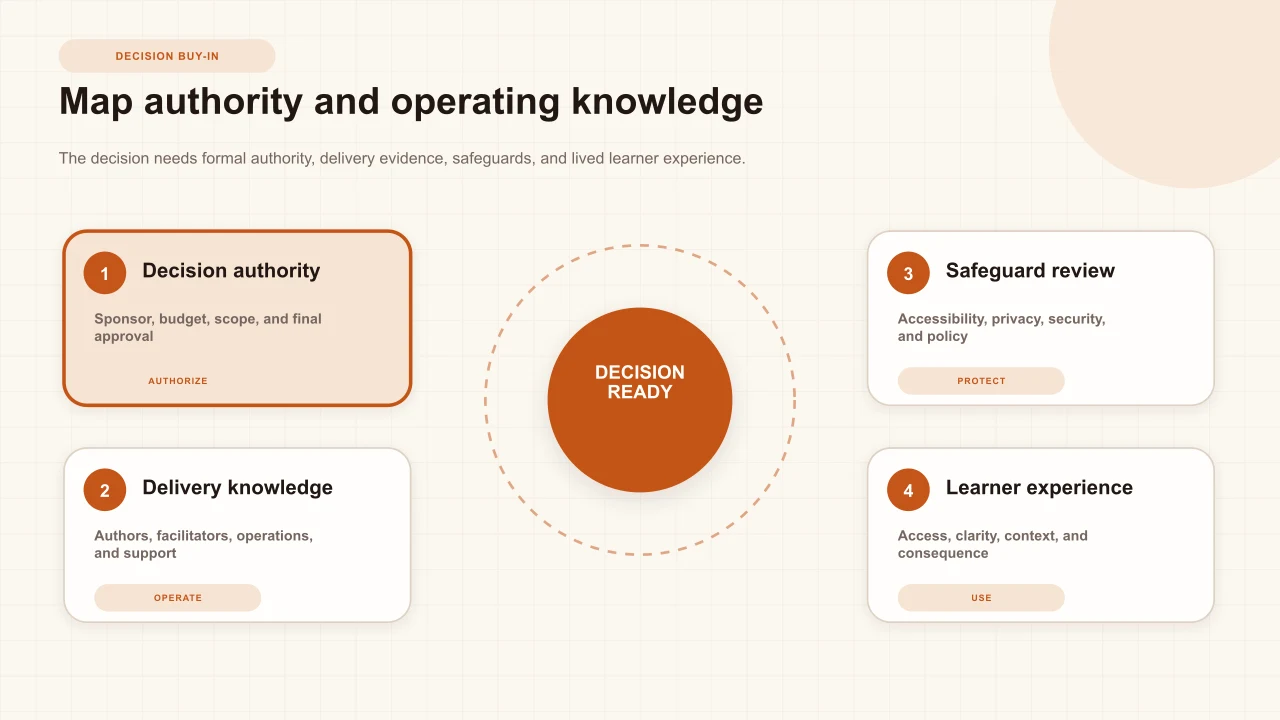
List the people affected by the proposal and the people with formal authority. They are not always the same. A learning leader may own the budget; an instructor understands authoring time; learners experience access and clarity; IT owns identity and embedding conditions; privacy, safeguarding, security, and accessibility reviewers own critical constraints; operations inherits support; procurement owns commercial terms.
For each group, record the decision or knowledge it contributes, the evidence it needs, when it must be involved, and who can resolve a disagreement. Avoid the vague label “stakeholder consulted.” A thirty-minute demonstration is not meaningful participation if the person could not inspect the part of the workflow they are responsible for.
The updated CDC framework uses “interest holder” to emphasize people and organizations with an investment in or experience of the program. Whatever term your organization uses, include skeptical and affected voices, not only project sponsors. A dissenter may expose a device, workload, language, accessibility, or policy condition that the central team cannot see.
Name the problem in operational terms
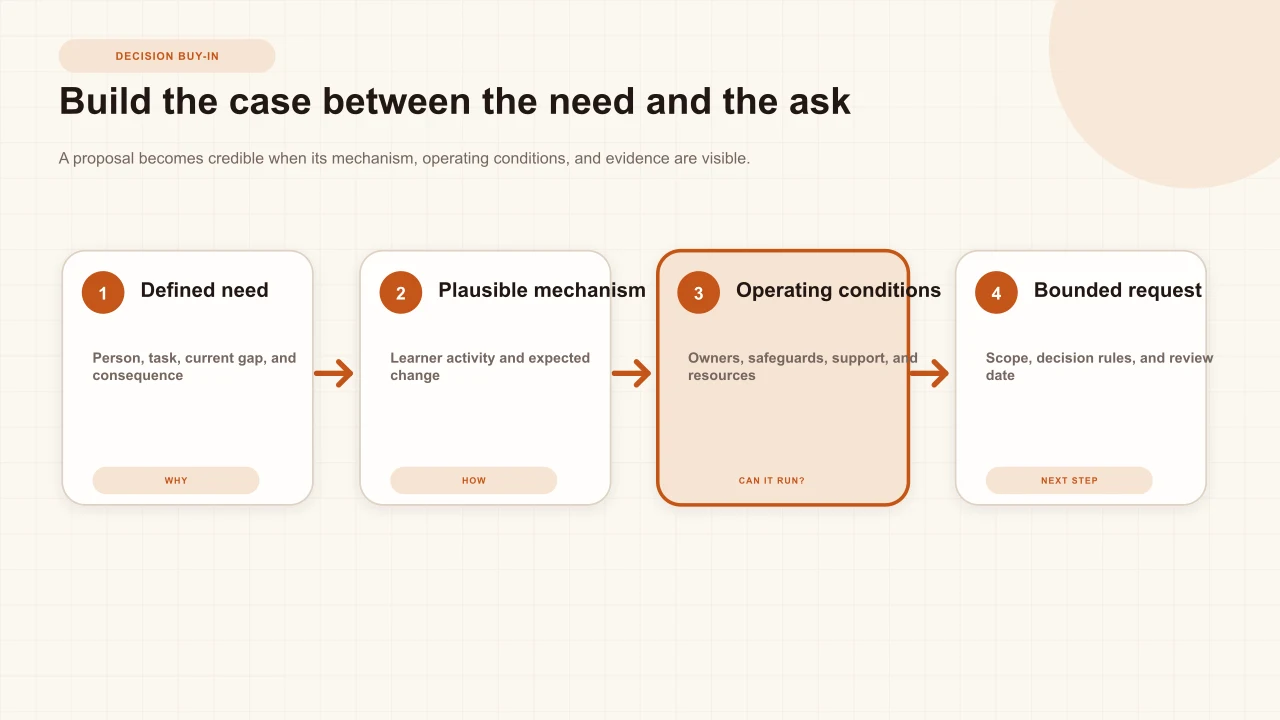
Replace generic claims such as “passive video is boring” with an observable performance or workflow gap. New staff may reach live queue work without practicing escalation decisions. Instructors may not know which explanation learners misunderstood. Compliance reviewers may be unable to confirm that a required decision was practiced. These statements identify a person, task, and consequence without pretending the proposed tool has already solved them.
Describe the current route and its costs. How is the content produced, assigned, supported, and reviewed today? Where do delays, repeated explanations, errors, or inaccessible alternatives occur? Include the “do nothing” or improve-the- current-process option. HM Treasury's Green Book treats objectives, alternative options, costs, benefits, risk, and uncertainty as parts of appraisal; a tool purchase should not become the default merely because it is the first option documented.
Connect the proposal to existing objectives
Tie the proposed learner behavior to a current organizational objective. A support organization may need consistent escalation judgment; a university may need accessible formative feedback; a safety team may need documented practice before supervised work. Use the language already present in program plans, service standards, curriculum outcomes, or risk controls. Do not invent a parallel “innovation” objective to make the tool appear strategic.
Build a short logic chain: resources enable activities; activities produce outputs; outputs may contribute to outcomes under stated assumptions. The IES Program Evaluation Toolkit recommends logic models because they expose those links. If the case jumps directly from “add interactions” to “increase productivity,” the missing steps are assumptions, not evidence.
Show the complete workflow
A stakeholder demonstration should begin before the polished learner screen. Use a representative video, learning objective, question, access route, and device. Show how an author creates or edits the experience, previews it, publishes it, shares or embeds it, and verifies the public result. Then answer as a learner and inspect what the owner can actually review afterward.
Include the awkward edges: caption preparation, phone width, keyboard use, password or sign-in states, returning sessions, exports, ownership, and content changes. If uploaded video is required for spatial interactions, say so. If a YouTube source is used, verify that it is embeddable and use only interactions supported in that source mode. A workflow demonstration is evidence only for the route actually reproduced.
Feature theatre
Show an impressive interaction on a perfect screen and narrate the rest of the operating model.
Decision evidence
Run a representative author-to-learner task, record friction, and expose the conditions that remain unresolved.
Build an evidence ladder
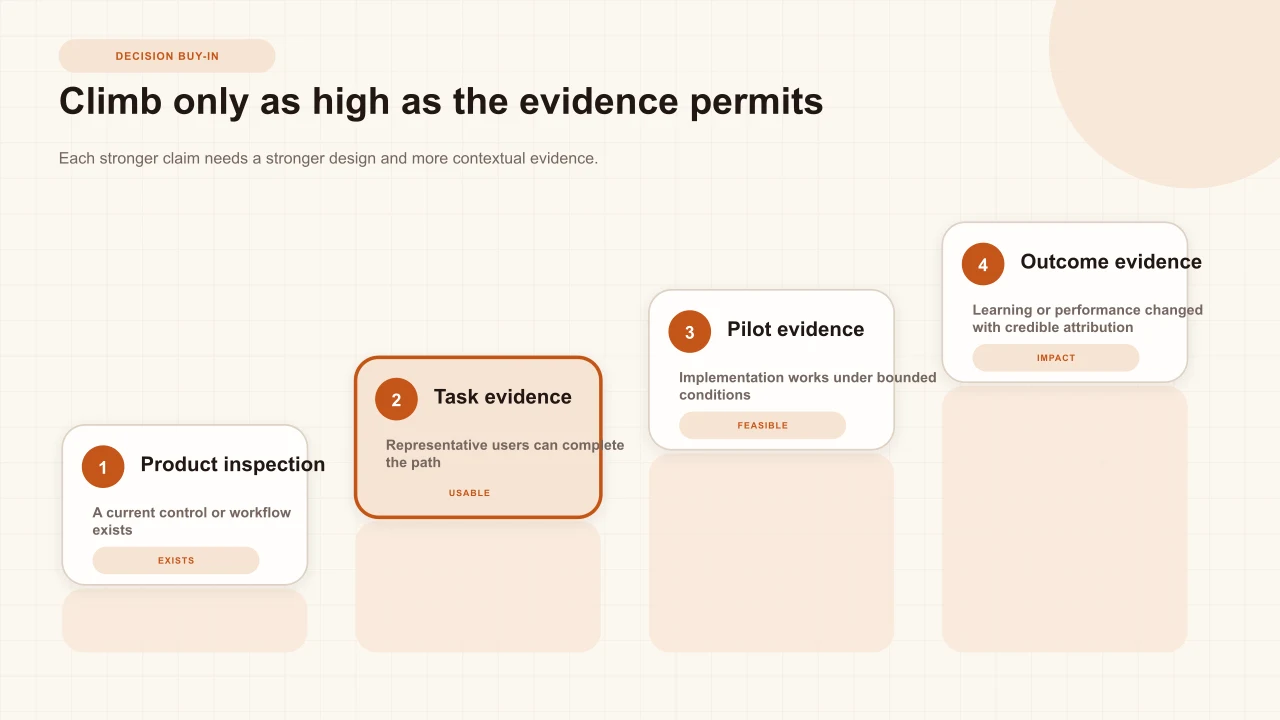
Separate evidence by what it can support. Product inspection can establish that a control exists. A task test can show whether representative users can complete a workflow. A pilot can describe feasibility and implementation under bounded conditions. Outcome evaluation can examine learning change. A credible impact design is needed before attributing outcomes to the intervention rather than prior knowledge, selection, instruction, incentives, or other changes.
The U.S. GAO's evidence-based policymaking guide distinguishes planning for results, building evidence, using it, and supporting continuous improvement. Apply the same discipline to the decision deck. Label observed facts, estimates, assumptions, and unanswered questions. One small usability test should not be promoted into a forecast for organization-wide impact.
Surface safeguards before objections
Put non-negotiable safeguards in the main case rather than an appendix. State the accessibility standard and review route, the learner identity and data plan, security and procurement checks, content approval, retention, incident handling, and support ownership. Link the detailed interactive-learning data privacy review and the interactive-video accessibility guide where they answer the next question.
NIST's Privacy Framework organizes privacy risk management around governance, identifying data processing, control, communication, and protection. W3C's planning guidance similarly treats accessibility as an organizational process with responsibilities, budget, monitoring, and stakeholder engagement. These are operating responsibilities, not badges that a product screenshot can settle.
Estimate resources honestly
Count more than license price. Identify author training, source preparation, caption correction, question writing, review, accessibility testing, privacy and security work, LMS or embed configuration, learner support, analytics review, content maintenance, and program management. Include the time of people who already work for the organization; existing salary does not make their time free.
Present a range where effort is uncertain. Separate one-time setup from recurring work and distinguish a small pilot from steady-state operation. If reusable templates or a trained author group may reduce later effort, label that as a hypothesis to measure. The companion interactive-video ROI guide shows how to build a cost and value model without manufacturing a return.
Use a bounded pilot as the ask
When the complete case is not yet proven, ask permission to learn. Define the population, lesson, authoring workflow, dates, owners, support route, evidence, safeguards, and decision rules. The interactive-video pilot guide separates feasibility, implementation, learner evidence, and impact so the team does not overread attractive session data.
Digital Promise's EdTech Procurement Framework connects needs analysis, selection, planning, implementation, evaluation, and scale. Use the pilot to test the riskiest assumptions in that chain. Approval should specify the maximum commitment, the evidence review date, and who can stop or change the work if a critical condition fails.
Answer objections with conditions
Translate objections into decision conditions. “Authors do not have time” becomes an authoring-time threshold and support test. “Learners will not use it” becomes an access, clarity, and completion question. “We cannot take on another system” becomes an ownership, integration, security, and support requirement. “Where is the ROI?” becomes a request for a cost baseline, outcome measure, time horizon, and uncertainty range.
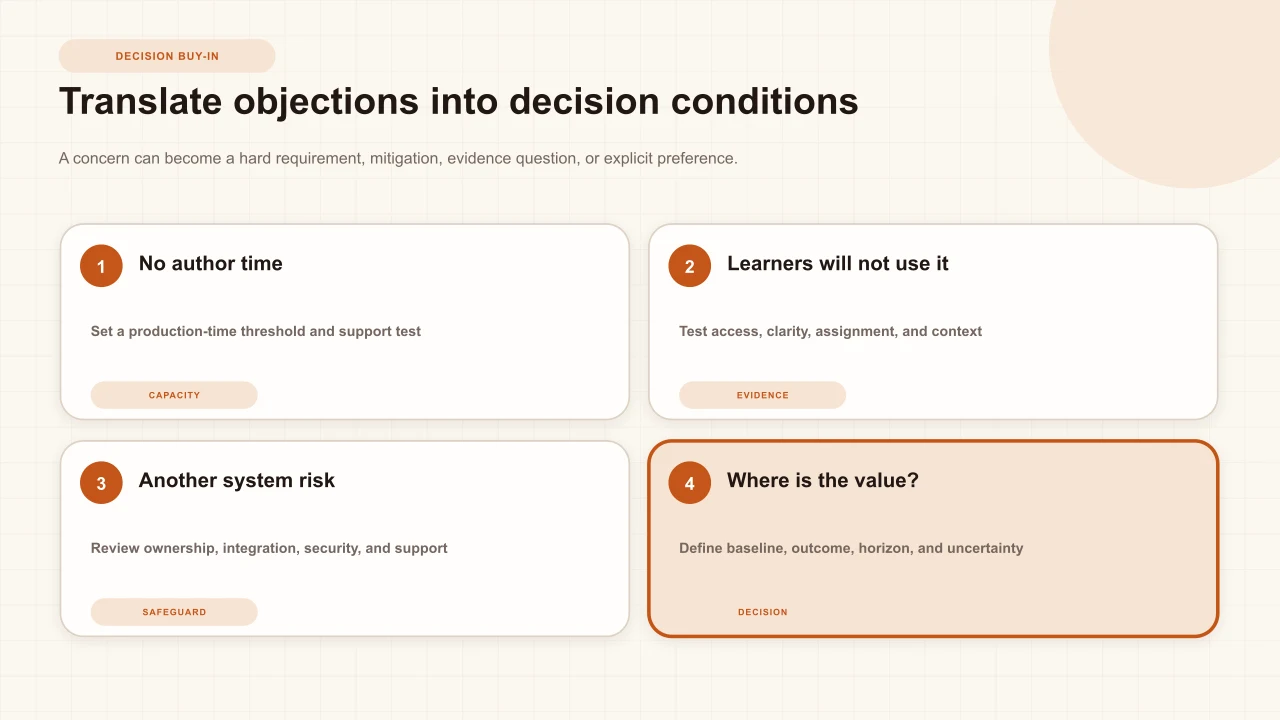
Record whether each concern is resolved, accepted, deferred, or blocking. Name the owner and deadline. This creates a traceable decision and prevents a late concern from becoming an unexplained veto. It also prevents the project team from treating a legitimate safeguard as resistance to innovation.
Write a one-page decision brief
Decision
State the exact approval, scope, duration, budget boundary, and decision owner.
Need and mechanism
Describe the present gap, proposed learner task, and logic connecting activity to intended outcome.
Evidence and uncertainty
Separate observed workflow evidence, estimates, assumptions, unknowns, and claims that are out of scope.
Operating conditions
Name owners, safeguards, access, support, maintenance, and the resources needed beyond the license.
Next review
Set the decision rules, evidence date, and scale, iterate, extend, or stop options.
Interakly product boundaries
Interakly can provide the authoring and learner workflow, published access options, session and response evidence, and source-specific interaction behavior described in its current product. It does not determine your learning objective, legal basis, accessibility conformance, institutional decision rights, support capacity, outcome measure, or financial return. Those remain program decisions.
Uploaded video and YouTube are not interchangeable. Uploaded media supports the complete owned-media and spatial workflow; the YouTube path uses supported timestamped over-video interactions and depends on embeddable playback. Verify the exact workflow in Preview and as a published learner before presenting it as evidence. The broader interactive-video design best-practices guide provides the release-quality design checklist.
A practical meeting sequence
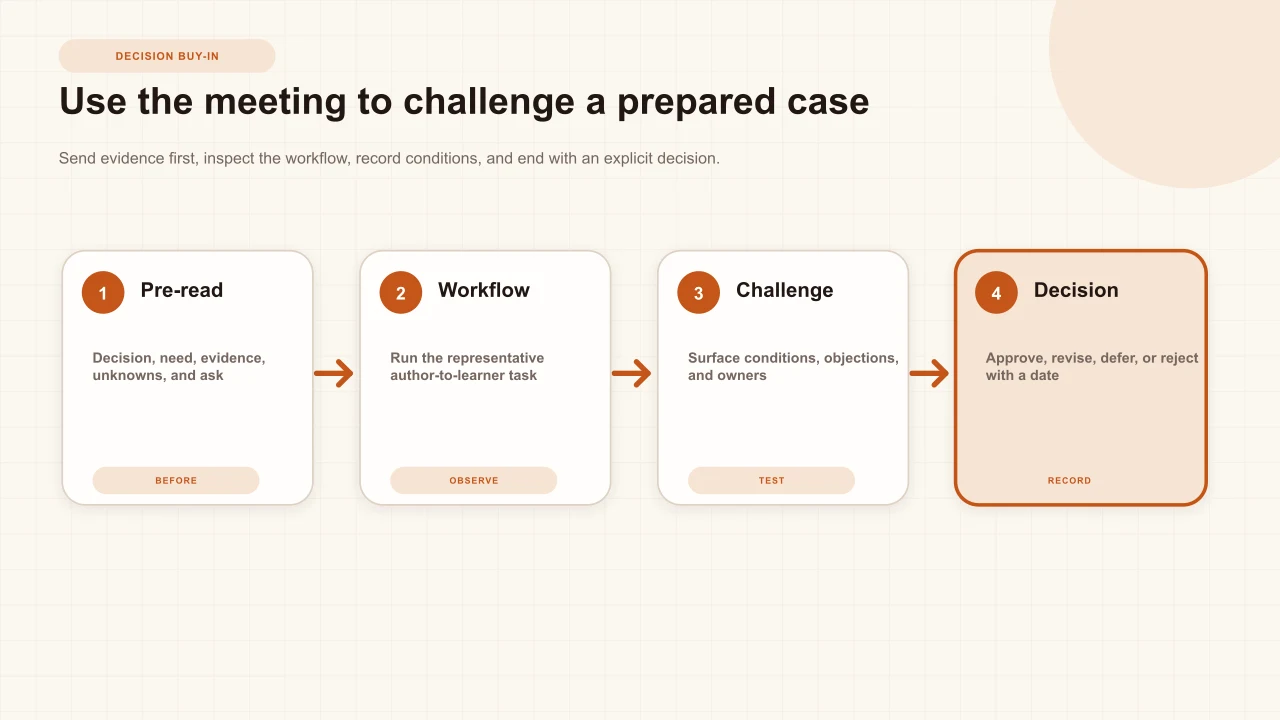
Send the one-page brief and a short evidence appendix before the meeting. Open by confirming the decision and the problem. Run the representative workflow. Invite the people responsible for safeguards and delivery to state conditions. Review cost ranges and evidence limits. End with a recorded approve, approve-with- conditions, revise, defer, or reject decision and a named review date.
After the meeting, publish the decision record to participants. Include dissent, owners, actions, and assumptions that need testing. This is the beginning of the operating model described in the interactive-content governance guide, not the end of stakeholder involvement.
Sources and further reading
- CDC Program Evaluation Framework — collaboration, standards, evidence, and action.
- CDC: focus evaluation questions and design — intended users and uses of findings.
- Digital Promise EdTech Procurement Framework — need, implementation, evaluation, and scale.
- IES Program Evaluation Toolkit — logic models, evidence questions, and dissemination.
- U.S. GAO evidence-based policymaking practices — planning, evidence use, and learning culture.
- HM Treasury Green Book 2026 — options, value, risk, and uncertainty.
- W3C Planning and Managing Web Accessibility — responsibilities, resources, monitoring, and engagement.
- NIST Privacy Framework — privacy risk governance and communication.
FAQ
Who should be involved in an interactive-learning decision?
Include the decision owner and the people who will author, deliver, support, govern, and use the experience. Depending on context, that can include learning leaders, instructors, learners, IT, accessibility, privacy, procurement, security, operations, and finance.
Should the business case promise better engagement or ROI?
No. State the need, the proposed mechanism, the evidence already available, the uncertainties, and what a bounded test can establish. Attractive interaction data does not by itself prove learning impact or financial return.
What should a stakeholder demonstration include?
Use a representative source and show the complete author-to-learner path: creation, review, publishing, access, mobile or assistive use, response evidence, support, and ownership after launch. Do not limit the demonstration to the most polished learner screen.
How much evidence is enough before asking for approval?
Match evidence to the decision. A workflow test may support approval for a small pilot; organization-wide adoption usually needs stronger implementation, cost, safeguard, and outcome evidence. Label every gap rather than filling it with assumptions.
What if a stakeholder objects late in the process?
Treat the objection as information about an unaddressed condition. Identify whether it is a hard requirement, a risk to mitigate, an evidence gap, or a preference. Record the owner and next action instead of arguing from product enthusiasm.
Is stakeholder buy-in the same as unanimous support?
No. A sound decision has clear authority, informed participation, documented concerns, and explicit conditions. People can disagree while still understanding how the decision was made and what evidence will trigger review.
Turn the decision case into observed evidence
Build one representative Interakly lesson, test the complete author-to-learner workflow, and use what actually happens to shape the next decision.
Explore corporate training