Interactive Content Governance: Ownership, Review, and Change
Create a practical governance model for interactive learning content with accountable owners, risk-based review, controlled change, and deliberate retirement.
Interactive learning content does not become stable when it is published. The source video changes, a policy is revised, a caption error is reported, a link expires, an answer becomes ambiguous, an LMS configuration moves, or the person who understood the lesson leaves. Interactions add more connected parts, so an apparently small edit can change scoring, feedback, branching, completion, data, or the learner path.
Governance is the lightweight operating system that keeps those parts owned and reviewable. It defines the governed unit, assigns authority, records dependencies, sets review triggers, controls change, validates releases, handles feedback, and retires content deliberately. It is not a committee for approving every comma, and it is not a spreadsheet no one updates.
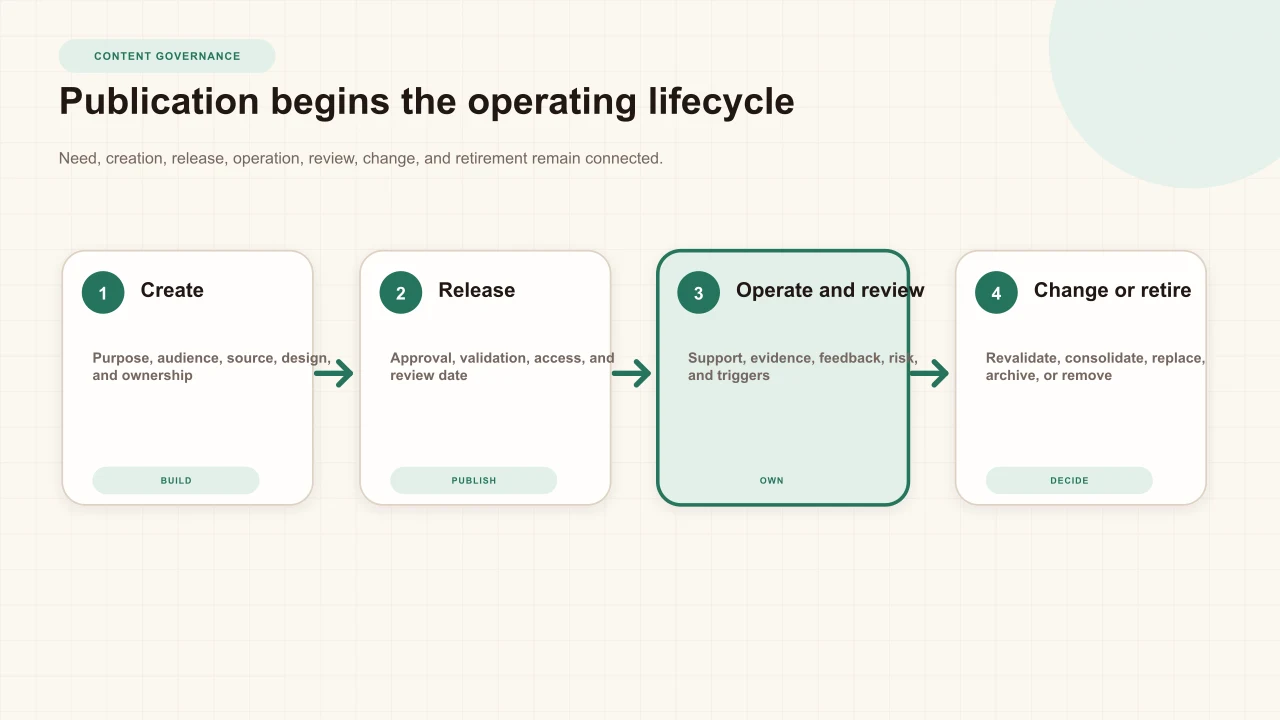
Treat publication as the start of ownership
A launch checklist answers whether the first release is ready. Governance answers who keeps it ready after learners begin using it. Name the accountable owner, operational support route, review date, change authority, and retirement condition before publication. If those fields cannot be assigned, the asset is not ready to become a durable part of the learning library.
W3C's Planning and Managing Web Accessibility guidance treats accessibility as a recurring organizational practice: assign responsibilities, provide resources, evaluate early and regularly, monitor change, respond to feedback, and sustain progress. The same lifecycle logic applies to the wider lesson. A passing review today does not prevent tomorrow's edit from introducing an inaccessible control, inaccurate caption, or confusing answer.
Define the governed content unit
Decide what receives an identifier and lifecycle record. A unit may be a complete interactive video, a pathway, a reusable interaction template, a source-media package, or a course embed that carries its own access and context. Avoid defining the unit so narrowly that connected changes become invisible or so broadly that no owner can review it meaningfully.
Record the learner-visible dependencies: source media, captions and transcript, prompts, choices, correct answers, feedback, scoring, branching routes, links, attachments, access settings, embed or LMS placement, certificates, and downstream reporting. The governed unit is not only the text displayed in the editor. It is the complete experience the learner receives and the evidence the organization later interprets.
Assign accountable roles
Give one role or team final accountability for accuracy, relevance, review, and retirement. Separate that accountability from the people who perform the work. Authors create and revise; subject experts approve meaning; accessibility reviewers test the learner path; privacy, safeguarding, legal, security, or compliance roles review applicable risks; platform administrators manage configuration; support receives incidents; analysts interpret evidence.
The GOV.UK Service Manual describes a service owner as having overall responsibility for operating and continually improving a service and a content designer as responsible for content that remains accurate, relevant, accessible, and based on user need. Your titles may differ, but the two ideas matter: someone has decision authority, and multidisciplinary expertise remains available across the lifecycle.
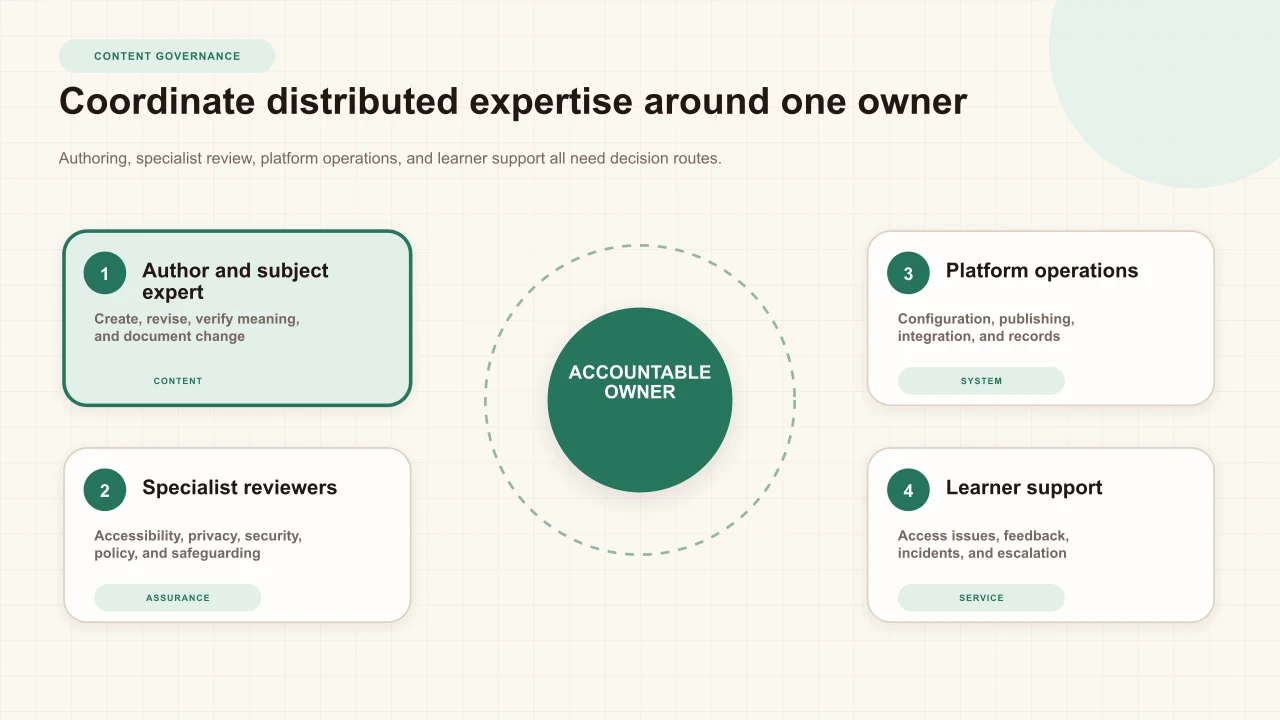
Create an escalation path for disagreement and absence. Who can block release? Who accepts a documented residual risk? Who inherits the asset when the owner changes role? A named individual can improve immediacy, but an accountable team or function provides continuity. Record both the current contact and the enduring organizational owner where possible.
Create a minimum content register
The register should answer operational questions, not collect metadata for its own sake. Include a stable identifier, title, purpose, audience, risk tier, accountable owner, current author, subject reviewer, source, language, publication state, learner access route, embed or course locations, last and next review, current version, dependencies, data use, records status, and retirement state.
Add evidence that will change a lifecycle decision: support volume, learner feedback, accessibility issues, use, question anomalies, completion context, policy updates, broken links, or source changes. Do not automatically equate low use with low value; a rarely used emergency procedure may be critical. Pair activity with purpose, audience, risk, and replacement availability.
Inventory only
Title, URL, and date created—enough to count assets but not to decide who should act.
Decision register
Purpose, owner, risk, dependencies, review evidence, next date, and current retain-update-retire state.
Set risk-based review intervals
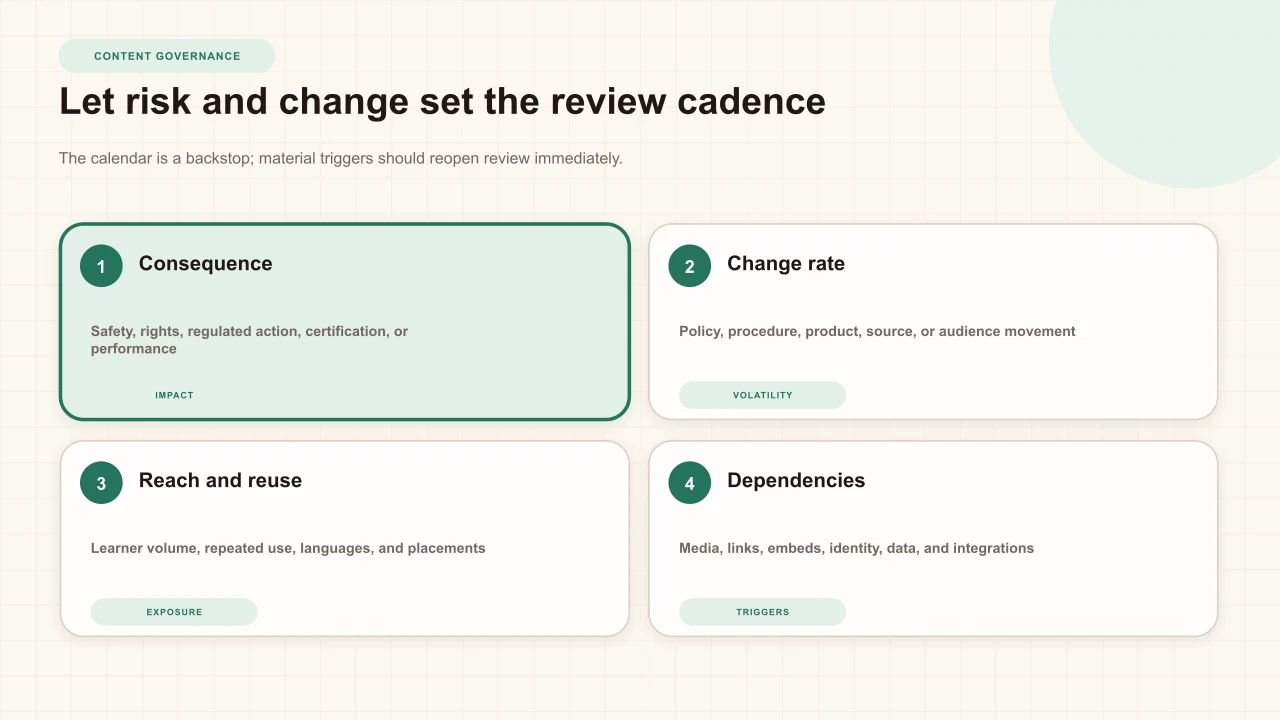
Define tiers using consequence and change rate. High-risk content may influence safety, legal rights, regulated action, clinical reasoning, certification, or mandatory work; it needs qualified reviewers, short intervals, and immediate trigger-based review. Medium-risk content may shape important performance without direct high-consequence action. Low-risk orientation or enrichment can use a longer cadence if the source and links are stable.
Time is only one trigger. Reopen review when policy, regulation, product, source media, answer meaning, audience, language, access model, integration, owner, or relevant learner evidence changes. W3C's sustainability guidance notes that changing content can introduce accessibility issues and recommends regular review of content, processes, resources, standards, technology, and user feedback.
Build a release gate
Create a short gate that scales by risk. Confirm objective and audience, subject accuracy, source and permissions, captions and transcript, interaction meaning, correct answers and feedback, scoring and completion, branching coverage, keyboard and phone operation, access and identity, privacy and retention, links and embeds, support contact, owner, review date, and change note. Use specialist review where the risk tier requires it.
Test in the editor and then as a learner through the actual published route. Preview can confirm composition and logic; it cannot prove that a password, invitation, restricted embed domain, LMS launch, or public link works in its destination. Use representative devices and accounts. Preserve evidence proportionate to the risk, such as an approval record, checklist, screenshots, or test results.
Control changes and versions
Define change classes. A correction that does not alter meaning may use a lighter path. A new answer, changed scoring rule, rewritten feedback, new audience, source replacement, branching change, access change, or data change requires renewed review of affected controls. An emergency fix may release quickly, but it still needs an owner, documented reason, validation, and follow-up review.
Keep a change record that says what changed, why, who approved it, which version was affected, what was retested, and whether learner or analytics interpretation changed. Do not silently compare response evidence across materially different questions or completion rules. If historical evidence must remain interpretable, preserve the wording and configuration that produced it or clearly mark the break.
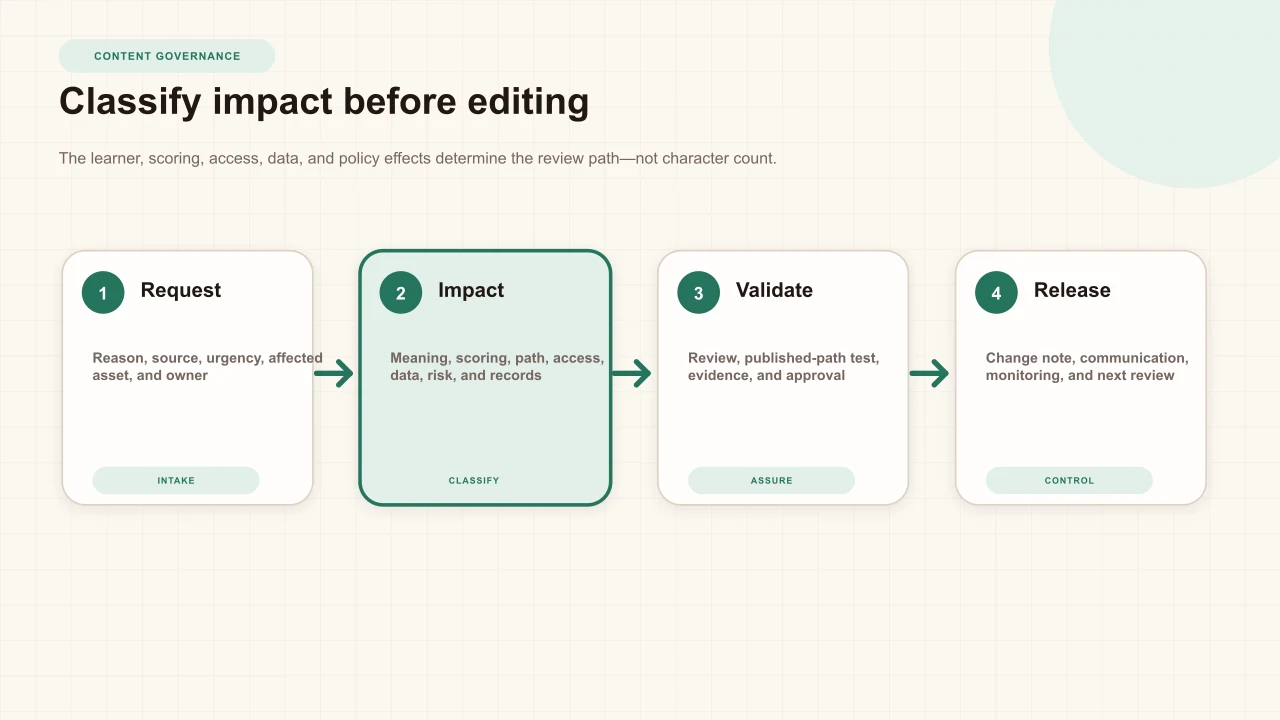
Revalidate the complete learner path
A changed component can affect siblings. Replacing a video can move timestamped prompts, captions, hotspots, overlays, and completion boundaries. Editing one multiple-choice option can alter correctness, feedback, score, branching, and question analytics. Changing identity or embed policy can prevent returning learners or an LMS from opening the content. Retest the full affected path rather than the field that was edited.
Include content extremes: long questions, localized copy, phone width, keyboard navigation, zoom, captions, incorrect and correct feedback, retakes, returning sessions, end-of-media interactions, and every reachable branch. The interactive-video design best-practices guide provides a broader release review, while the accessibility guide helps structure inclusive testing.
Govern data and integrations
Record what learner identity, session, response, score, watch, certificate, or comment data is used; why; who can access it; where it moves; how long it remains; and what changes when an integration is added. Reopen the data-privacy review when audience, purpose, fields, access, vendor terms, or downstream systems change. NIST's Privacy Framework places governance, inventory, risk assessment, communication, control, and protection inside a continuing management process.
Treat LMS placements, embed domains, source hosts, caption services, AI-assisted drafts, links, and exports as dependencies with owners and review triggers. A change outside the lesson can alter learner access or the meaning of evidence. Record the current configuration and a fallback or support route where the learning task is important.
Handle feedback and incidents
Give learners, instructors, and support staff a visible route to report inaccurate content, access barriers, confusing questions, caption problems, broken links, or privacy concerns. Route reports by severity, acknowledge them, preserve the relevant version and context, and tell the reporter what happens next where appropriate. User feedback is governance evidence, not an inbox separate from the review process.
Define stop conditions. A serious accuracy, safeguarding, accessibility, privacy, security, or source-rights problem may require unpublishing or restricting access before the full review is complete. Less severe issues can enter a prioritized change queue. Record the decision, owner, affected audience, remediation, and verification before reopening.
Decide whether to retain, update, consolidate, or retire
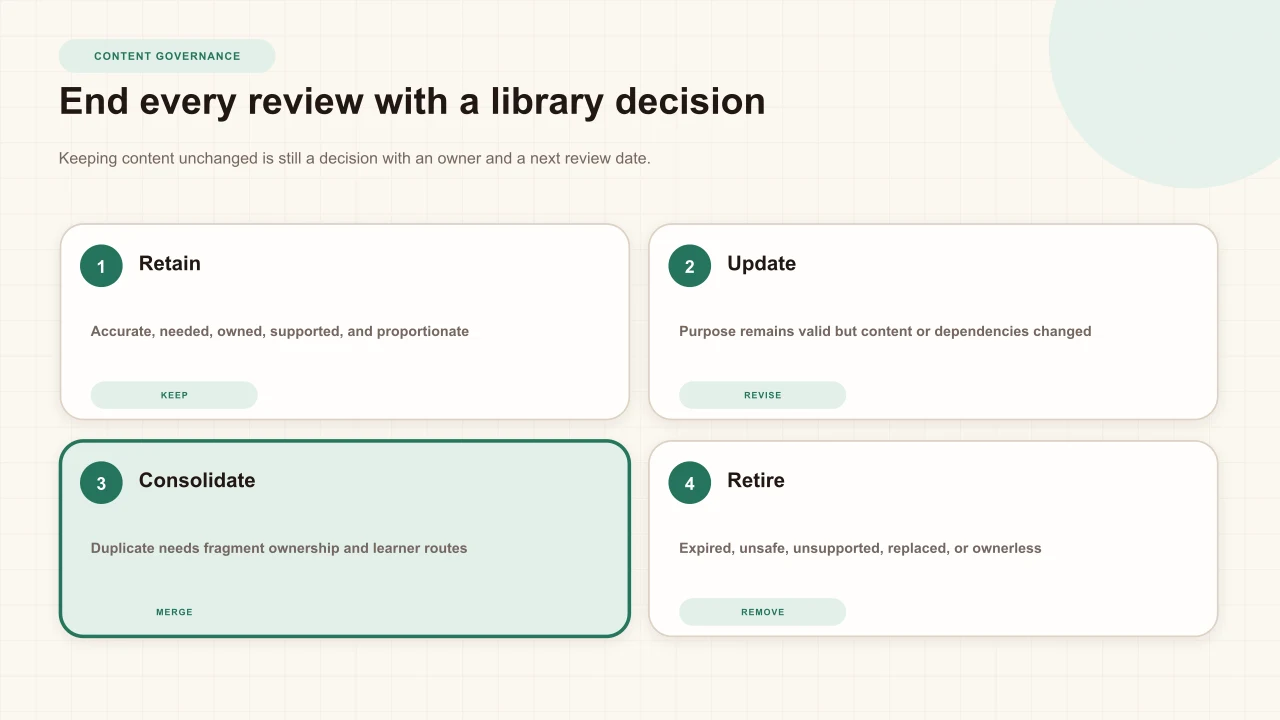
Review should end with a lifecycle decision. Retain when the content remains accurate, needed, owned, supported, and proportionate. Update when the purpose remains valid but evidence or dependencies changed. Consolidate when multiple assets duplicate a need and fragment ownership. Retire when the need disappeared, the source or policy expired, the asset is unsafe or unsupported, a better current route exists, or no accountable owner can be assigned.
Plan the learner consequence of retirement. Remove or replace course links and embeds, communicate to owners, preserve required records, handle historical analytics and certificates appropriately, and redirect readers where a successor exists. Digital.gov's lifecycle guidance emphasizes that publishing is not the end and that governance supports creation, maintenance, updating, and removal.
Use the interactive-video content audit to turn this governance state into a practical inventory, published-path review, prioritization method, and owned refresh plan.
Interakly product boundaries
Interakly provides current content authoring, publication, access, interaction, response, and analytics behavior. Those product records can support an operating register and review, but they do not assign your institutional owner, decide a review interval, approve subject accuracy, interpret law or policy, accept risk, preserve every required external record, or decide when a lesson should retire.
Verify source-specific behavior. Uploaded video supports the owned-media and spatial interaction workflow; YouTube supports the current compatible over-video interactions and depends on embeddability. Changing source can therefore be a material governance event. Do not assume a preview, old screenshot, or historical configuration proves the current published learner path.
Start with a lightweight operating cadence
Weekly intake
Triage feedback, incidents, dependency changes, and urgent review triggers.
Monthly register review
Resolve owner gaps, overdue assets, upcoming policy changes, and blocked maintenance.
Quarterly portfolio decision
Review risk, duplication, support, learner evidence, and retain-update-consolidate-retire proposals.
Release-level validation
Apply the proportional gate whenever a material content, source, access, scoring, or data change ships.
Annual operating review
Evaluate whether roles, policy, resources, tools, and review intervals still fit the library and its risks.
Keep the system small enough to operate. Start with the highest-risk and most-used assets, a minimum register, named owners, and a visible queue. Add automation only after the team can describe the decision it supports. Governance succeeds when issues reach the right person and assets receive timely decisions—not when the metadata form contains every imaginable field.
The stakeholder buy-in guide helps establish decision authority and resources, and the honest ROI guide keeps recurring ownership and maintenance work visible in the value case. Use the interactive-video pilot guide to establish an evidence and review cadence before a wider rollout.
Sources and further reading
- W3C Planning and Managing Web Accessibility — responsibilities, resources, monitoring, and continual improvement.
- W3C: Sustain accessibility — review content, process, standards, technology, and feedback.
- W3C organizational accessibility policies — scope, responsibilities, monitoring, and review.
- Digital.gov content lifecycle guidance — ownership, maintenance, audits, and retirement.
- GOV.UK sustainable service lifecycle — continuous improvement, support, and service health.
- GOV.UK service-team roles — service ownership and multidisciplinary content responsibilities.
- NIST Privacy Framework — continuing governance of privacy risk and data processing.
- U.S. National Archives governance guidance — roles, authority, lifecycle, and records-management structures.
FAQ
Who should own an interactive learning asset?
Assign an accountable content owner or team with authority to approve accuracy, relevance, review, and retirement. Other roles may author, review accessibility or policy, operate the platform, support learners, or analyze evidence, but accountability should not disappear between them.
How often should interactive content be reviewed?
Use risk and change triggers rather than one universal interval. High-consequence, policy-sensitive, frequently changing, widely reused, or integration-dependent content needs shorter review. Stable low-risk content can use a longer cadence, but every asset still needs an owner and next review date.
Does updating one question require republishing the whole lesson?
The release decision should cover the complete learner experience affected by the change. Even a small edit can alter answer meaning, feedback, scoring, captions, branching, completion, analytics interpretation, or downstream documentation, so revalidate the relevant path before release.
What belongs in a content register?
At minimum: stable identifier, title, purpose, audience, accountable owner, subject reviewer, source media, publication and access route, risk tier, last and next review, dependencies, data use, current status, and change record. Add only fields the operating team will maintain.
When should interactive content be retired?
Retire or replace content that is inaccurate, duplicative, unused without a continuing need, unsupported, inaccessible beyond a reasonable remediation path, tied to an expired policy or source, or ownerless. Preserve required records and redirects according to the organization’s policies.
Does Interakly provide a complete governance system?
No. Interakly provides current content, publication, access, interaction, response, and analytics capabilities. The organization remains responsible for accountable ownership, subject approval, review dates, records duties, policy interpretation, risk acceptance, and retirement decisions.
Give every interactive lesson an owner and a next decision
Use Interakly’s real published workflow as one part of a proportionate lifecycle: approve, monitor, review, change, and retire deliberately.
Explore corporate training