Data Privacy in Interactive Learning Media: A Guide
Plan identity, access, event collection, retention, and review for interactive learning media without gathering more learner data than the program needs.
Interactive learning media can record more than a play event. A session may include answers, scores, progress, comments, drawings, identity details, route choices, and timestamps. That evidence can support feedback and program improvement, but its value does not make every possible field necessary. A responsible plan begins by asking what decision the program must make and what minimum evidence can support it.
This guide is an operational framework, not legal advice. Requirements differ by jurisdiction, learner age, institutional role, contract, and context. Use it to prepare a clearer conversation with privacy, legal, security, safeguarding, accessibility, and learning stakeholders.
Begin with purpose, not fields
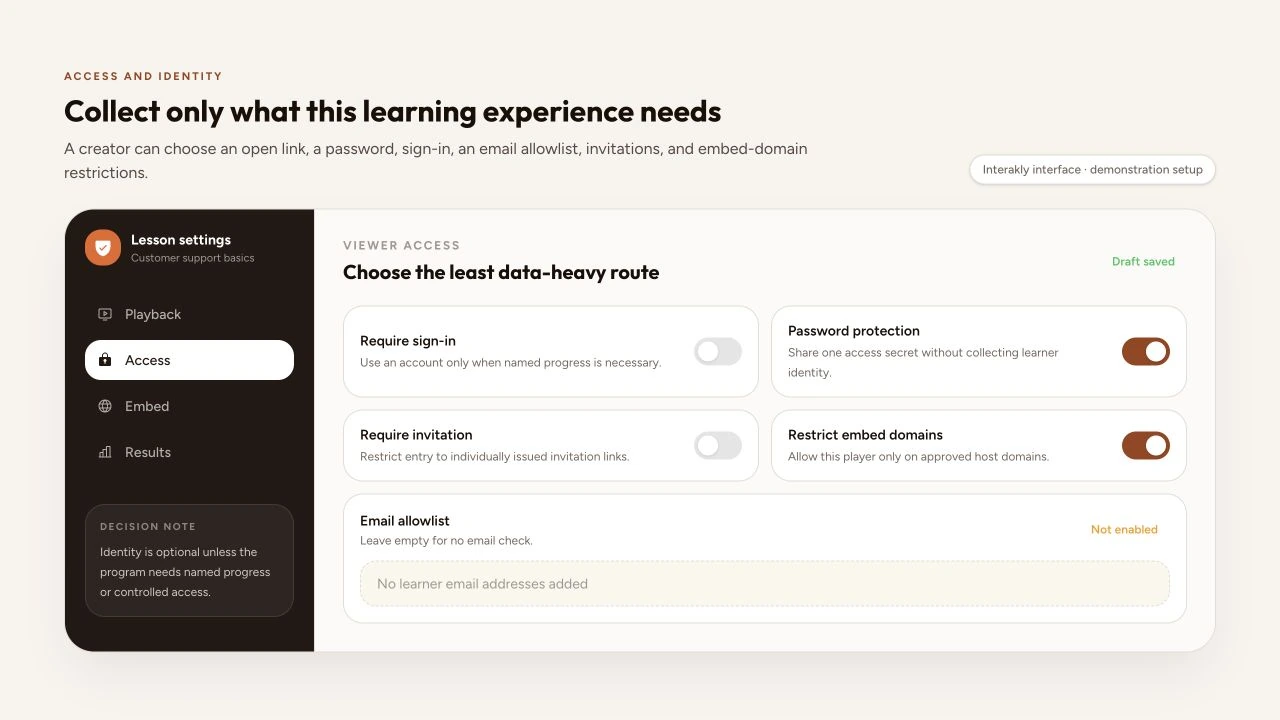
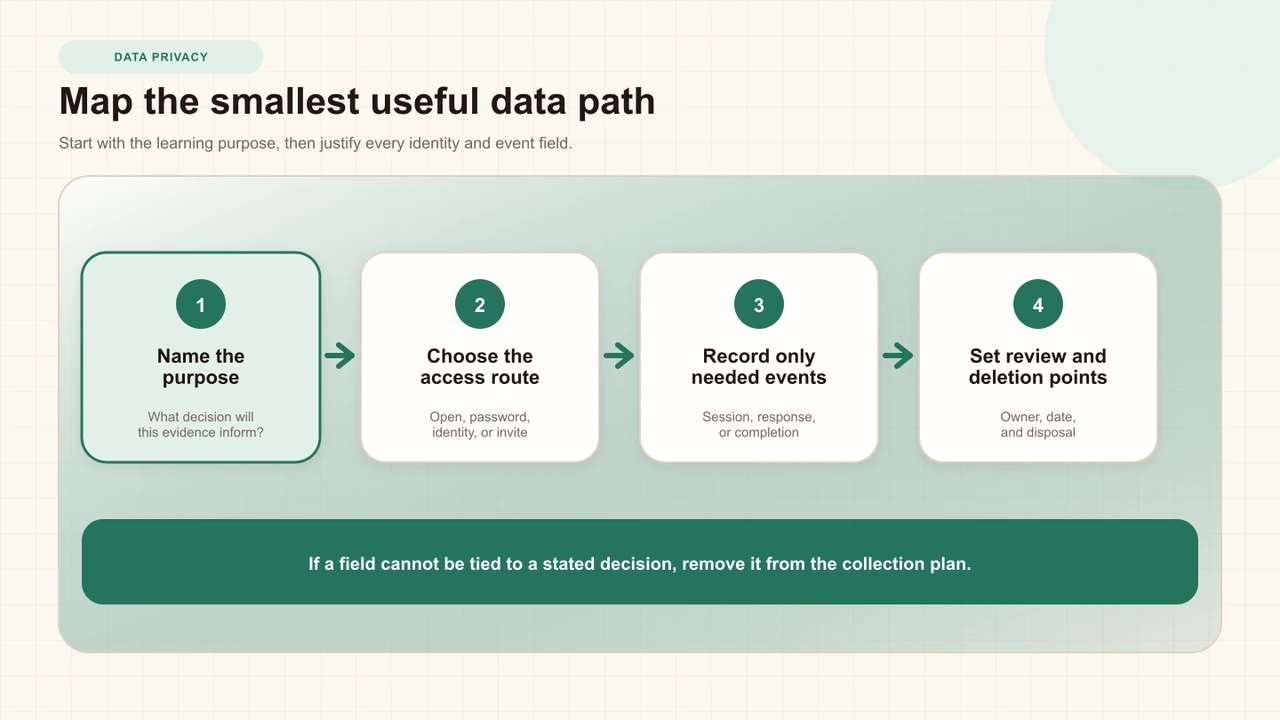
Write a one-sentence purpose before configuring the player: “Give new employees private practice and show the trainer which concepts need revision” is more useful than “collect analytics.” The first statement separates response patterns from named performance. It also makes it easier to challenge a request for email, department, location, or a permanent account when the instructional decision does not need them.
The European Union's GDPR expresses data minimisation as personal data that are adequate, relevant, and limited to what is necessary for the stated purposes. The principle is useful outside a single jurisdiction as a design discipline: collect the smallest defensible set, restrict its uses, and reassess when the purpose changes. The NIST Privacy Framework likewise treats privacy as risk management rather than a one-time notice.
Choose the least intrusive access route
Access control and identity collection are related but different. An open link can support anonymous practice. A password can limit casual access without identifying each learner. An email check, account sign-in, or invitation can support named progress or a bounded audience, but each adds identity data and operational work. Choose the lowest rung that still satisfies the purpose and local policy.
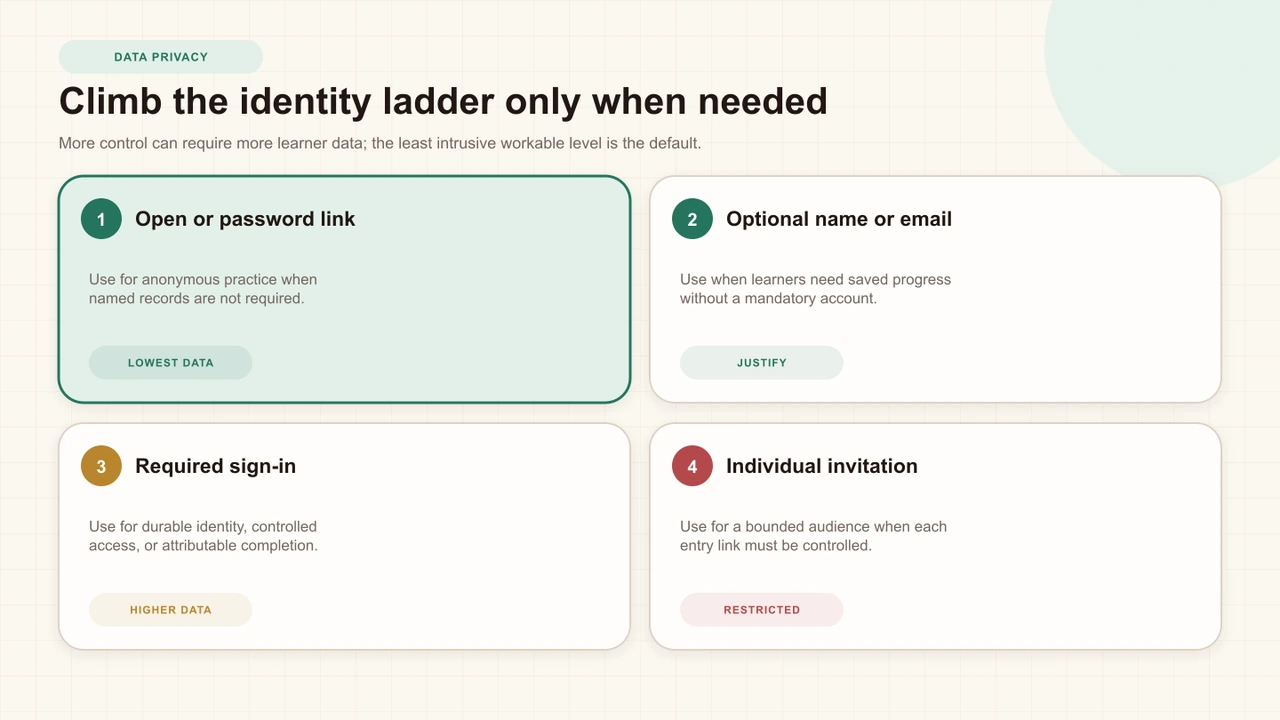
Do not describe an anonymous session as “no data.” The session may still contain answers, timestamps, device-related technical information, and progress. Conversely, do not assume a named session is automatically inappropriate. A certification program may need attributable completion. The defensible choice is the one that matches the declared purpose and is transparent to the learner.
Map what the learner experience records
Inventory the complete journey, not just the registration form. Start at the share link or LMS launch, continue through the media player and every interaction, and finish with analytics, exports, certificates, and deletion. For each step, record the field, source, purpose, storage location, people with access, downstream recipients, and retention rule.
Entry
List link tokens, invitation details, account identifiers, email checks, and LMS launch claims.
Participation
List sessions, watch progress, answers, scores, comments, uploads, drawings, branches, and technical recovery events.
Interpretation
List dashboards, filters, question-level results, completion rules, and any identity joins.
Movement
List CSV exports, LMS grade returns, embeds, support logs, backups, and local working files.
Keep technical telemetry distinct from instructional evidence. A recovery event can show that a source failed; it is not a learner answer. A view is usually a session event; it is not necessarily a unique person. A score reflects configured grading rules; it is not a general profile of the learner. These definitions reduce both privacy risk and analytical error.
Separate identity from learning evidence
Ask whether the analysis genuinely needs names attached. Content revision often needs an aggregate distribution: many learners chose the same distractor, or sessions frequently ended near one moment. Individual coaching, credentialing, or access enforcement may need identity. Keeping these purposes separate can prevent a useful aggregate question from expanding into unnecessary learner profiling.
Over-collected
Require every learner to create an account so the team can see whether one distractor is confusing.
Purpose-matched
Use aggregate response counts for item revision; add identity only if a separate coaching or completion purpose requires it.
Small groups deserve particular care. Even when a dashboard omits names, a unique role, location, timestamp, or open-response detail may make a person recognizable. Suppress or combine slices that create an obvious re-identification risk, and do not circulate screenshots merely because the dashboard itself is access-controlled.
Define roles and authority
Name who decides the purpose, who configures the lesson, who administers the platform, who can view individual results, who can export, and who answers learner requests. In an education setting, those roles may sit across a school, district, teacher, service provider, and LMS provider. A product toggle cannot decide the institution's legal authority or satisfy every local approval process.
The US Department of Education's student privacy resources advise teachers to check whether a service has been approved by the school or district. Their FERPA guidance also explains that a provider operating under the school-official exception must be under the institution's direct control for use and maintenance of education records and must not use or redisclose the data for unauthorized purposes. Apply the precise rule with qualified local reviewers rather than relying on a generic “FERPA compliant” label.
Set retention before launch
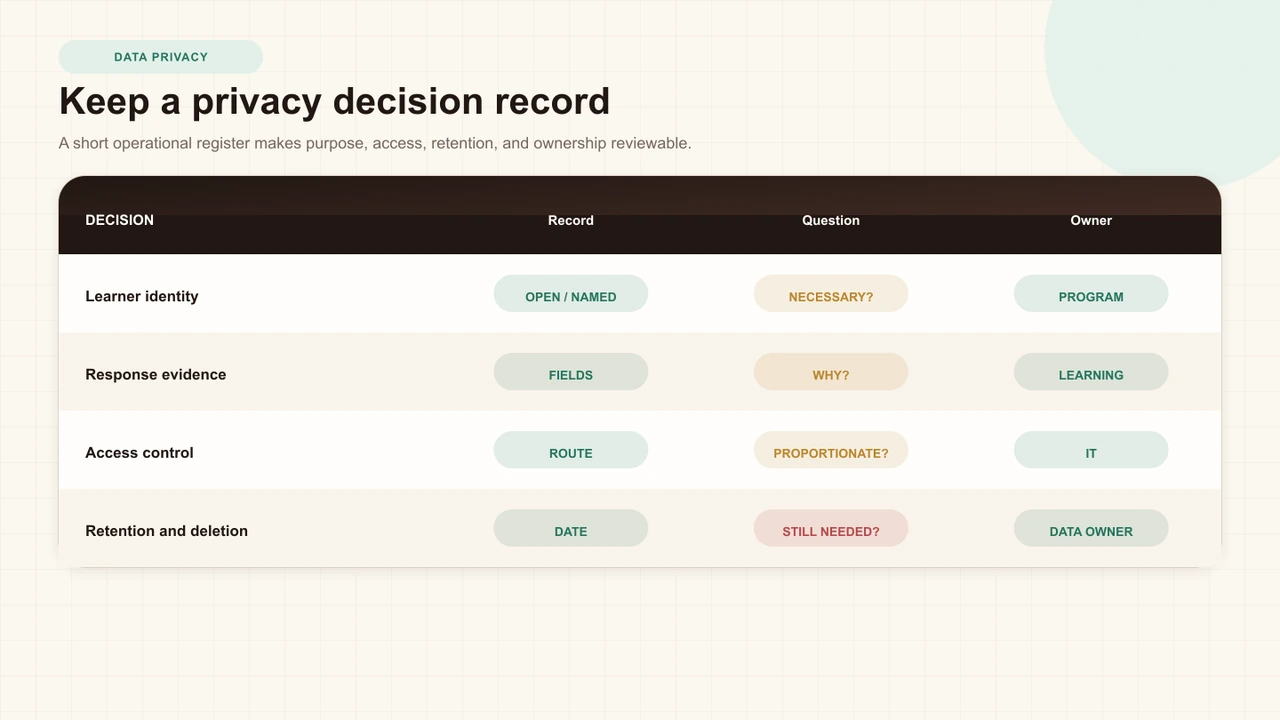
“Keep it in case it becomes useful” is not a retention schedule. Define a review date for active pilot records, a rule for completed programs, and a deletion process for exports and local copies. Confirm what deletion means across the primary service, backups, downstream systems, and audit records. Some records may require retention; others may need prompt disposal. Write the distinction before data accumulates.
Retention should follow the unit actually stored. If the dashboard is session-based, decide how long sessions and their responses remain useful. If a certificate or grade becomes an institutional record, its ownership and schedule may differ from detailed watch events. Do not silently retain every low-level event for as long as the final completion record.
Review vendors and agreements
Read the current privacy policy, data-processing terms, subprocessors, security information, deletion process, breach commitments, support access, hosting locations, and change-notification terms. The Department of Education's model terms checklist is useful because it asks how an online service collects, uses, transmits, and protects information—not merely whether its homepage displays a trust badge.
For children, the FTC's education-technology policy statement emphasizes that providers covered by COPPA cannot condition school participation on unnecessary commercial data collection and cannot shift their own legal duties to schools. That is one example of why a privacy review must consider the exact audience and use, not a broad assumption that educational intent makes every practice acceptable.
Plan learner transparency
Give learners useful notice at the point of collection: what is required, why it is needed, who will see it, and what happens if they do not provide it. Avoid vague labels such as “for analytics” when the actual purpose is named completion, access enforcement, or question-level review. Make the privacy policy reachable, but do not expect a long policy to replace clear in-context explanation.
Transparency also applies to consequential interpretation. If an interaction affects a score, pass threshold, certificate, branch, or human review, explain that behavior. Provide a route for correction or assistance when identity or submitted work is wrong. A technically accurate notice can still fail if it arrives after the learner has already disclosed the information.
Handle exports and integrations
An export creates another copy with its own permissions, storage, retention, and deletion risks. Export only the columns needed for the declared task, use approved storage, restrict recipients, and delete working files when the review ends. A convenient CSV should not become an unmanaged shadow learner database on personal devices or email threads.
LMS launches and grade return add systems and identifiers to the path. Verify the launch claims, course context, role mapping, grade fields, audience, and authorization. Interoperability describes how systems exchange data; it does not decide whether a specific exchange is necessary or legally authorized. Review both the interactive-media service and the destination system.
Respond to changes and incidents
Repeat the review when a pilot becomes mandatory, anonymous viewing becomes named, a new interaction collects free text or media, an LMS connection is added, an export goes to a new team, or a vendor changes a material term. The ICO's DPIA guidance is one formal example: organizations subject to UK data-protection law must complete an assessment before processing likely to result in high risk. Even where that exact duty does not apply, change-based review is sound practice.
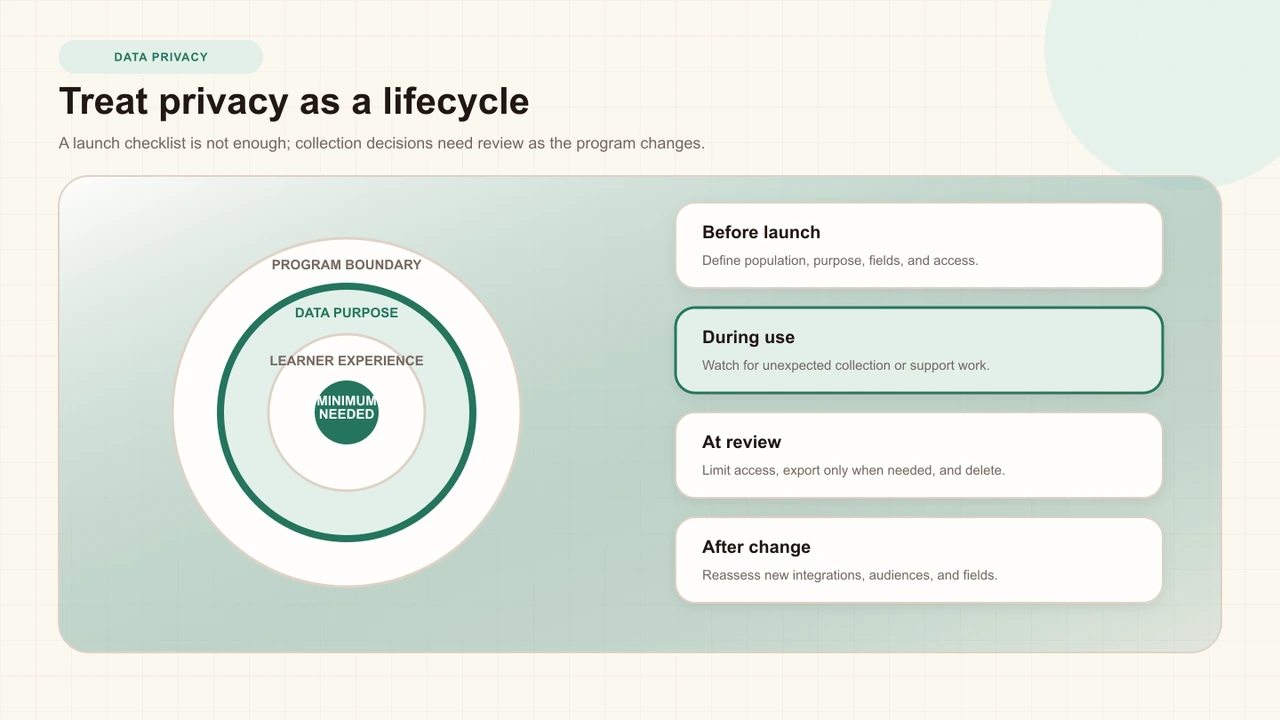
Define an incident route before launch: how a creator reports an unexpected exposure, who can suspend sharing, who investigates, who communicates, and what records are preserved. The right response depends on the incident and governing obligations, but ambiguity about ownership reliably wastes time.
Interakly product boundaries
Interakly supports open published links, password protection, required sign-in, email allowlists, invitation-only access, and embed-domain restrictions. It records video sessions and interaction evidence needed for playback, responses, scoring, completion, and analytics. Public video reads strip sensitive fields such as password material and authored correct-answer data. Owner-only operations protect editor settings and detailed results.
Uploaded video supports the full spatial interaction canvas; YouTube video supports the non-spatial interaction workflow. That source distinction can change which events and authoring features are relevant, but it does not remove the need for a privacy decision. Current product practices are described in the Interakly privacy policy. The policy says Interakly does not sell personal data, use student data for advertising, or use student data to train AI models. Verify the current policy and your agreement at the time of adoption rather than relying on this article as a contract.
A practical privacy review
Write the purpose
Name the learning and operational decisions in plain language.
Choose access
Use the least identity-intensive route that satisfies the real need.
Inventory the path
Map entry, session, interactions, analytics, exports, integrations, and deletion.
Assign owners
Record authority, permissions, review dates, support, and incident responsibility.
Test the notice
Have a representative learner explain what is collected and why before launch.
Recheck after change
Repeat the review when purpose, audience, fields, systems, or terms move.
Carry this record into a needs-based tool evaluation and a bounded pilot. The companion guides on evaluating an interactive video tool and running an interactive video pilot show how privacy becomes a testable selection and launch criterion. For design decisions inside the lesson itself, use the broader interactive-video best-practices guide.
Sources and further reading
- NIST Privacy Framework — voluntary guidance for identifying and managing privacy risk.
- US Department of Education: Privacy and Education Technology — official education-technology privacy resources.
- US Department of Education Student Privacy FAQ — FERPA-oriented questions on school and provider responsibilities.
- Model Terms of Service checklist — questions for evaluating online educational services.
- FTC Policy Statement on Education Technology and COPPA — official US children's privacy enforcement guidance.
- GDPR Article 5 — official EU text including purpose limitation and data minimisation.
- ICO guidance on data-protection impact assessments — current UK regulator guidance on high-risk processing assessments.
FAQ
What learner data does an interactive video need?
There is no universal minimum. An anonymous practice lesson may need only a session and responses, while attributable completion may require a durable learner identifier. Start with the decision the program must make, then justify each field.
Is anonymous viewing always more private?
It usually reduces direct identity collection, but anonymous sessions can still contain behavioral and response data. Treat those events as data with a defined purpose, access policy, and retention period.
Should every learner be required to sign in?
No. Require sign-in when the learning or access purpose genuinely needs durable identity. A password, invitation, or open link may be sufficient for other experiences.
Does this guide provide legal advice?
No. It is an operational planning guide. Applicable law, contracts, school policy, age, jurisdiction, and institutional roles can change the answer; involve the appropriate privacy, legal, safeguarding, and security reviewers.
Can learning analytics be exported?
A product may support exports, but permission to export does not settle whether the export is necessary, who may receive it, where it may be stored, or when it must be deleted. Treat each export as a new controlled copy.
When should a privacy review be repeated?
Repeat it when the audience, identity route, fields, purpose, integration, vendor, retention rule, or sharing destination changes—and after incidents or unexpected data behavior.
Design the learning path before you collect the data
Build an interactive lesson, choose a proportionate access route, preview it as a learner, and document what evidence the program actually needs.
Explore video interactions