Knowledge Check vs Quiz: Which Should You Use?
Choose between a low-stakes knowledge check and a scored quiz by comparing purpose, feedback, attempts, reporting, and the consequence of the result.
The useful difference between a knowledge check and a quiz is not the number of questions or the shape of the answer buttons. It is the decision attached to the result.
Use a knowledge check when the response should improve what happens next in the learning experience. Use a quiz when the score must summarize performance well enough to support a stated consequence. This guide helps you make that choice before you write the first question.
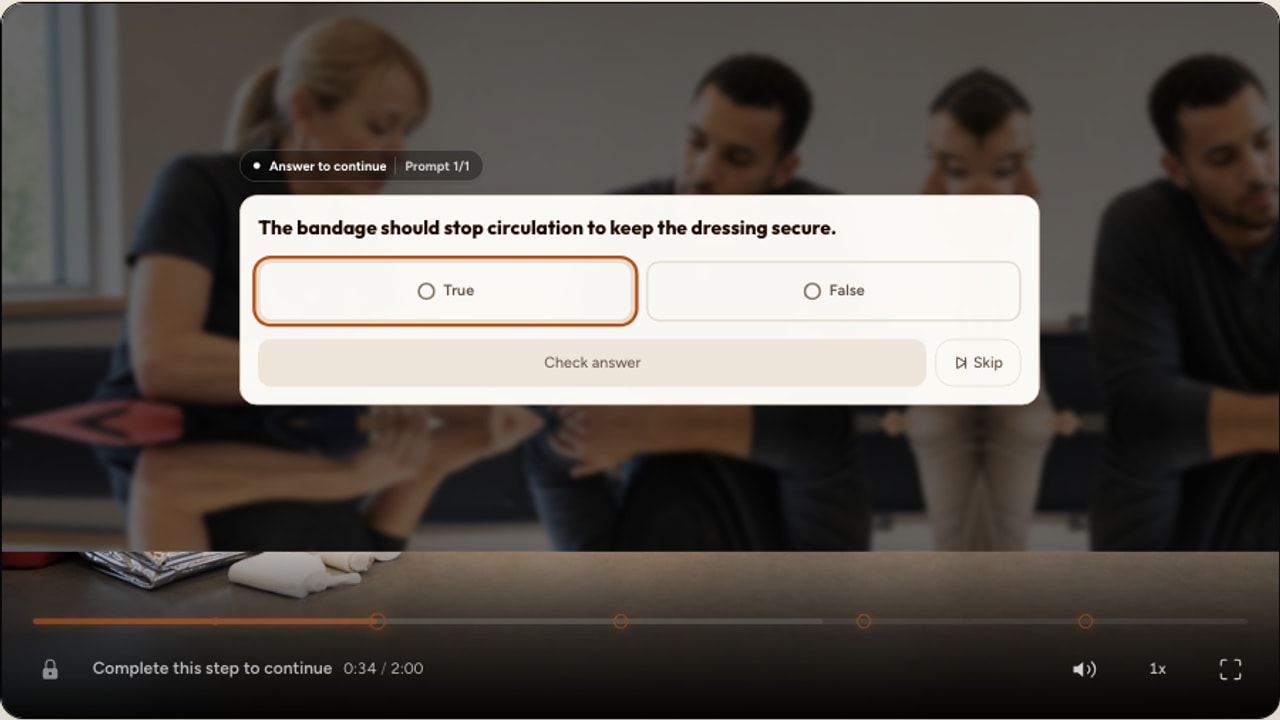
The decision in one sentence
Ask this question: What will someone do differently because of the result?
- If the answer is review an explanation, correct a misconception, choose a new example, or adjust the next lesson, build a knowledge check.
- If the answer is award credit, determine pass status, issue a certificate, approve progression, or create a formal record, build a quiz with enough evidence and quality control for that decision.
Names do not determine stakes
“Knowledge check” and “quiz” are ordinary product and teaching labels, not universally standardized assessment categories. Carnegie Mellon University's assessment guidance lists quizzes as a possible formative assessment, while the National Academies describes formative assessment by what its evidence enables: meaningful feedback and adjustments to learning or instruction.
This is why the same multiple-choice interaction can serve two very different designs. With no consequential score, explanatory feedback, and a chance to try again, it can be a practice check. When several questions contribute to a passing threshold or certificate, they form a scored quiz. The interface may look similar, but the promise to the learner is different.
Label-led decision
It has three answer choices, so it is a quiz.
Purpose-led decision
Its feedback changes the learner's next step, so it is a formative knowledge check.
Use a knowledge check when learning comes next
A knowledge check belongs inside the learning loop. It asks for a small piece of evidence, responds to that evidence, and leaves the learner better prepared for the next section. Its value comes from retrieval and correction, not from the permanence of the score.
Use this pattern when you need to:
- retrieve one important idea after a complete explanation;
- surface a misconception before it causes a later error;
- let viewers judge their readiness to continue;
- collect a prediction before a reveal without grading the guess;
- decide what to reteach in the next class, meeting, or coaching session;
- give practice that can be repeated without penalty.
A good knowledge check still needs a clear answer, fair timing, and useful feedback. Low stakes do not excuse vague wording. They simply change how much consequence the response carries.
Place the check after a fair evidence boundary
Choose timestamps around completed explanations, demonstrations, decisions, and predictions.
Use a quiz when a result must support a decision
A quiz becomes necessary when you need a summarized result. That result might be modest, such as whether a learner should revisit one module. It might also carry more weight, such as a passing score or certificate.
Use this pattern when you need to:
- measure several stated objectives rather than one local idea;
- report a score that learners and instructors can interpret;
- apply a consistent pass threshold or completion rule;
- define whether and how retakes affect the result;
- include reviewed text or media responses in a final score;
- support certificate eligibility after grading is complete.
The higher the consequence, the stronger the evidence must be. A one-item quiz can check one fact. It cannot support a broad claim that someone has mastered a whole procedure, unit, or role.
Six decisions that shape the experience
Purpose
Improve the next learning step
Summarize performance against stated criteria
Consequence
None, or deliberately low stakes
A score may affect completion, pass status, or a certificate
Feedback
Specific enough to guide correction now
Useful feedback, with answer release matched to the retake policy
Attempts
Retry is usually part of the learning design
Retakes are defined before launch and applied consistently
Coverage
One current concept or misconception
Enough independent evidence for the intended score meaning
Reporting
A signal for learner and instructor action
A result that may need identity, review, and a lasting record
Do not choose one side of every row mechanically. A useful practice check may still record a response, and a scored quiz should still provide feedback. The table shows the center of gravity for each design.
A practical consequence ladder
Stakes are not binary. Use this ladder to match the strength of your assessment design to the weight of the decision it supports.
Level 1
Practice check
What should the learner notice or correct next?
Zero or low points, immediate explanation, retry encouraged
Level 2
Progress checkpoint
Is this section ready to continue, review, or reteach?
Recorded response, clear criteria, low consequence
Level 3
Scored quiz
What achievement does this score reasonably summarize?
Defined points, coverage, passing rule, and retake policy
Level 4
Credential decision
Is the evidence strong enough for a lasting claim?
Verified identity where needed, final grading, audit-ready policy
Moving up the ladder should add evidence and safeguards, not merely a more official title. Before a result affects a credential, confirm that the questions cover the intended outcome, scoring is consistent, required accommodations are available, and reviewed responses are final.
Turn one prompt into either experience
Imagine a lockout training video that shows a technician isolating stored energy. The base prompt is: “What must the technician verify before work begins?” The wording can stay the same while the surrounding design changes.
As a knowledge check
- Place it immediately after the complete verification demonstration.
- Use zero or low points.
- Explain why isolation is not complete until the verification step.
- Let the learner change the answer after reviewing the feedback.
- Use the response pattern to decide whether the next cohort needs a clearer example.
As part of a quiz
- Map it to the stated procedure objective.
- Give it a defined point value alongside other independent questions.
- Set the video-wide passing and retake policy before publishing.
- Keep answer release consistent with any allowed retake.
- Use the final result only for the decision the complete question set can support.
Practice promise
Use this response to notice the missing verification step, then correct your understanding.
Assessment promise
Use this item with the rest of the quiz to judge performance against the published criteria.
Build both patterns in Interakly
Interakly does not require a separate “knowledge check” interaction type. Both patterns use the same real response components. You create the difference through the question's points, feedback, and retake behavior, then through the video's player and scoring settings.
Configure a knowledge check
Choose the smallest useful response
Use multiple choice, true or false, fill in the blank, numeric input, or another supported interaction only when it matches the evidence you need. Use a poll for opinion, confidence, or prediction rather than inventing a correct answer.
Set the learning treatment
Use zero or low points, add an explanation, and choose whether this question should inherit, allow, or prevent answer changes.
Protect the viewing moment
Use the video-level Player settings option Pause on question when the learner must read and respond before the explanation continues.
Preview correction and return
Answer correctly and incorrectly, inspect the feedback, change the answer if allowed, and confirm playback resumes in the right place on desktop and phone.
Configure a scored quiz
Create a small assessment blueprint
List the objectives, then assign enough independent questions to represent each one. Remove duplicate items that collect the same evidence.
Set answer rules and points
Configure each correct answer, explanation, point value, and per-question retake override. Confirm every item contributes as intended.
Set the video-wide result policy
In Scoring settings, choose whether to show the score screen and whether a passing score is required. In Player settings, define the default retake behavior and whether viewers may change individual answers.
Handle reviewed work honestly
If the quiz includes text or media work that needs human review, treat the first result as provisional. Interakly waits for final grading before resolving certificate eligibility.
Run both sides of the threshold
Complete one passing and one non-passing path, test the retake policy, and verify the final score or certificate behavior only after all grading is complete.
Match the response type to the evidence
Compare objective questions, constructed responses, audience input, context cards, and spatial activities.
Make a scored quiz defensible
The Standards for Educational and Psychological Testing centers validity on the interpretations and uses of scores. In practical terms, that means you should state what the quiz result is supposed to mean, then collect evidence strong enough for that claim.
Use these checks before a score affects pass status, progression, or a certificate:
- Coverage: Each important objective has appropriate representation, and minor details do not dominate the score.
- Alignment: The response format measures the intended skill rather than incidental reading speed, memory for decoration, or interface precision.
- Answer quality: Keys are correct, distractors are plausible, and open-response criteria are explicit.
- Administration: Required evidence is visible, timing is fair, and accessibility needs are considered.
- Scoring: Points and thresholds match the published policy, including partial credit and reviewed responses.
- Interpretation: The result supports only the claim the assessment was designed to make.
Write questions that produce interpretable evidence
Build clear stems, plausible alternatives, useful feedback, and fair answer rules.
Four realistic examples
A software walkthrough
Ask one knowledge check after the instructor demonstrates a permission setting: “Which role should receive edit access?” Give explanatory feedback and allow another attempt. The result helps the learner correct the setup before following the next step.
A workplace safety refresher
Use several scored questions when annual completion requires a passing result. Cover the critical decisions, not only terminology. Define the retake policy, pilot every answer path, and avoid claiming the quiz proves hands-on competence unless the evidence actually represents it.
A flipped-classroom lesson
Use section-level knowledge checks to reveal what needs attention in class. The response pattern can guide the next discussion even if no grade is attached. A separate end quiz can summarize preparation when the course requires a recorded score.
A product certification module
Combine practice checks during demonstrations with a scored final quiz. Keep the practice attempts consequence-free, then make the final coverage, threshold, review process, and certificate criteria explicit. The two layers serve different jobs without forcing every interaction to carry the same stakes.
The final decision checklist
- The action caused by the result is written in one sentence.
- The learner can tell whether the moment is practice or assessment.
- The response format matches the evidence you actually need.
- Question timing preserves every required part of the video evidence.
- Feedback supports the next learning step.
- Attempts and answer changes follow a deliberate, published policy.
- Points are zero or low when the moment is intended as practice.
- A scored quiz covers enough independent evidence for its stated use.
- Human-reviewed work remains provisional until grading is complete.
- Certificate or pass decisions use only final, defensible results.
- The complete experience has been tested on desktop and phone.
Research sources
- Carnegie Mellon University, Eberly Center. Formative vs summative assessment. A practical comparison of assessment purposes and examples.
- National Academies of Sciences, Engineering, and Medicine (2018). How People Learn II: Learners, Contexts, and Cultures. See the discussion of assessment and feedback in Chapter 7.
- Black, P., and Wiliam, D. (2009). Developing the theory of formative assessment. Educational Assessment, Evaluation and Accountability, 21, 5–31.
- Roediger, H. L., and Karpicke, J. D. (2006). Test-enhanced learning: Taking memory tests improves long-term retention. Psychological Science, 17(3), 249–255.
- Butler, A. C., and Roediger, H. L. (2008). Feedback enhances the positive effects and reduces the negative effects of multiple-choice testing. Memory & Cognition, 36, 604–616.
- American Educational Research Association, American Psychological Association, and National Council on Measurement in Education (2014). Standards for Educational and Psychological Testing.
FAQ
What is the difference between a knowledge check and a quiz?
A knowledge check is usually designed to improve learning during instruction through retrieval, feedback, and another opportunity to act. A quiz usually produces a score or result used to summarize performance. The labels are not standardized, so the real distinction is what happens because of the response.
Should a knowledge check be graded?
It can record correctness or points, but keep the stakes low when its main purpose is practice. If the result affects a grade, certificate, access decision, or formal record, treat it as an assessment and apply the quality controls expected of a quiz.
Can a quiz still be formative?
Yes. A quiz is formative when its evidence and feedback are used to improve the learner's next attempt or the teacher's next instruction. A quiz can also be summative when its score is used to judge achievement after learning. The same question format can serve either purpose.
Should learners be allowed to retry a knowledge check?
Usually yes, when the goal is correction and practice. Give useful feedback before the retry, and decide whether changing an answer should replace the original response or simply support learning. A final quiz may use a stricter retake policy when the result carries a real consequence.
Can a knowledge check count toward a certificate?
It can contribute points, but once the result affects certificate eligibility it is no longer consequence-free practice. Review the answer key, accessibility, scoring, retry policy, and coverage as carefully as you would for the rest of the scored quiz.
How many questions should a knowledge check or quiz have?
Use the smallest set that collects the evidence you need. One question may be enough to check one completed idea. A scored quiz needs enough independent questions to support the decision attached to its result. Do not infer broad mastery from one easy item.
Build the complete video quiz workflow
Choose a source, add supported questions, configure feedback and scoring, preview the experience, and publish.
Choose the smallest useful question set
Plan question density from objectives, concept boundaries, and response effort instead of a timer.
Build a quiz on a supported YouTube video
Follow the complete workflow for adding, previewing, and publishing questions on an embeddable YouTube source.
Build the right kind of learning moment
Start with the decision your evidence must support, then configure questions, feedback, scoring, and retakes around that purpose.
Explore video interactions