How to Choose a Quiz Pass Score
Choose a defensible quiz pass score by matching the threshold to its consequence, score resolution, evidence quality, grading process, and certificate policy.
A quiz pass score is not a reward for choosing a familiar percentage. It is a decision rule. It says that results at or above one point on the score scale are sufficient for a stated purpose, while results below it are not.
That decision should begin with the minimum performance you need to see, the evidence your quiz can actually collect, and the consequence of a mistaken pass or fail. Only then should you translate the rule into a percentage.
The short answer
Choose a pass score by answering three questions in order:
- What must a minimally successful learner be able to do?Write the boundary in observable terms before discussing a percentage.
- Does this quiz collect enough relevant evidence? Check coverage, answer quality, weighting, accessibility, and score resolution.
- What happens if the decision is wrong? The cost of a false pass or false fail determines how much evidence and review the rule needs.
An 80% rule can be reasonable in one setting and arbitrary in another. It can also behave like a 100% rule when the quiz has too few questions to produce a score between 80 and 100.
Start with the consequence, not a percentage
A low-stakes practice activity and a workplace approval decision should not inherit the same evidence requirements just because both happen in a video player. Classify the decision first.
Practice
Decision
What should the learner review or try next?
One or more focused checks with useful feedback
Threshold approach
Usually no pass threshold
Minimum safeguard
Keep consequences low and let correction drive the next step
Progress checkpoint
Decision
Is the learner ready to continue this course or module?
Enough independent questions to represent the checkpoint
Threshold approach
A stated minimum tied to the covered objectives
Minimum safeguard
Pilot the rule and offer a clear review or retry path
Certificate
Decision
Has the learner met the published completion claim?
Final graded score with adequate objective coverage
Threshold approach
A separate certificate rule when the claim is stronger
Minimum safeguard
Do not issue while positive-point work awaits review
High consequence
Decision
Can this result affect safety, employment, or regulated practice?
Multiple relevant sources, often including performance evidence
Threshold approach
Use a qualified standard-setting process
Minimum safeguard
Do not improvise the decision from a convenient percentage
This is a proportionality rule. As the consequence grows, add stronger coverage, clearer scoring criteria, more review, and a more formal standard-setting process. Raising the percentage by itself does not make weak evidence stronger.
Decide whether the moment needs a pass score at all
Separate practice that improves the next learning step from a quiz whose result supports a consequence.
Define minimum acceptable performance
Replace “What percentage feels rigorous?” with “What would a learner at the minimum acceptable boundary know or do?” This boundary description is the standard that the percentage is meant to represent.
For a short phishing-awareness module, a boundary description might be:
A successful learner identifies the main signs of a suspicious message, avoids the unsafe action, and selects the organization's correct reporting route in realistic examples.
That statement is more useful than “80%” because it guides the rest of the design. It tells you which scenarios belong in the quiz, which minor facts should not dominate, and what kind of mistake is too important to average away.
Write the boundary with four parts:
- Audience: who the rule is for, including relevant role or experience level.
- Required behavior: the decisions, explanations, or procedures expected at the boundary.
- Conditions: the information, tools, time, or reference material the learner may use.
- Consequence: what passing permits and what not passing requires next.
Convention-led rule
Set 80% because that is what our quizzes usually use.
Criterion-led rule
Pass learners who demonstrate the minimum decisions required for this module's stated next step.
Check what the quiz can support
A threshold cannot repair a quiz that measures the wrong things. Before setting the score, audit the evidence underneath it.
- Objective coverage: important outcomes are represented, and trivial details do not consume most of the available points.
- Question quality: stems are clear, keys are correct, distractors are plausible, and the wording does not introduce avoidable reading or cultural barriers.
- Independence: several near-duplicate questions do not create the appearance of broad evidence.
- Authenticity: the response resembles the decision or application named in the learning objective.
- Scoring consistency: point values and review criteria are applied the same way to equivalent work.
- Administration: learners see all required evidence, receive appropriate access support, and know the attempt policy.
The Standards for Educational and Psychological Testing asks for evidence supporting the intended interpretation and use of scores. In a course, that means a quiz score should support only the claim it was designed to support. Five recall items can summarize performance on those five items. They do not automatically establish broad mastery.
Improve the evidence beneath the percentage
Write clear stems, plausible alternatives, fair answer rules, and feedback that matches the learning objective.
Calculate score resolution before choosing a threshold
Score resolution is the set of results learners can actually obtain. On a four-question equal-point quiz, each answer moves the score by 25 percentage points. A threshold slider may display 80%, but no learner can earn 80%, 85%, 90%, or 95%.
What an 80% threshold actually requires
Equal-point examples use Interakly's rounded whole-number result.
4 equal questions
Possible scores
0, 25, 50, 75, 100
Setting
80%
Passing work
4 of 4 correct
Meaning
80% behaves exactly like 100% because 80 cannot be earned.
5 equal questions
Possible scores
0, 20, 40, 60, 80, 100
Setting
80%
Passing work
4 of 5 correct
Meaning
The displayed threshold maps cleanly to an obtainable score.
8 equal questions
Possible scores
0, 13, 25, 38, 50, 63, 75, 88, 100
Setting
80%
Passing work
7 of 8 correct
Meaning
The first passing result is 88% after whole-number rounding.
10 weighted points
Possible scores
Depends on point combinations
Setting
80%
Passing work
At least 8 of 10 points
Meaning
The rule is clear only if the weights represent the intended evidence.
Interakly calculates earned points as a share of possible points and rounds the final percentage to a whole number. Zero-point interactions do not enter the percentage. Partial credit contributes the corresponding share of an item's configured weight.
How many questions can a learner miss?
For an equal-weight quiz, use this planning formula:
With 10 equal questions and an 80% threshold, the calculation is ceiling (10 × 80 ÷ 100), which is 8. The learner can therefore miss 2 questions. With 8 equal questions at the same threshold, ceiling (8 × 80 ÷ 100) is 7, so the learner can miss 1. State the concrete rule next to the percentage when learners need to understand it.
A question-count formula does not work when questions have different weights or allow partial credit. Enumerate every attainable point total, including each partial-credit value permitted by the rubric. Convert each total to a percentage using the same rounding as the learner result, then find the lowest attainable total that meets the threshold. This catches gaps where a displayed percentage does not correspond to a score a learner can actually earn.
Use this simple check before publishing:
- List every possible point total.
- Convert each total into its displayed whole-number percentage.
- Find the first score at or above the proposed threshold.
- Describe that result as a concrete answer pattern.
- Decide whether that pattern matches your boundary description.
Choose points and weighting deliberately
Equal points are often the clearest starting point. They make the score easy to calculate, explain, and audit. Weight an item more heavily only when it represents more of the intended evidence, not merely because its wording is longer or its response format is harder.
Imagine a ten-point quiz with six recall questions worth one point each and one scenario worth four points. At an 80% threshold, a learner needs eight points. That may be appropriate if the scenario genuinely samples a larger, central skill. It may be misleading if one complex item is unreliable or if the six recall items overrepresent minor details.
Audit weighting with these questions:
- Would two qualified reviewers assign similar importance to this evidence?
- Can one topic dominate merely because it has more questions?
- Can strong minor-fact recall hide failure on a central decision?
- Can one ambiguous high-weight item determine the whole result?
- Does partial credit have explicit, consistently applied criteria?
Separate passing from certificate eligibility
Passing a quiz and earning a certificate can represent different claims. Interakly therefore provides two controls:
- Passing score: the video-wide threshold for a pass or fail result. Set it to Off when the experience should not classify the learner this way.
- Certificate minimum score: the final score required for certificate eligibility when certificates are enabled.
These settings are independent. A course might use 70% to pass and 90% for a distinction-style certificate, but that design creates two achievement categories and must be explained. In many straightforward completion courses, using the same threshold is easier for learners to understand.
Handle provisional scores fairly
A quiz can combine immediately scored questions with text or media work that needs a person to review it. The first percentage is then incomplete evidence, not a final verdict.
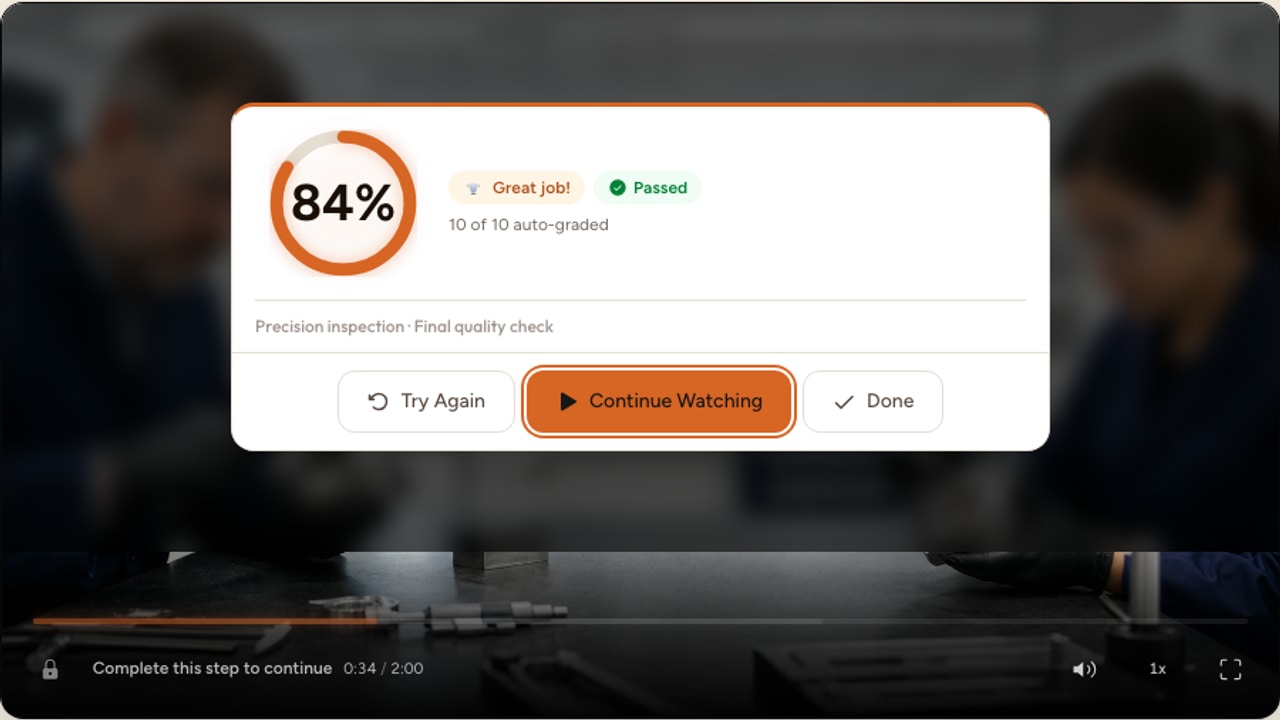
In Interakly, a completed session remains provisional while any positive-point response still needs educator grading. The learner may see the current auto-graded percentage, but the player withholds pass or fail and certificate eligibility until review is complete. A zero-point reflection can still be reviewed without delaying the scored decision.
A fair learner message should answer four questions:
- Which part of the result is currently available?
- What work is still waiting for review?
- Can the percentage change after review?
- Where can the learner return to see the final result?
Avoid messages such as “You scored 60%, try again” while a response is still awaiting marks. The accurate message is that the auto-graded result is provisional and the final outcome will update after review.
Set the policy in Interakly
Finish the scored question set
Confirm every intended scored interaction, answer key, point value, partial-credit rule, and review criterion before choosing the video-wide threshold.
Open Scoring settings
Choose whether to show the score screen. Set Passing score above 0% to enable pass or fail, or leave it Off for practice and neutral completion experiences.
Set certificate policy separately
If certificates are enabled, choose the certificate minimum score and make its meaning clear. Interakly waits for manually graded positive-point work before resolving eligibility.
Define attempts before launch
Choose the video-wide retake policy and any per-question answer-change rules. Decide whether feedback or correct answers remain visible before another attempt.
Preview the complete result path
Run a failing result, the first passing result, a provisional reviewed result, and a certificate-eligible result. Check the exact learner wording and next action in each state.
In a branched video, Interakly scores the graded interactions that were reachable on the learner's path. Test every route so different valid paths still support the same published meaning.
Build the full quiz and scoring workflow
Add supported question types, configure feedback and points, set video-wide scoring, preview, and publish.
Test both sides of the decision
A threshold is not ready merely because the settings save. Treat it as a policy that needs evidence and operational testing.
- First failing pattern: identify the highest score below the threshold and decide whether that learner should truly not pass.
- First passing pattern: identify the lowest obtainable score at or above the threshold and inspect the actual mistakes it permits.
- Answer-path test: verify full credit, no credit, partial credit, skipped work, and changed answers where allowed.
- Review-state test: complete with a positive-point open response pending, then grade it above and below the boundary.
- Retake test:confirm what resets, what remains visible, and which result becomes the learner's current record.
- Certificate test: check final scores below, at, and above the certificate minimum after all grading is complete.
- Device test: read the result, review state, and next action on desktop and phone without relying on color alone.
After launch, review item performance and learner work. Unexpectedly high failure may reveal instruction, wording, access, or scoring problems. A high pass rate may reflect excellent learning, an easy quiz, or weak coverage. The percentage alone cannot tell you which explanation is true.
Four threshold examples
A practice lesson with no pass decision
A two-question software walkthrough asks viewers to choose the correct menu and identify the saved state. The purpose is immediate correction. Leave Passing score Off, give clear feedback, and let the learner try again. Adding an 80% threshold would simply turn two questions into an all-or-nothing test without improving the learning evidence.
A five-question module checkpoint
A course checkpoint covers five equally important objectives with one clear question for each. A proposed 80% threshold means four of five correct. Review the five possible one-error patterns. If missing any one objective should trigger review but not prevent progression, the rule may fit. If one objective is essential, the average needs an additional requirement or a better assessment design.
A certificate with reviewed work
A customer onboarding course uses six auto-graded questions and one positive-point implementation plan reviewed by an instructor. Configure pass and certificate rules from the complete point model. Describe the first percentage as provisional, withhold the pass label, and issue the certificate only after the reviewed plan brings the final score to the stated minimum.
A safety task with high consequences
A video explains an equipment isolation procedure. Multiple-choice questions can check recognition and decision knowledge, but they do not directly show that a worker performs the procedure correctly. Use a qualified standard-setting process for any consequential written test and pair it with observed performance evidence. Do not create a safety clearance by raising a short recall quiz from 80% to 90%.
Write a one-page threshold record
Keep a short decision record with the course. It makes the policy easier to explain, review, and revise when questions change.
- Purpose: the exact decision the result supports.
- Boundary: the observable description of minimally acceptable performance.
- Evidence: objectives, question set, response formats, and scoring criteria.
- Score model: points, weighting, partial credit, rounding, and obtainable scores.
- Threshold: the setting and the first concrete passing answer pattern.
- Exceptions: any separately enforced critical requirement.
- Review: who grades constructed responses and how disagreements are handled.
- Attempts: answer changes, retakes, feedback release, and result replacement.
- Certificate: whether its minimum differs from the pass threshold and why.
- Evidence used: expert judgment, pilot responses, item review, and approval date.
Research sources
- American Educational Research Association, American Psychological Association, and National Council on Measurement in Education (2014). Standards for Educational and Psychological Testing. See the standards on intended score interpretations, uses, and cut scores.
- Zieky, M. J., and Perie, M. (2006). A Primer on Setting Cut Scores on Tests of Educational Achievement. Educational Testing Service. A practical overview of the judgmental, multi-stage nature of standard setting.
- Norcini, J. J. (2003). Setting standards on educational tests. Medical Education, 37(5), 464–469. The article explains why standards are value judgments situated in purpose, content, and context.
- College Board. Setting standards for CLEP exams. A current example of a documented Modified Angoff process using qualified panels, performance judgments, and review.
- National Research Council (2001). Knowing What Students Know: The Science and Design of Educational Assessment. National Academies Press. A framework connecting claims about learning, the evidence required, and tasks that elicit that evidence.
FAQ
What is a good passing score for a quiz?
There is no universal percentage that is good for every quiz. A sound threshold represents the minimum acceptable performance for a stated purpose and is supported by the questions, points, score resolution, and consequences of the decision. A low-stakes progress check needs less evidence than a safety, employment, or credential decision.
Is 80% a standard passing score?
No. Eighty percent is a familiar convention, not a universal assessment standard. On a four-question equal-point quiz, 80% and 100% both require four correct answers. On a five-question quiz, 80% requires four. Always calculate the scores learners can actually obtain before selecting the displayed threshold.
How many quiz questions can a learner miss and still pass?
For an equal-weight quiz, calculate minimum correct = ceiling(total questions × threshold ÷ 100), then subtract that number from the total questions. With 10 questions and an 80% threshold, a learner needs 8 correct and can miss 2. Weighted questions and partial credit need a list of every attainable point total instead of this question-count formula.
Should a certificate use the same threshold as the quiz pass score?
It can, but the two rules should be chosen deliberately. Interakly lets creators configure passing and certificate eligibility separately. If the thresholds differ, explain what each one means so a learner can understand how someone might pass a quiz without yet qualifying for a certificate.
How do manually graded answers affect the pass result?
In Interakly, a completed result stays provisional while a positive-point text or media response still needs review. The learner may see the current auto-graded percentage, but pass or fail and certificate eligibility wait for final grading. Zero-point reflective work does not change the scored result.
Should every quiz question have the same number of points?
Equal points are often easier to explain and audit. Use unequal weights only when an item genuinely represents more of the intended evidence, not because it looks harder. Check that the weighting cannot hide failure on a critical skill behind strong performance on minor recall questions.
Can one critical question determine whether someone passes?
A percentage average alone may not protect a critical requirement. If one error must prevent approval, state that rule separately and use an assessment process capable of enforcing and reviewing it. Do not assume a short video quiz proves practical competence in a safety-critical or regulated task.
Use low-stakes evidence to improve the next step
Design questions, feedback, and instructor action for learning before attaching a consequential threshold.
Check whether the quiz has enough evidence
Plan question count from objectives, concept boundaries, and response effort rather than an arbitrary timer.
Choose a retake policy that matches the threshold
Decide when another attempt supports learning, how feedback should change, and what the score record should preserve.
Configure the complete scored experience
Create questions, set points and feedback, define scoring and attempts, preview every result state, and publish.
Build a score learners can understand
Define the decision first, calculate the obtainable scores, then configure passing, review, retakes, and certificate eligibility around evidence you can defend.
Explore video interactions