How to Set a Fair Video Quiz Retake Policy
Set a fair video quiz retake policy for practice, graded checks, manual review, score replacement, and certificates in Interakly.
A fair video quiz retake policy answers three questions before the learner presses Play: what may be tried again, which result counts, and what help appears between attempts. Without those answers, a generous practice feature can feel like an arbitrary grading rule.
Interakly supports two broad choices. You can let someone restart the whole video as a fresh attempt, and you can let them revisit individual answered questions inside the current attempt. Those actions have different records, score behavior, and review consequences. Configure them as separate parts of one written policy.
How many retakes should learners get?
For a typical low-stakes quiz, start with two total attempts: the original attempt and one learning retake. Practice activities can allow more when each retry still requires useful retrieval. A consequential assessment may need one attempt, a different assessment form, or a qualified review process instead of repeated exposure to the same questions.
A complete two-attempt rule specifies five things:
- Attempt count: one original attempt and one learning retake, unless the stated purpose supports open practice.
- Remediation: require a concrete step before the retake, such as replaying named evidence, reviewing feedback, or completing a short coached practice task.
- Feedback release: after the first attempt, show enough information to correct the reasoning without exposing an answer key that invalidates the next scored attempt. Release the full explanation after the final score-changing opportunity.
- Score rule: state whether the newest, first, highest, or average attempt is the program result. Interakly keeps a whole-video retake as a separate session and does not merge attempts into a best or average score automatically.
- Administrative exception:treat a verified technical interruption or an approved accommodation as an administrative replacement, not as the learner's one learning retake. Record and administer that exception outside the ordinary retry flow.
Retakes are a policy, not a button
The educational case for another attempt is strongest when the attempt requires retrieval, follows meaningful review, and produces better evidence. Roediger and Karpicke found that retrieval practice supported stronger delayed retention than repeated study in their prose-learning experiments. Karpicke and Roediger later showed that repeated retrieval, not repeated exposure alone, was central to long-term retention in their vocabulary-learning task.
That evidence does not mean every graded quiz should offer unlimited repeats of the same questions. A learner can also memorize option positions, use revealed answers, or click until a score changes. The policy has to preserve the difference between learning from another retrieval opportunity and collecting a better number from an exposed answer key.
Know the three ways a learner can try again
Three different actions
“Try again” does not always change the same record
Change one answer
Same video session
The new response replaces the earlier response for scoring.
Correct a specific misconception without restarting the lesson.
Retake the video
New video session
A fresh attempt starts at the beginning; the prior session remains separate.
Demonstrate the complete objective again after review or more practice.
Retry a hotspot
Current hotspot response
Authored hotspot attempts use their own attempt count and scoring rules.
Let a learner search again inside one visual task.
The first two actions are the main video policy. The third matters when a quiz uses a hotspot with its own authored attempt allowance. Do not use “retry,” “change answer,” and “retake” as interchangeable labels in instructions. A hotspot retry can follow an attempt-count rule, while a later answer change replaces the response, and a full retake creates a new session.
Decide whether this is practice or a scored quiz
Separate low-stakes correction from a summative decision before choosing pass, feedback, and retake rules.
Decide what a new attempt should mean
Start with the claim you want the result to support. If the question is a practice checkpoint, a corrected answer can be the learning outcome. If the quiz decides readiness, completion, or certificate eligibility, a new answer is new evidence and needs an explicit scoring rule.
Document these five choices:
- Scope: may the learner change one answer, restart the whole video, or do both?
- Result: does the newest response count, or does a new full attempt remain a separate record?
- Preparation: what should happen between attempts, such as replaying evidence, reading feedback, or completing coaching?
- Disclosure: which explanation, correct answer, or rubric can be shown without invalidating the next scored attempt?
- Consequence: can the result affect progression, certification, safety, employment, or access to something valuable?
Do not promise “best score,” “average score,” or “first score” unless your wider assessment process actually applies that rule. Interakly uses the new response inside an individual answer change and starts a separate session for a whole-video retake. It does not merge the best parts of two attempts into one result.
A retake policy matrix
Policy matrix
Start from the decision the quiz supports, then choose the attempt rules.
Practice check
Help the learner retrieve, correct, and continue.
Answer change
On for most scored questions
Full retake
On
Feedback and safeguard
Explain the evidence, then invite another attempt.
Protect: Do not attach a consequential claim to the practice score.
Module checkpoint
Decide whether the learner is ready for the next section.
Answer change
Use selectively by question
Full retake
Usually on after review
Feedback and safeguard
Repair the gap without exposing the answer while scoring can change.
Protect: State that a changed answer replaces the earlier one.
Reviewed assignment
Combine auto-graded evidence with text or media work.
Answer change
On only when resubmission is intended
Full retake
After final review, if policy allows
Feedback and safeguard
Mark the result provisional until human grading is complete.
Protect: A changed reviewed response must return to pending review.
Certificate assessment
Support a published completion or achievement claim.
Answer change
Often off after submission
Full retake
On or off according to a written policy
Feedback and safeguard
Release only what the next permitted attempt should reveal.
Protect: Require identity and issue only from a final graded result.
The matrix is a starting point, not a universal standard. A five-question compliance quiz cannot become a defensible certification assessment only by turning answer changes off. The question set, access controls, scoring, review, and evidence all have to support the intended decision.
Use retakes as part of formative assessment
Plan the question, feedback, learner action, and teaching response as one evidence cycle.
Choose feedback timing deliberately
A second attempt without feedback may simply repeat the same error. In a multiple-choice study, Butler and Roediger found that both immediate and delayed feedback improved later correct recall and reduced intrusions from wrong options compared with no feedback. Another experiment by Butler, Karpicke, and Roediger found stronger final test performance from delayed feedback than immediate feedback in that particular prose and multiple-choice task.
Those findings support providing corrective information and thinking carefully about timing. They do not establish one delay for every video quiz. For an in-video practice question, useful feedback often belongs close to the response because the relevant frame and reasoning are still available. For a later graded retake, you may want the learner to review the concept without receiving the exact next answer.
Answer oracle
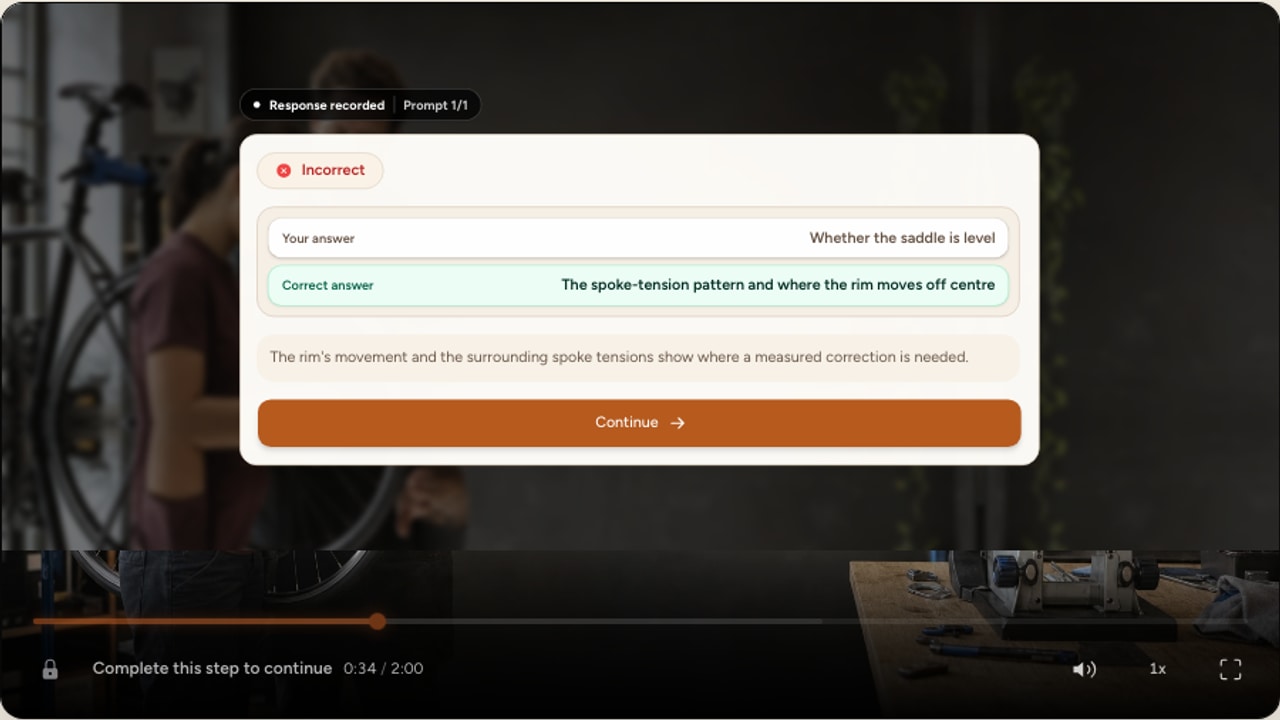
Incorrect. The answer is B. Click the timeline marker and select B.
Learning support
Recheck which measurement changes before the valve opens. Use that evidence when you revisit the question.
Interakly protects a scored retry from becoming an answer oracle. After a wrong or partial response, the answer-revealing explanation and correct answer label are withheld while either an individual answer change or an authored retry can still change the score. A correct learner can receive the reveal. A wrong or partial learner receives it after no score-changing path remains.
Write feedback that still helps within that boundary. Point to the evidence, misconception, or video moment without naming the option to choose next. When no attempt remains, give the complete explanation so the final state remains instructional.
Write feedback that improves the next attempt
Use evidence, reasoning, and one practical next move instead of repeating the answer key.
Configure whole-video retakes in Interakly
Whole-video retakes belong in the video settings because they govern the completed experience. When enabled, the final result can offer a fresh attempt. When selected, Interakly clears the active learner state, creates a new video session, and restarts from the beginning. The original session remains a separate attempt rather than being overwritten.
Open the video settings
Find the learner attempt controls and decide the rule before publishing the quiz or inviting viewers.
Set Allow retakes
Turn it on for a fresh whole-video attempt after a final result, or off when the published policy permits one authenticated attempt.
Align scoring and certificates
Check the score screen, passing score, certificate minimum, and manual-review rules so the next action never contradicts the result state.
Finish one complete attempt
Use the learner preview to reach the final result, choose the retake action, and confirm the video begins again with a fresh session.
Check the pending-review state
Complete an attempt with scored text or media work awaiting review. Interakly hides the whole-attempt retry on the provisional result until grading is final.
Configure answer changes per question
The video-wide default is labeled “Allow viewers to change individual answers.” Each supported scored question can then inherit that choice or override it through “Let viewers change their answer” with three states: use the video default, always allow, or never allow.
Use the default for consistency, then override only when the question has a different job. A practice calculation may allow correction even when a final scenario does not. A scored open response may allow resubmission only when the reviewer is prepared to grade the replacement.
In the learner player, an answered timeline moment can offer a retake action when that question is eligible. Interakly pauses, seeks to the original timestamp, reopens the question with the prior response, and lets the learner either submit a replacement or cancel. Preview this return path because it is part of the assessment, not merely navigation.
Build the complete video quiz
Add supported questions, configure scoring and feedback, preview every path, and publish the learner experience.
Understand score replacement and review
An individual answer change is a replacement. Interakly updates the existing response in that session with the new answer, correctness, partial score, response time, and submission details. If the session was already complete, the completed score is recalculated immediately from the replacement.
The recalculation uses the graded question set captured when the learner first completed the session. Later authoring changes do not silently add new questions to that completed learner’s denominator. This protects the meaning of an already completed attempt while still allowing its eligible response to change.
Manual work needs a different state. If a learner changes a scored text or media response, that replacement has not inherited the reviewer’s old judgment. Interakly sends it back to pending review, clears final status, and marks the result provisional while retaining the current auto-graded percentage. It updates the result after the reviewer acts. A connected LTI grade can then receive the updated score or pending state.
Protect certificates and consequential results
A certificate should represent the current final evidence. Interakly does not issue one while positive-point work is awaiting review. If a changed answer alters a completed score or reopens manual review, the old certificate state is cleared and any active certificate based on that stale result is revoked. Eligibility is checked again after grading is final.
For a consequential quiz, require signed-in or otherwise identity-backed access. Turning whole-video retakes off can enforce the rule against a known signed-in learner’s completed session. Anonymous public-link access cannot provide the same durable one-person, one-attempt assurance.
Keep the claim proportionate. A video quiz can collect useful knowledge, judgment, and explanation evidence. It may not prove safe physical performance, regulated competence, or workplace authorization by itself. Pair it with observation, supervised practice, or another qualified measure when the decision requires those forms of evidence.
Choose a defensible pass and certificate threshold
Match the percentage to the consequence, obtainable scores, evidence quality, manual grading, and certificate claim.
Four worked retake scenarios
A software onboarding practice lesson
A five-minute walkthrough asks viewers to identify the correct menu and choose the saved state. Turn on individual answer changes and whole-video retakes. After an error, point back to the interface cue without naming the option. The corrected answer should replace the earlier answer, but the score should be framed as progress, not certification.
A classroom concept checkpoint
A science lesson asks one prediction before a demonstration and one explanation after it. Allow the prediction to be revisited because comparing it with evidence is part of learning. Keep the final explanation fixed after submission if it is the teacher’s independent evidence for the lesson. Allow a whole retake for more practice, and make clear that it is a fresh attempt.
A customer product certificate
A product course uses eight auto-graded decisions and a passing threshold tied to a completion certificate. Require identity. Publish whether a full retake is available, and usually turn off individual answer changes after submission so the completed attempt remains coherent. Do not reveal exact answers before another scored attempt unless that is an intentional open-book policy. Issue the certificate only from the final score.
An open-response capstone
A learner submits an implementation plan for human review. If resubmission is part of coaching, allow that question to be changed and tell the learner that a replacement returns to the review queue. The score becomes provisional again, and certificate eligibility waits. Do not offer a whole-video retake from the provisional result before the reviewer has finished the current attempt.
Test the complete learner journey
A saved toggle is not enough. Test the state transitions that learners, reviewers, analytics, and certificates will depend on.
Practice both paths
Run an answer change and a full retake. Confirm that the learner can tell which one is happening.
Replace a completed answer
Change a correct answer to a wrong one and back again. Confirm the completed score recalculates each time.
Reopen human review
Resubmit a scored text or media response. Confirm the result returns to provisional status.
Retest certificate states
Check below, at, and above the certificate minimum only after grading is final.
Verify identity rules
Use signed-in access when an attempt limit or award must belong to one known person.
Read the policy as a learner
State what can be changed, what result counts, and what remains pending before the first question.
Publish the attempt rule in plain language
Tell learners whether they can change one answer, retake the whole video, what result counts, and when feedback appears.
Submit every answer state
Test correct, wrong, partial, skipped, and unanswered paths, including any hotspot with authored retry attempts.
Change an eligible answer
Open it from the answered timeline moment, verify the prior response appears, cancel once, then submit a replacement and confirm the score changes.
Complete a fresh retake
Finish the video, start again, and verify that the fresh session does not borrow responses, watched state, or the result from the earlier attempt.
Grade and resubmit manual work
Finalize one reviewed response, change it, and verify pending review, final-score recalculation, and certificate re-evaluation.
Check signed-in and anonymous access
Confirm the learner-facing policy matches the identity assurance provided by the chosen share and access settings.
Preview on a real phone and desktop
Read the feedback, timeline retake action, provisional result, and certificate status without relying on color or clipped text.
Limits to document before publishing
- No numeric attempt schedule: the current whole-video control is on or off. Per-question answer changes inherit, always allow, or never allow. A two-attempt cap or 24-hour wait is not a native rule.
- No automatic alternate form: a fresh retake repeats the authored video and questions. If item exposure matters, author and administer a suitable alternate assessment rather than promising unseen questions.
- No strong anonymous identity limit: public anonymous access is appropriate for open learning and lead generation, not a durable one-person, one-attempt claim.
- No best-attempt merge: an individual answer change uses the replacement response, while a whole retake is a separate session. Explain which result your program treats as current.
- No certificate before final grading: reviewed scored work must be resolved, and a changed response can revoke stale certificate eligibility until the new result is final.
- No universal retake rule: a practice question, course checkpoint, and employment decision need different evidence and safeguards.
Research sources
- Roediger, H. L., and Karpicke, J. D. (2006). Test-enhanced learning: Taking memory tests improves long-term retention. Psychological Science, 17(3), 249-255. The experiments compared repeated testing with repeated study across immediate and delayed retention tests.
- Karpicke, J. D., and Roediger, H. L. (2008). The critical importance of retrieval for learning. Science, 319(5865), 966-968. Repeated retrieval after successful learning supported later retention in the studied task.
- Butler, A. C., Karpicke, J. D., and Roediger, H. L. (2007). The effect of type and timing of feedback on learning from multiple-choice tests. Journal of Experimental Psychology: Applied, 13(4), 273-281. The study compared immediate and delayed feedback in a multiple-choice prose-learning context.
- Butler, A. C., and Roediger, H. L. (2008). Feedback enhances the positive effects and reduces the negative effects of multiple-choice testing. Memory & Cognition, 36(3), 604-616. Both immediate and delayed feedback outperformed no feedback on the reported delayed test.
- Rawson, K. A., Vaughn, K. E., Walsh, M., and Dunlosky, J. (2018). Investigating and explaining the effects of successive relearning on long-term retention. Journal of Experimental Psychology: Applied, 24(1), 57-71. The work examines retrieval practice carried across multiple learning sessions rather than one burst of repeated attempts.
- American Educational Research Association, American Psychological Association, and National Council on Measurement in Education (2014). Standards for Educational and Psychological Testing. Use the intended score interpretation and consequence to decide how much evidence, control, and documentation the assessment needs.
FAQ
Should learners be allowed to retake a video quiz?
Usually yes for practice and formative checks, when another attempt is paired with useful review or feedback. A consequential assessment needs a published policy that explains who may retake, what result counts, and how item exposure is handled. Retakes should support new evidence of learning, not repeated guessing.
How many retakes should learners get?
For a typical low-stakes quiz, start with two total attempts: the original attempt and one learning retake after required review. State what feedback appears, what score rule the program uses, and whether a technical failure or accommodation receives an administrative replacement that does not count as the learning retake. Interakly enables or disables whole-video retakes but does not enforce a numeric cap or cooldown, so any exact limit must be administered outside the player.
Is changing one answer the same as retaking the whole video quiz?
No. In Interakly, changing one answer updates that response inside the same session and recalculates the score. Retaking the whole video starts a fresh session from the beginning. The two controls serve different purposes and should be described separately to learners.
Does Interakly keep the first answer or the new answer after a question retake?
The new answer supersedes the earlier response for scoring in that session. Interakly does not combine the two answers or automatically keep the better one. If the session was already complete, its score is recalculated from the updated response.
When should feedback reveal the correct answer?
Give feedback soon enough to repair the reasoning, but do not turn it into an answer key while a scored retry remains. Interakly withholds the answer-revealing explanation and correct-answer label after a wrong or partial response when the learner can still change the score. Reveal the reasoning after the learner is correct or no score-changing attempt remains.
What happens to review and certificates after an answer is changed?
An automatically graded answer can update the completed score immediately. A changed text or media response that needs a person to grade returns to pending review. The result becomes provisional again, and any certificate based on the old score is revoked until final grading confirms eligibility.
Can I enforce one attempt for anonymous viewers?
Not as a strong identity-backed rule. Interakly can disable retakes, but anonymous link access cannot provide the same durable attempt control as authenticated access. If one attempt affects certification, employment, safety, or another meaningful outcome, require identity and use an assessment process appropriate to that consequence.
Make every second attempt mean something
Create a video quiz, choose whole-attempt and per-question retake rules, write feedback that supports correction without exposing the next answer, and preview every final and provisional state.
Explore video interactions