Retrieval Practice with Video: A Practical Guide
Use retrieval practice with video carefully: choose recall targets, place prompts, write feedback, revisit ideas over time, and interpret response evidence honestly.
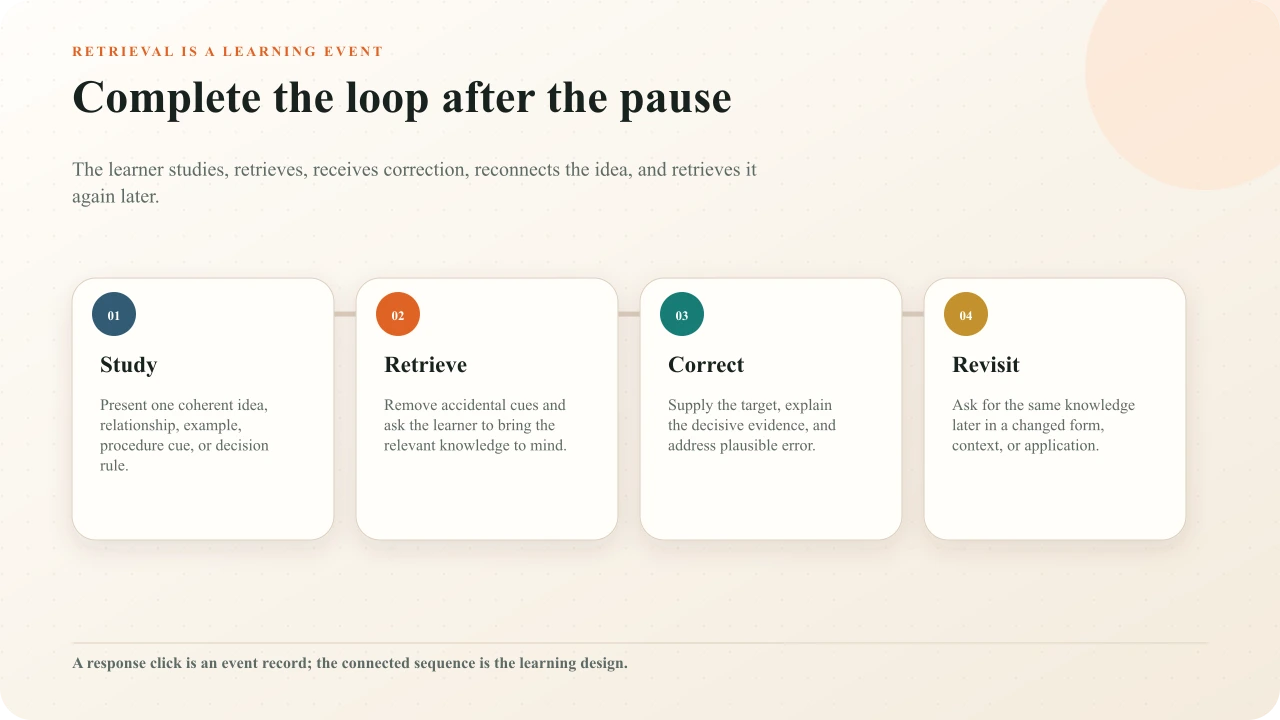
Retrieval practice asks a learner to bring information to mind instead of only seeing it again. In a video lesson, that might mean recalling a step before a demonstration continues, explaining a cause after an example, identifying a previously named structure, or applying a rule to a new case. The response becomes part of learning when it is followed by useful feedback, comparison, replay, discussion, or later retrieval.
Research reviews and meta-analyses generally report benefits of practice testing over restudy across many conditions, but “add quizzes to video” is not a scientific guarantee. Outcomes depend on what is retrieved, how success and error are handled, when the idea returns, what the final task demands, and what comparison is being made. This guide turns that cautious evidence into a practical design sequence without treating response clicks as proof of durable learning.
Define retrieval practice precisely
A prompt is not automatically retrieval practice. “How confident are you?” is reflection. “Which example did you prefer?” is a poll. Clicking a visible label may be recognition or inspection. Retrieval requires the learner to recover relevant prior information and use it in the response. Name that information in the lesson plan: a term, relationship, sequence, rule, explanation, comparison, procedure cue, or decision criterion.
The Institute of Education Sciences practice guide on organizing instruction and studyrecommends using quizzing to promote learning, re-exposing learners to key content, and asking deep explanatory questions. A review by Roediger and Butler describes retrieval as a learning event and notes that feedback can enhance its benefits. Those sources support a design direction, not a promise that any interface question will work.
Retrieval practice is also distinct from asking about target material before it has been taught. The pretesting-with-video guide explains how a low-stakes initial attempt can prepare attention, why the following instruction must correct it, and why effects on unpretested material require separate evidence.
Choose knowledge worth retrieving
Prioritize knowledge that supports later reasoning or performance: a governing principle, a discriminating cue, a step whose omission matters, a vocabulary relationship, or a decision rule. Avoid spending the learner's effort on incidental names, decorative details, or facts already visible in the question unless recognition itself is the objective.
Define the eventual use. If learners must explain a mechanism, retrieve causes and relationships, not only terms. If they must diagnose a configuration, retrieve the criteria and then apply them to a changed example. If they must perform a procedure, video retrieval can rehearse sequence and cues but cannot replace supervised performance evidence. The broader interactive-video lesson-design guidehelps connect the video activity to preparation, practice, and transfer outside the player.
Distinguish recall recognition and reflection
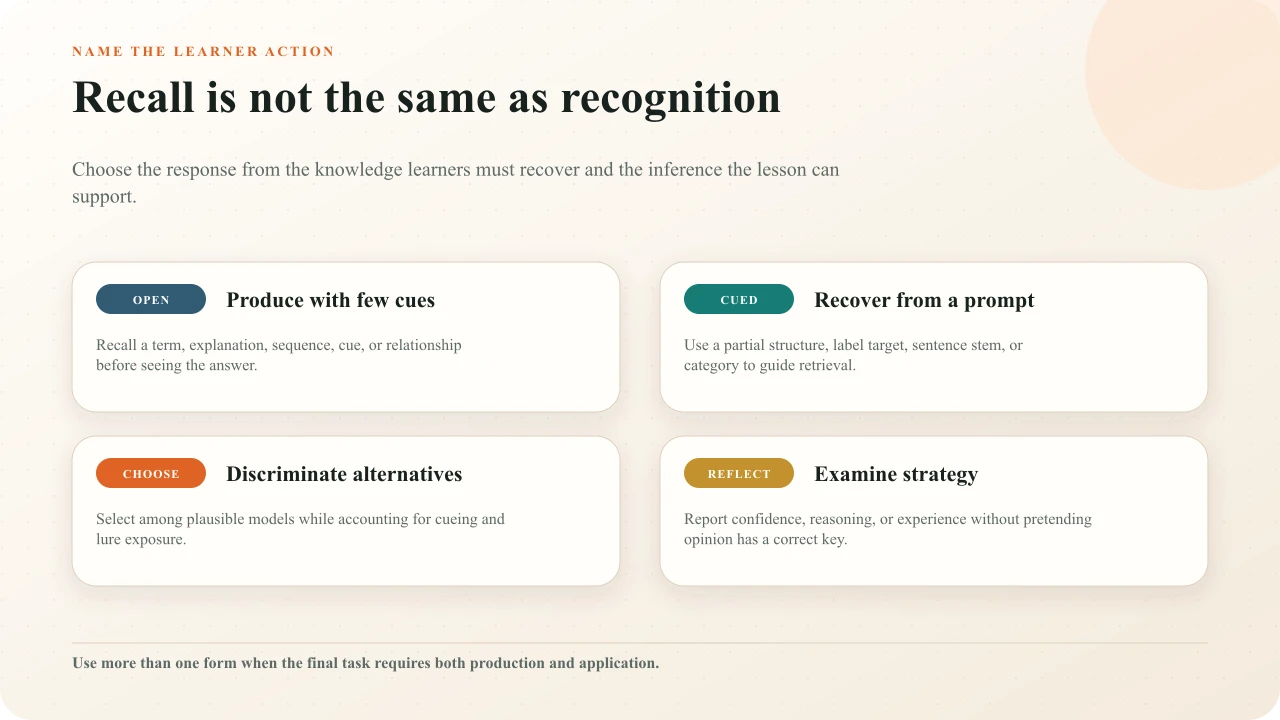
Open recall asks learners to produce an answer with few cues. Cued recall provides a stem or partial structure. Multiple choice requires discrimination among visible alternatives and may cue knowledge that the learner could not independently produce. Reflection asks learners to examine confidence, strategy, or experience. Each can serve a lesson, but they do not support the same inference.
Recognition only
The procedure name and all three correct steps remain visible while the learner selects the same wording from a list.
Retrieval then discrimination
The learner first recalls the next check, then chooses between plausible applications and receives feedback tied to the governing cue.
Multiple-choice practice can help, but distractors also expose learners to errors. Roediger and Marsh found that multiple-choice tests can improve later performance while also creating risks from selecting or remembering lures. Use defensible alternatives, require commitment, and provide corrective feedback rather than treating a plausible wrong answer as harmless decoration.
Place the first retrieval after a coherent idea
Let the source complete the information unit before asking learners to retrieve it. Pause after a mechanism, worked step, comparison, or short sequence—not midway through the sentence that establishes the answer. For prediction, pause before the outcome but after all decision conditions are visible. For explanation, let the example finish and then remove unnecessary cues.
Immediate retrieval can strengthen encoding and expose misunderstanding while feedback is still close. It provides weaker evidence of delayed retention because the material is fresh. Label the purpose accurately. The question-placement guideoffers a detailed method for conceptual boundaries, answer leakage, interruption cost, and resume timing.
Make the learner generate an answer
Give enough quiet time to retrieve before revealing choices or feedback. A short-answer field, mental response followed by reveal, label task, ordering task, or explanation prompt can all create generation. If open text will only be recorded, say so; do not imply automated evaluation. If a facilitator will review responses, explain when and how.
Keep prompts specific: “Without replaying, list the two observations that distinguish condition A from condition B” is more useful than “What do you remember?” Tell learners whether spelling, order, terminology, rationale, or examples matter. For sensitive or high-stakes content, avoid collecting personal detail that the learning purpose does not require.
Use feedback to correct and reconnect
Feedback should supply the target knowledge, explain the decisive cue, and reconnect it to the video. For a correct answer, confirm why it works. For a plausible error, identify the distinction the learner missed and direct attention to the relevant frame or explanation. Then resume with a line that uses the recovered idea.
Retrieval failure is not a reason to withhold the answer indefinitely. Karpicke and Roediger's work on repeated retrieval with feedbackfound benefits of repeated testing and opportunities to restudy in their text-learning experiments. Translate the principle carefully: let learners attempt, then make accurate correction available, then ask them to retrieve again later. Do not copy one experimental schedule as a universal course rule.
The video-feedback guide provides templates for correct, partially correct, misconception, retry, and open-response states. Feedback quality matters more than a celebratory animation that says only “Correct.”
Repeat retrieval without cloning questions
Revisit the same knowledge in a changed form. Ask for the term, then the relationship, then an application. Change surface details while preserving the governing principle. A learner who memorizes the option position has practiced the interface, not the concept.
Karpicke and Blunt reported retrieval-practice advantages over elaborative concept mapping in their science-text experiments. That does not make retrieval and explanation competitors in every lesson. A useful sequence can retrieve core ideas and then ask learners to organize, explain, map, or apply them. Design for the final use rather than choosing one branded technique for every objective.
Space practice beyond one viewing
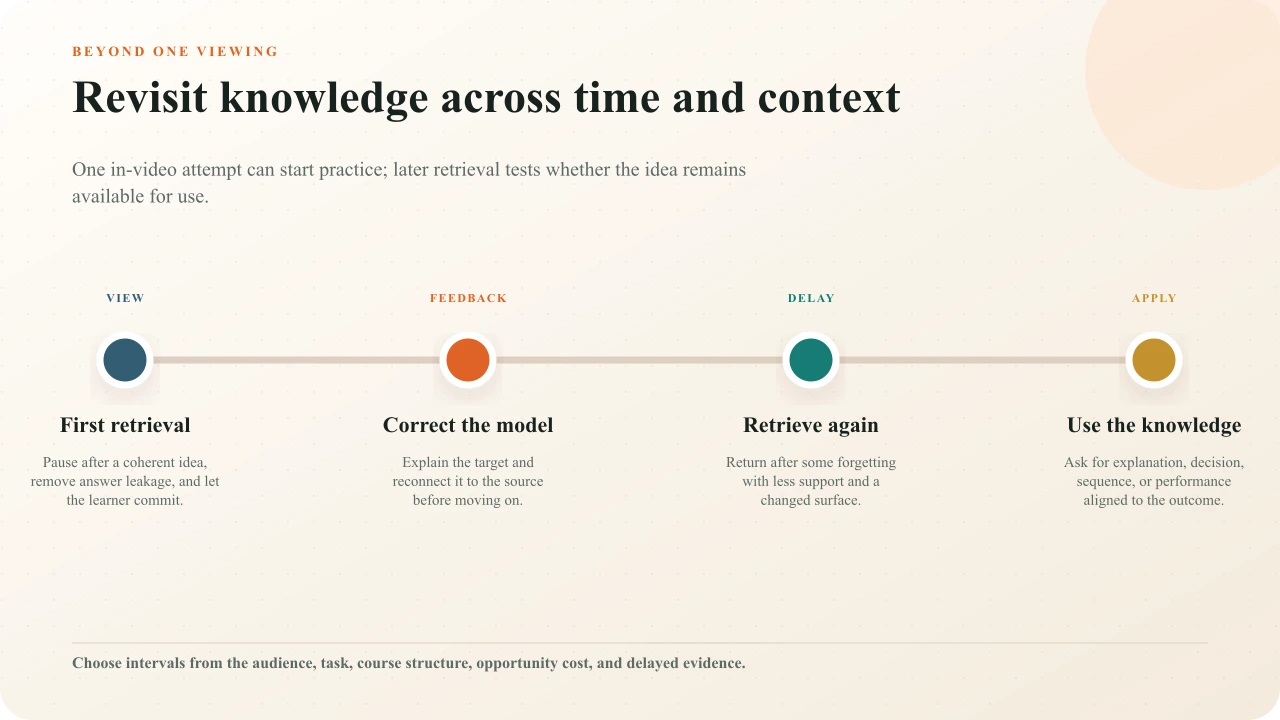
One video session can contain repeated retrieval, but durable learning often requires later opportunities after some forgetting. Revisit the idea in a following lesson, practice set, discussion, assignment, or job aid. Keep the stable concept while changing context and cues. Record when the learner last encountered it so the course can plan a sequence instead of relying on one dense cluster of questions.
Rowland's meta-analytic review of testing versus restudyfound an overall testing effect while examining moderators and boundary conditions. Adesope, Trevisan, and Sundararajan's meta-analysis of practice testinglikewise emphasizes conditions under which practice tests enhance or inhibit learning. Use these syntheses to justify testing a retrieval sequence, not to select one fixed spacing interval for every audience and domain.
Use video evidence without hiding it
Decide whether the task is memory or visual interpretation. If learners must recall a rule, avoid leaving the rule visible behind the card. If they must apply the rule to a gauge, gesture, diagram, or process state, preserve the relevant frame. Do not blur or cover evidence simply to make the interaction feel more difficult.
Uploaded video supports spatial activities when the precise place in the frame is part of the evidence. Supported YouTube experiences use compatible non-spatial interactions. Source type does not determine the learning strategy: both can support retrieval questions, but precise frame hotspots and click regions require uploaded video in Interakly. Use spatial response only when location is part of the retrieval target.
Keep stakes and difficulty productive
Retrieval should be challenging enough to require recall but possible enough that learners can engage and use feedback. Preteach unfamiliar terms, allow an initial worked example, and adjust cues deliberately. Low-stakes practice can make error informative. If the response affects a grade, credential, employment decision, or access, a short in-video activity needs stronger assessment, security, accommodation, privacy, and governance review.
Do not infer that harder always means better. A 2023 study reported conditions whereretrieval practice impaired transitive inferencein its experiments. Different tasks can reward different learning activities. Use delayed and transfer-aligned measures to test whether your particular sequence supports the intended outcome.
Interpret response data cautiously
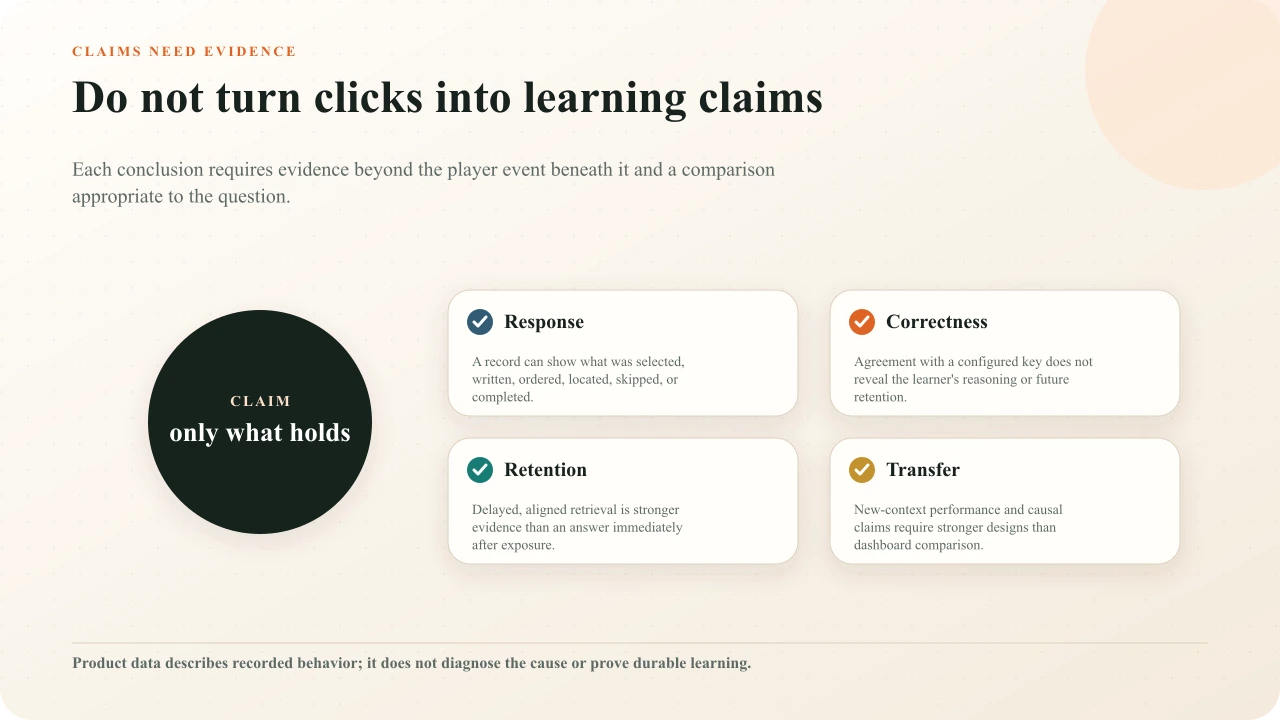
A response record can show that a learner selected, wrote, ordered, located, skipped, or completed something under the configured conditions. Correctness can show agreement with the configured key. It does not diagnose why the learner answered, prove durable retention, establish transfer, or show that the video caused a later outcome.
Compare immediate and delayed performance, first attempts and retries, and item evidence with the limits stated. Review distractors and prompts that teach errors. Use qualitative feedback when possible. The video-question analytics guideexplains denominators, attempts, missingness, interpretation, and decisions without turning a dashboard into a causal claim.
Build a retrieval sequence in Interakly
Name the target
Write the exact knowledge, relationship, procedure cue, or rule learners should retrieve and the later task it supports.
Choose the response
Select open recall, cued recall, discrimination, ordering, labeling, or explanation according to the evidence—not novelty.
Place the first attempt
Trigger after a coherent idea or before an outcome, remove answer leakage, and preserve visual evidence required for application.
Write corrective feedback
Supply the target, explain the decisive cue, address plausible error, and reconnect the response to the next segment.
Plan later retrieval
Revisit the same knowledge in a changed form and context beyond the first viewing rather than cloning the question.
Test and interpret
Complete the learner route on phone and desktop, inspect delayed performance where possible, and report only claims supported by the data.
Interakly can place supported questions and activities at configured moments, collect responses, show configured feedback or results, and expose current session and response evidence. It does not establish that a question caused learning, validate an assessment, interpret an open response unless a real review process does so, or replace subject, accessibility, privacy, and research review.
Audit the complete learning loop
Give the lesson to someone who did not author it. Ask what they were supposed to retrieve, what cues remained, how feedback changed their understanding, and when the idea returned. Test keyboard, touch, focus, captions, replay, retry, mobile composition, and the real published link or embed. Record whether the later task actually resembles the learning claim.
Revise questions that are trivial, ambiguous, cue-dependent, misleading, or disconnected from the continuation. Remove retrieval moments whose responses have no instructional use. A smaller sequence with clear targets, honest feedback, and later reuse is more defensible than frequent interruptions justified only by a generic “active learning” label.
Use retrieval evidence for a responsible next decision
Connect low-stakes responses to feedback, reteaching, discussion, and revision without confusing practice with a final judgment.
Sources and further reading
- IES What Works Clearinghouse: Organizing Instruction and Study
- Roediger and Butler: The Critical Role of Retrieval Practice in Long-Term Retention
- Rowland: Meta-Analytic Review of Testing Versus Restudy
- Adesope, Trevisan, and Sundararajan: Meta-Analysis of Practice Testing
- Karpicke and Blunt: Retrieval Practice and Elaborative Studying
- Karpicke and Roediger: Repeated Retrieval During Learning
- Roediger and Marsh: Multiple-Choice Testing and Later Performance
- Tran et al.: Retrieval Practice and Transitive Inference Boundary Conditions
FAQ
What is retrieval practice with video?
It is an opportunity for learners to bring previously presented knowledge to mind while or after using video, followed by an appropriate continuation such as feedback, comparison, replay, or later practice. It is a learning event, not merely a scored checkpoint.
Should retrieval questions appear during or after a video?
Either can be useful. During-video prompts can follow coherent ideas and support feedback while context is available. Delayed prompts can require more independent retrieval and provide evidence about retention. A sequence often uses both for different purposes.
Is multiple choice retrieval practice?
It can require retrieval and discrimination, but visible options also provide cues and expose incorrect alternatives. Use plausible choices, require a commitment before feedback, explain the decisive evidence, and include uncued retrieval when the outcome requires independent production.
Should retrieval practice be graded?
Often it can be low stakes or ungraded so learners attempt difficult recall and use feedback. If results affect a grade, certification, or access decision, apply stronger validity, reliability, security, accommodation, privacy, and institutional review.
How often should retrieval practice be repeated?
There is no universal interval. Revisit important knowledge after some forgetting can occur and in more than one context, then adjust using the audience, task, difficulty, feedback quality, opportunity cost, and delayed performance—not a fixed timer alone.
Does retrieval practice always improve learning?
No method guarantees improvement in every task or condition. Reviews and meta-analyses generally report retention benefits relative to restudy under many conditions, but effects vary, badly designed questions can teach errors, and some studies identify boundary conditions or different effects for inference tasks.
Turn one pause into a complete retrieval loop
Name the knowledge, remove accidental cues, let the learner commit, provide corrective feedback, and schedule a changed retrieval opportunity after the first viewing.
Explore higher education