How to Track Responses to an Interactive YouTube Video
Learn how to read sessions, completion, scores, and question responses for an interactive YouTube video without confusing product analytics with learning proof.
Adding questions to a YouTube video creates a new evidence layer. YouTube still hosts the source media, while Interakly presents compatible timestamped interactions and records the sessions and responses produced through that interactive experience. The useful question is not simply “What is the correct rate?” It is “Which records were created, under which configuration, for which prompt, and what decision can they reasonably inform?”
This guide explains how to review current response evidence without inflating it into proof of attention, motivation, learning, transfer, or business impact. It assumes you have already created a supported, embeddable experience using the interactive YouTube workflow.
Define the question before opening analytics
Start with a decision. Are you checking whether assigned viewers reached the ending, whether one question is behaving differently from the others, whether a revision removed ambiguity, or whether a facilitator should revisit a topic? Each question needs a different denominator, window, comparison, and follow-up. Opening a dashboard without a decision invites the most visually prominent number to become the story.
Write the scope before interpreting: project and version, delivery route, audience, identity coverage, date window, completion rule, question configuration, and known incidents. If the YouTube source, captions, timestamp, answer key, access settings, or learner assignment changed, note the change. The US Department of Education's questionnaire development guideemphasizes clear purpose, precise wording, and interpretable response options; those same principles matter when deciding whether an item's results can answer your review question.
Understand what Interakly records
Current Interakly analytics can describe recorded sessions, completion according to the project's configured rule, scores for graded interactions, identity context where available, per-question response totals, correct rates for graded questions, answer distributions, and a most-common-wrong pattern where the data supports it. Watch-activity surfaces use recorded progress samples. These are descriptive product records, not observations of every cognitive event that occurred while the source played.
A person can open the experience without reaching a prompt. A session can complete according to a configured trigger without demonstrating every intended outcome. A recorded choice can match the answer key without revealing whether the learner reasoned, guessed, retried, or knew the answer beforehand. Product evidence becomes useful when its operational definition stays attached to it.
Separate sessions, completion, scores, and responses
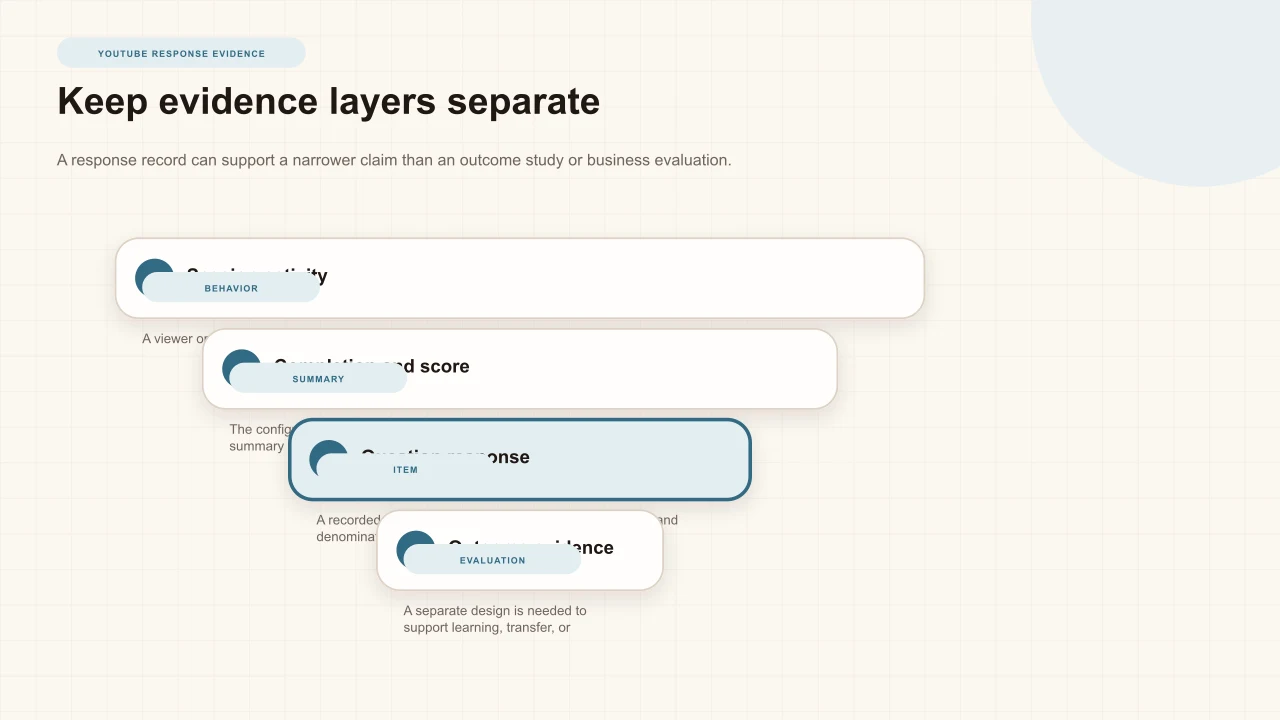
Sessions describe access to and activity within the interactive experience. Completion describes whether a session met the configured completion condition. Score summarizes configured graded responses. A question distribution uses the recorded responses for that specific prompt. These measures can relate to one another, but none is a substitute for another.
For example, 100 sessions, 70 completions, and 55 responses to a question do not imply that 45 people refused to answer. Some sessions may not have reached it, some may have followed another path, some may fall outside the response configuration, and some may have encountered a delivery problem. Investigate the route and definitions before assigning intent. The completion-rate guide explains how to keep completion as one behavioral signal rather than proof of learning.
Read one question as a complete evidence card
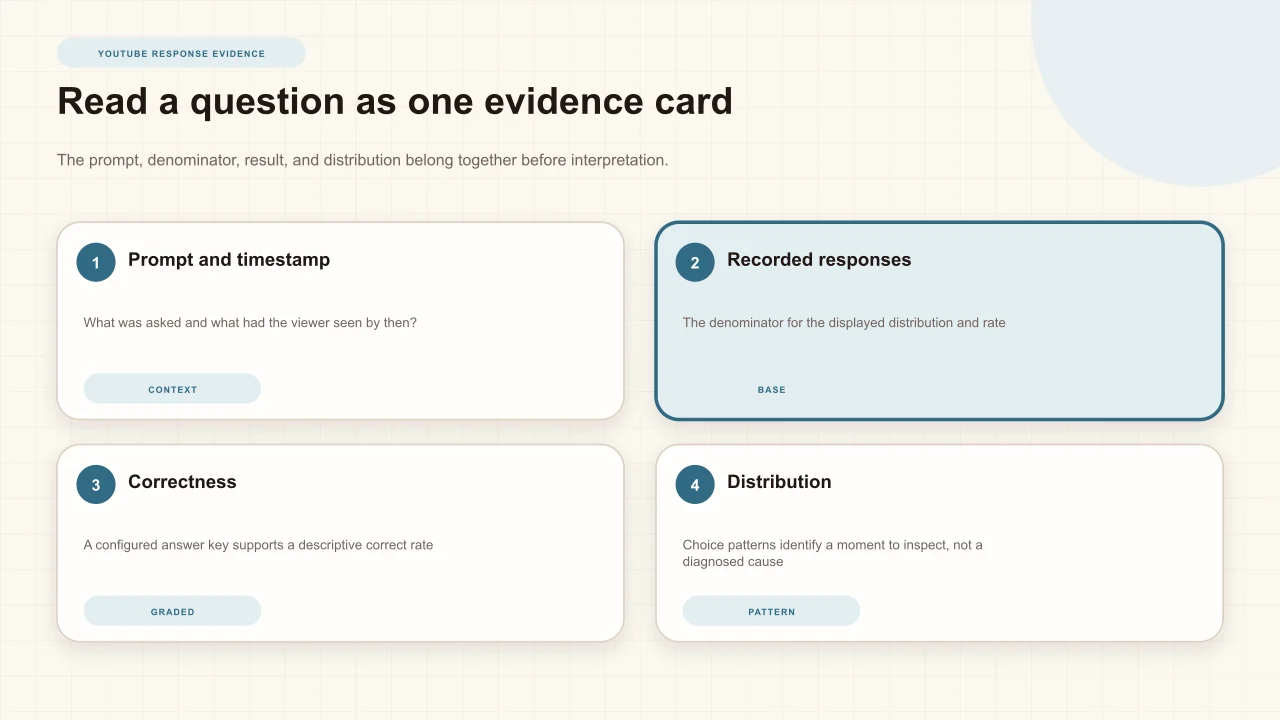
Keep the prompt, timestamp, response type, recorded-response count, answer configuration, correctness rate, and distribution together. Read the question exactly as the learner saw it. Then inspect what the source video had shown by that timestamp, whether captions conveyed the key term, and whether the overlay preserved the visual evidence required to answer.
Correctness exists only for an interaction with a defensible configured answer. A poll about preference or a rating of confidence should be summarized as audience input, not scored as knowledge. A free response may require qualitative review rather than a simple correct rate. Use the response format's real evidence affordance instead of forcing every interaction into the same success metric.
Read per-question analytics without overclaiming
Use response totals, correct rates, distributions, and common-wrong patterns as descriptive evidence tied to the current item.
Name the denominator
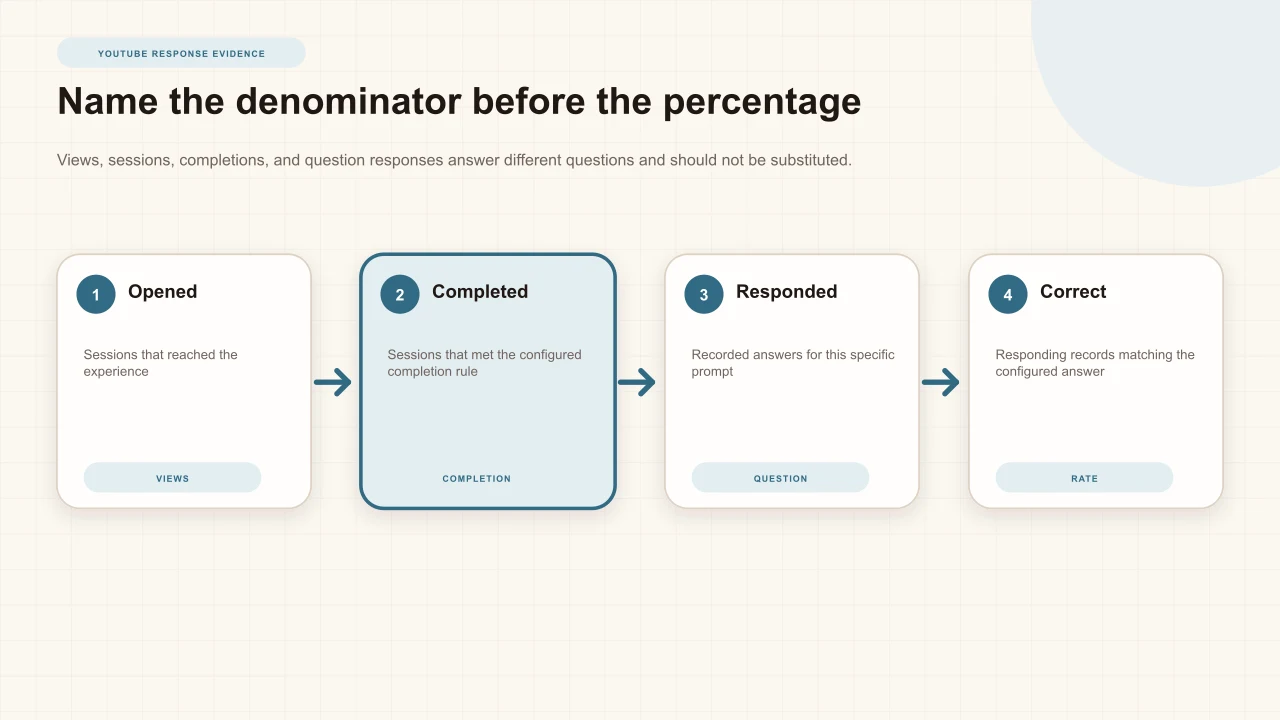
The denominator determines the meaning of a rate. Completion may use sessions that opened the experience. A question distribution uses records that answered that prompt. The correct rate uses recorded responses evaluated against the configured key. A percentage of all assigned learners requires a separate, reliable assignment roster and matching identity coverage; it cannot be reconstructed by relabeling anonymous session data.
Show counts beside rates. “30 of 48 recorded responses matched the configured answer (63%)” is more informative than “63% passed.” Name exclusions or technical-unavailable records when the interface reports them. A small denominator produces a fragile pattern, and a large denominator does not correct a badly written question. The Standards for Educational and Psychological Testingprovide a wider professional framework for validity, reliability, fairness, and appropriate score interpretation; product analytics alone do not establish those properties.
Interpret answer distributions cautiously
A distribution shows which recorded choices were selected. A dominant wrong option can indicate a plausible misconception, but it can also reflect an attractive wording clue, overlapping options, an incorrect key, missing source evidence, caption ambiguity, an early timestamp, or a mobile layout problem. Treat the pattern as a locator for inspection, not a diagnosis.
An option nobody chooses may be implausible and contribute little evidence. Nearly universal correctness may reflect mastery, prior knowledge, a transparent answer, or a low-demand item. Nearly universal error may reflect instruction, question construction, source mismatch, or access friction. Read nearby qualitative feedback, support reports, and the actual learner path before deciding which hypothesis deserves a revision.
Overclaim
Most viewers chose B, so they misunderstand the policy and need remedial training.
Bounded interpretation
B was the most common recorded wrong choice. Inspect its wording, the explanation before 1:14, captions, answer key, and delivery context before deciding why.
Handle anonymous and identified evidence
Identity depends on the current access route and learner state. Some experiences can be open and anonymous; others may require sign-in, invitation, an allowlist, or another configured gate. Report named and anonymous coverage honestly. Do not infer that two anonymous sessions are the same person, and do not join product records to other systems without an authorized, documented purpose and appropriate governance.
Collect the least identity needed for the learning purpose. If aggregate question patterns are sufficient, named tracking may add risk without decision value. If individual completion is required, define the roster, matching rule, access support, retention, and correction process. The interactive-learning data privacy guideseparates product configuration from the organization's obligations and decisions.
Account for content and configuration changes
A result belongs to the version that produced it. Editing a stem, answer, option, timestamp, feedback, retry rule, required state, source video, captions, access route, or branch changes the conditions. Record the change time and preserve a version note. Where old and new responses appear in one view, report separate windows or clearly explain that the combined rate spans different configurations.
Audience and delivery changes also matter. A voluntary public link and an assigned course may attract different viewers. A facilitator-led cohort and a self-directed cohort receive different context. A mobile-heavy distribution may expose interaction problems absent on desktop. Avoid claiming improvement solely because a later window has a better rate when the audience, source, assignment, or item also changed.
Inspect the YouTube learner path
Open the published Interakly route and complete it as a learner. Confirm the supported public or unlisted YouTube source is embeddable, loads in the target environment, and provides the visual and spoken evidence the prompt requires. Check pause timing, overlays, captions, controls, response submission, feedback, scoring, resumption, completion, and review. Repeat at the maintained phone-player size and with keyboard operation.
YouTube can change availability, embedding, captions, region access, or the source itself outside the Interakly project. Interakly adds an interactive layer; it does not copy or control the source media. The YouTube embedding guidanceexplains the platform's iframe player, while the YouTube API Services Termsdefine applicable API-service conditions. Audit both the interactive layer and the external source dependency.
Turn a pattern into a revision hypothesis
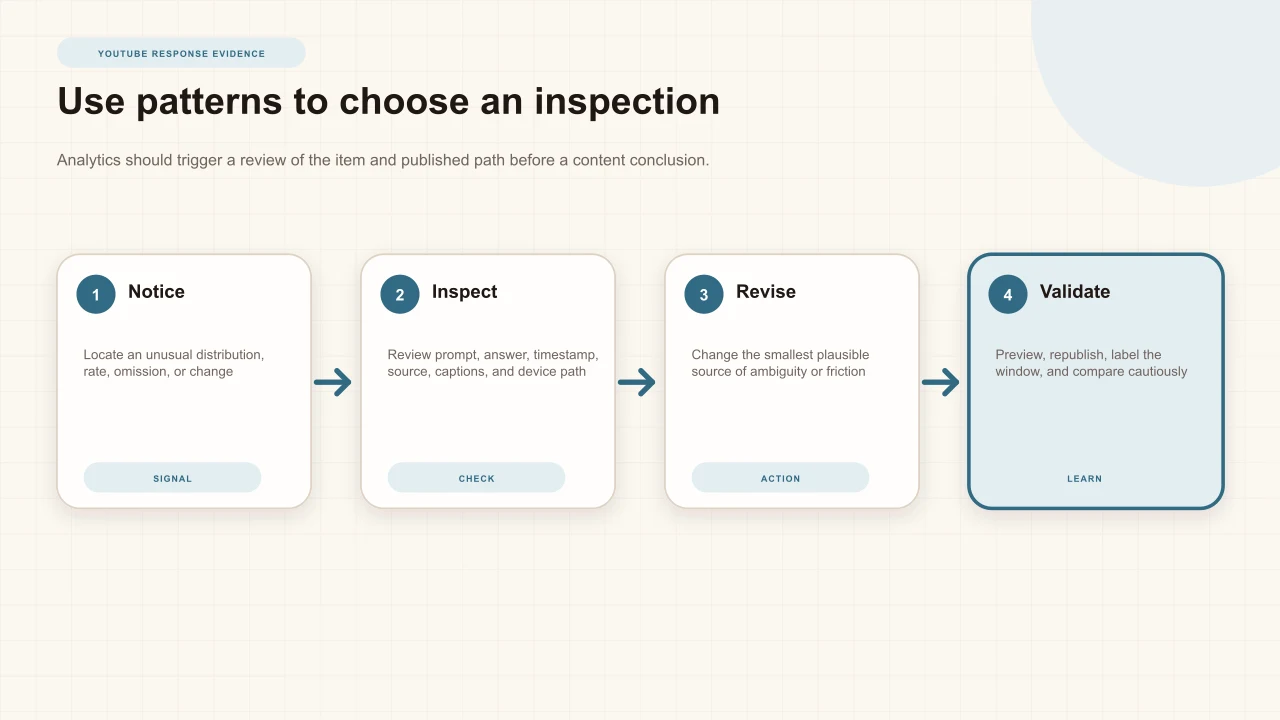
Convert a signal into a testable inspection statement. Instead of “learners do not understand verification,” write “the high selection of option B may arise because the source introduces the exception after the current timestamp.” Instead of “the video loses attention,” write “the completion change may be associated with the new access route, interaction length, source pacing, or audience.” List competing explanations before editing.
Inspect the cheapest plausible causes first: incorrect key, ambiguous option, obscured evidence, early timing, caption error, broken submit state, unsupported embed, or unclear feedback. If the item is sound, review the surrounding explanation and assignment context. Change one bounded mechanism where practical so the next window can be interpreted. Do not rewrite the entire lesson because one descriptive pattern looked uncomfortable.
Validate after a change
Preview the exact changed question, then publish and test the real learner route. Submit correct, incorrect, and edge-case responses; confirm the expected feedback, score, branch, completion, and analytics record. Recheck phone layout, keyboard flow, captions, and the source moment. Verify that the intended version is live at every material link or embed.
Open a new analysis window from the change date and preserve the old result as historical context. Compare counts and delivery conditions, not only rates. A later pattern can show that recorded behavior changed under the new configuration, but it does not by itself establish why or prove an improvement in durable learning. For broader interpretation, use an interactive-video pilot with a predeclared decision and complementary evidence.
Report the evidence boundary
A useful report names the project and version, source type, delivery route, date window, session count, completion definition, question wording, response denominator, result, identity coverage, technical exclusions, known changes, plausible interpretations, and next action. Put the limitations beside the number, not in a footnote nobody reads.
Current Interakly evidence can support statements such as “30 of 48 recorded responses matched the configured answer.” It cannot support “63% of employees learned the policy” without a valid roster, measurement model, and evaluation design. It cannot infer attention from playback, motivation from completion, or misconception from a selected option. The IES Program Evaluation Toolkitand the CDC's Program Evaluation Frameworkprovide broader structures for aligning evidence to evaluation questions and intended uses.
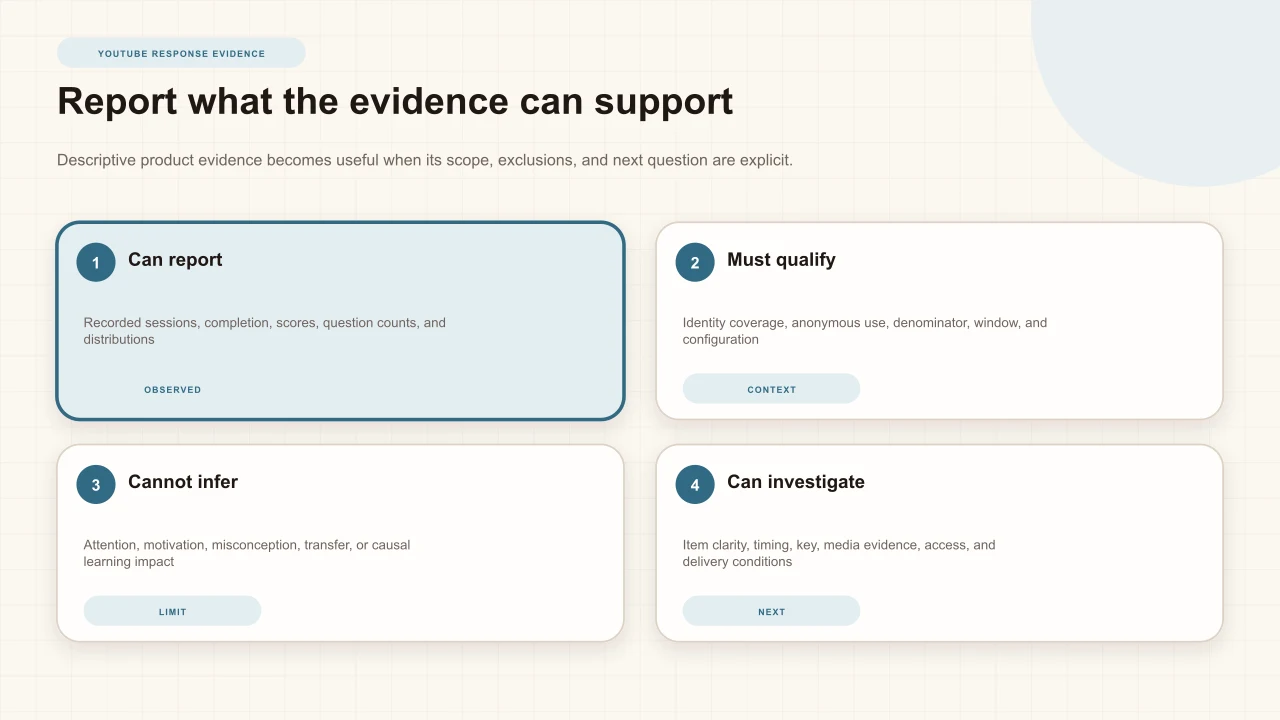
Interakly product boundaries
For a supported YouTube project, Interakly can place compatible non-spatial interactions over the embedded source and record the interactive session and response evidence it serves. The current analytics surfaces can include views or sessions, completion, score, identity categories where available, per-question response counts, correct rates for graded items, and distributions. Exact evidence depends on the interaction, access, publication, and session configuration.
Interakly does not own YouTube's source analytics, guarantee source availability, reconstruct every assigned learner, observe off-platform viewing, diagnose cognition, or prove causal learning impact. YouTube and uploaded video are not interchangeable: spatial interactions and source-controlled workflows require uploaded media. Use the current product interface and project configuration as the authority for what is actually recorded.
A practical response-review workflow
Name the decision
Define the project, version, audience, route, window, and question the evidence should inform.
Confirm definitions
Read the completion rule, grading configuration, identity coverage, and response denominator before the result.
Inspect one item
Review the exact prompt, timestamp, source evidence, answer key, distribution, captions, and learner layout.
List competing explanations
Separate item construction, delivery friction, source explanation, audience, and genuine knowledge hypotheses.
Make a bounded change
Revise the smallest defensible mechanism and record its release time and rationale.
Validate and reopen the window
Test the published path, then interpret new records under the new configuration without erasing history.
Interpret watch-activity patterns separately
Use progress samples to locate moments for inspection without calling them unique viewers or proof of attention.
Sources and further reading
- IES: An Educator's Guide to Questionnaire Development
- Standards for Educational and Psychological Testing
- IES: Program Evaluation Toolkit
- CDC: Program Evaluation Framework
- YouTube Help: Embed videos and playlists
- YouTube API Services Terms of Service
- YouTube Help: View video transcripts
- YouTube Help: Use automatic captioning
FAQ
Can I see who answered an interactive YouTube question?
That depends on the project access and identity configuration. Some sessions may be associated with signed-in or invited viewers while others may be anonymous. Report the identity coverage and do not treat an anonymous session as a named learner.
Does a high correct rate prove the YouTube video taught the topic?
No. A correct rate describes recorded responses to a configured question. Prior knowledge, answer clues, retries, selection effects, delivery context, and item quality can influence it. Learning or causal impact requires a separate evaluation design.
Why do question response counts differ from total views?
A view or session can start without reaching a question, a viewer may leave, skip where allowed, encounter another path, experience a technical failure, or use a configuration that does not produce the same response record. Use the question’s recorded-response denominator for its distribution.
What does the most common wrong answer mean?
It identifies a recorded choice pattern worth inspecting. It does not diagnose a misconception by itself. Review the option, source explanation, timestamp, captions, answer key, device path, and learner context before deciding what the pattern means.
Can I compare response rates before and after editing a question?
Only with clear version and time-window labels and appropriate caution. A changed stem, answer, timestamp, source video, access route, audience, or retry rule changes the measurement conditions. Preserve the change date and avoid presenting the values as directly equivalent when conditions differ.
Are YouTube Studio analytics the same as Interakly analytics?
No. YouTube owns and measures the source video within its platform. Interakly records the interactive experience and responses it serves, subject to the current project configuration. Treat them as separate evidence systems with different definitions and coverage.
Turn response patterns into responsible revisions
Start with one question, keep its denominator and configuration visible, inspect the learner path, and make the smallest change the evidence can justify.
Start with a YouTube link