Branching vs Linear Learning: When Should Learners Choose?
Compare branching and linear learning by objective, learner readiness, consequence value, coverage needs, production effort, and evidence.
The useful question is not whether branching is more modern than linear learning. It is whether a learner's choice should change what happens next. If the next step stays the same, a branch may add production work without adding learning value.
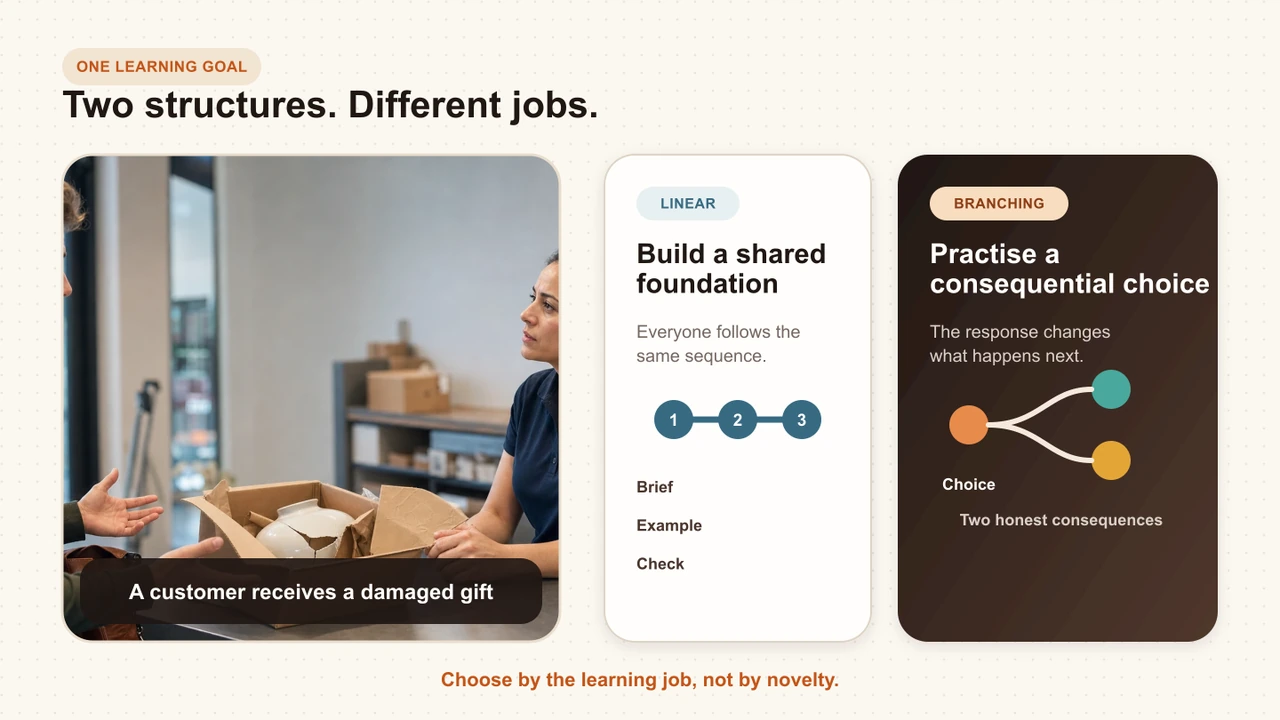
Use linear learning to build shared foundations and teach procedures whose order matters. Use branching to practise judgment when different choices should reveal different consequences. Use a hybrid when learners need both the same foundation and a safe place to make decisions.
The short answer
Choose linear
Everyone needs the same foundation, order is part of correct performance, or required coverage cannot be skipped.
Choose branching
Choice itself is the skill, and each credible option should change the information, consequence, or next task.
Choose hybrid
Learners need shared instruction first, then decision practice, then a common debrief or transfer task.
This is a selection guide, not a promise that one format produces a universal effect. Structure interacts with prior knowledge, feedback, practice, task realism, and implementation quality. The evidence section below explains why the choice needs to stay tied to the objective.
Define the three structures clearly
Linear
One designed sequence
Everyone follows the same ordered path. Learners can still pause, answer questions, practise, and receive feedback.
Branching
A decision changes the next context
A choice sends the learner to a consequence, new information, or task that follows from that decision.
Hybrid
Shared foundation, selective choice
Essential content stays common while decision practice branches where different reasoning should produce different consequences.
Three nearby ideas are often mixed together. Pace control lets a learner pause, replay, or choose when to continue. Nonlinear navigation lets a learner choose which topic or resource to visit. Branching changes the learner's next context because of a decision. A branched experience can include pace control, but the two are not the same treatment and should not share evidence as if they were.
What Is a Branching Scenario?
Review the mechanics of decisions, consequences, routes, Scenes, and Outcomes before choosing whether the format fits your objective.
What linear learning does well
Linear learning gives an instructional designer direct control over sequence and coverage. It works well when later ideas depend on earlier ones, when a procedure must happen in a safe order, or when every learner must receive the same policy, evidence, and demonstration.
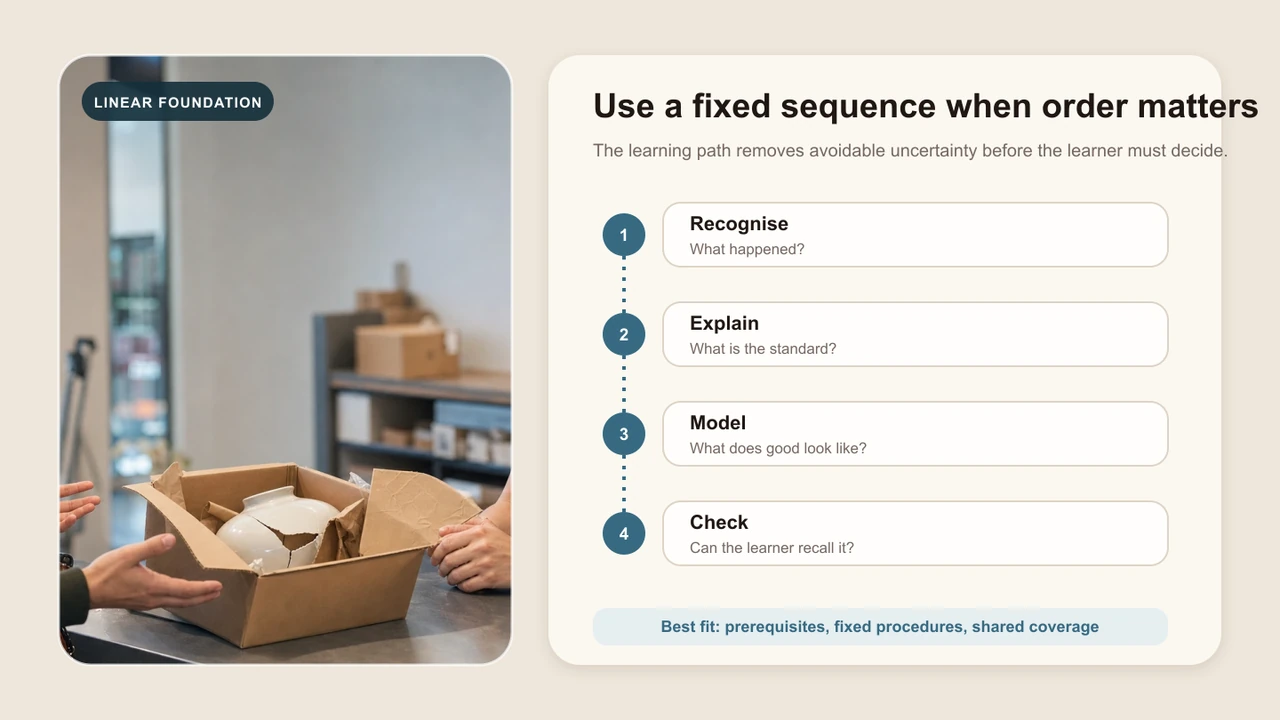
- Shared foundation: everyone receives the definitions, examples, and boundaries needed for later work.
- Ordered procedure: steps can be demonstrated and practised in the sequence required for correct performance.
- Comparable coverage: reviewers can verify what every learner encountered.
- Lower production risk: one strong route is easier to script, caption, localize, update, test, and support.
What branching learning does well
Branching is useful when the target performance is judgment. The learner sees enough context to choose, commits to an action, and encounters a result that follows from that reasoning. The changed route is not a prize or punishment. It is the instructional response.
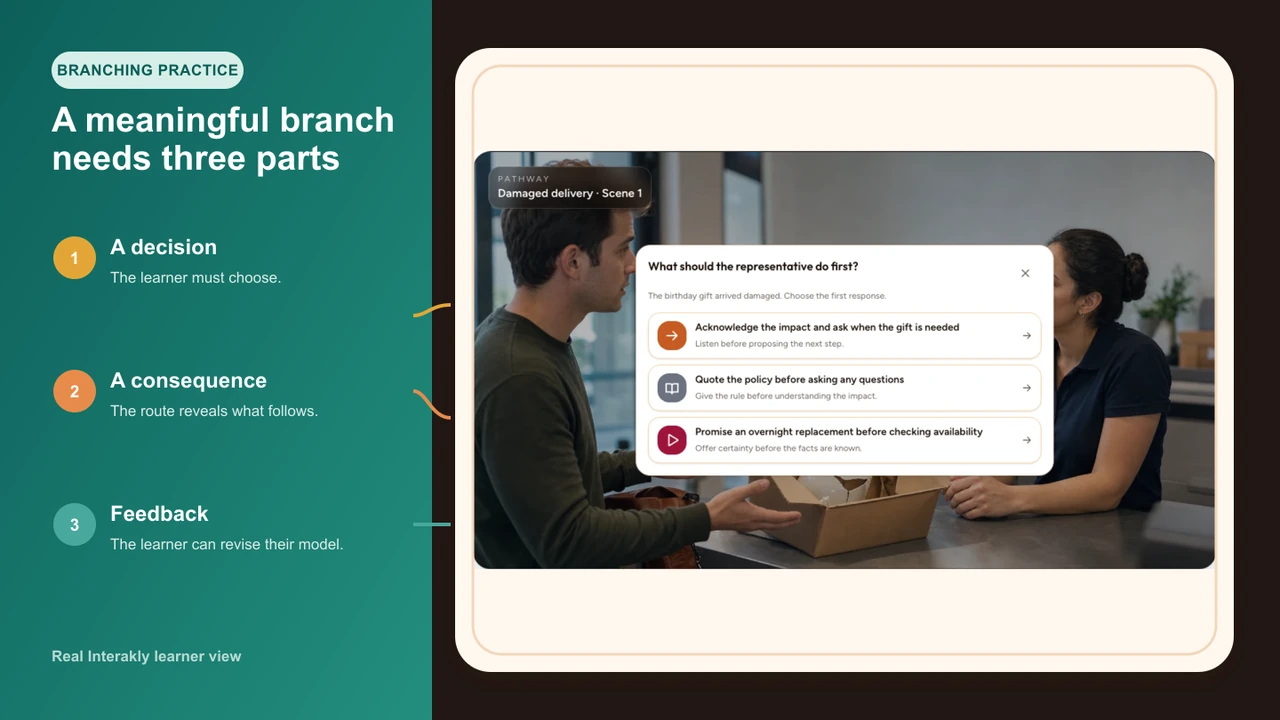
Good candidates include:
- a manager responding to a disclosure or performance problem,
- a clinician deciding what information to gather next,
- a service representative balancing policy and customer context,
- a salesperson diagnosing a need before recommending an option,
- a safety lead choosing a response as conditions change, and
- a student testing a claim and revising an explanation after evidence.
In each case, ask whether the learner's decision changes something worth seeing. If all options lead to the same explanation and next task, a direct question with good feedback may be clearer.
Branching Scenario Design: A Complete Practical Guide
Design meaningful choices, consequences, rejoining routes, scoring rules, accessibility, route QA, and post-release evidence.
What the comparison evidence actually says
The research does not justify a simple claim that branching beats linear learning. A 2024 study by Lacey, Francis, and Smith randomly assigned undergraduate biology students to branched decision-based videos or linear passive videos. Knowledge increased in both conditions, without a clear extra knowledge gain from branching. Learners often enjoyed or preferred the autonomy of the branched format, while many considered the linear videos more logically structured for core content. A redesigned, clearly scaffolded branching task was perceived as more engaging and useful for problem solving.
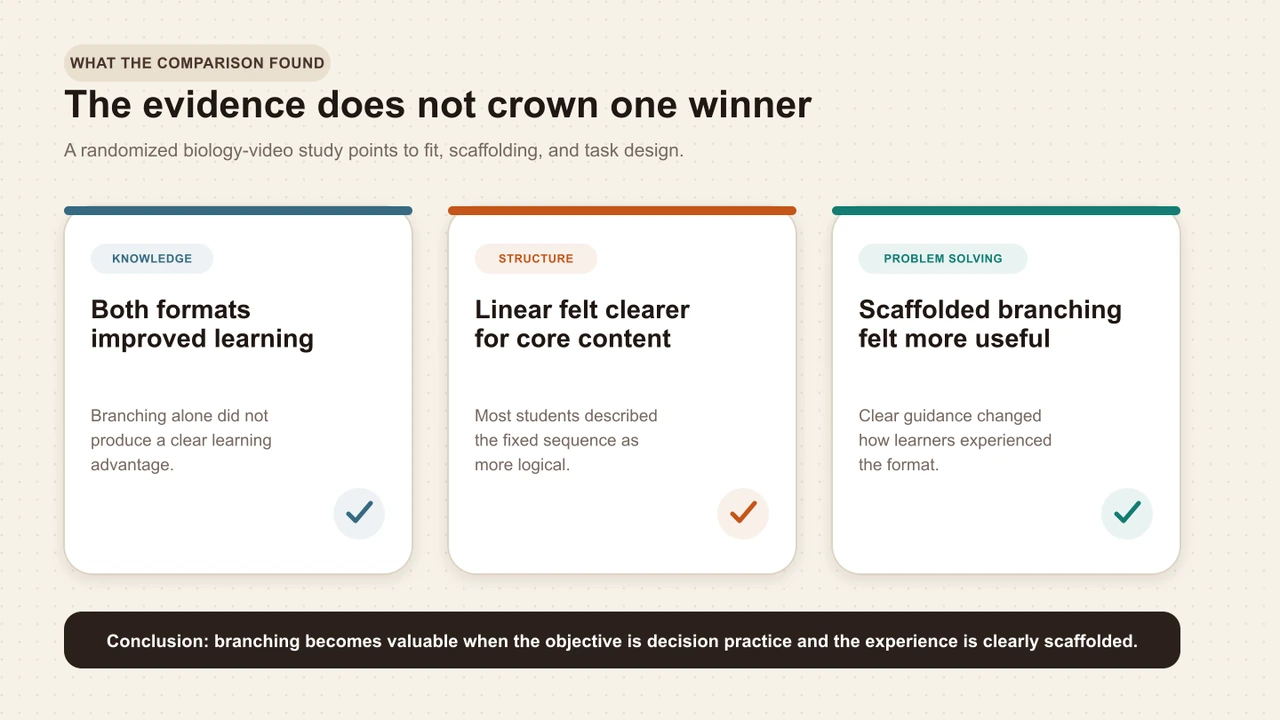
Other comparisons reinforce the need for caution. Martin's study of 240 students found a significant effect for practice but not for linear versus nonlinear navigation. A six-week study of linear and branched virtual patients found no significant format differences in motivation, self-efficacy, or reported learning strategies. These studies differ in tasks, populations, and outcomes, so they should not be pooled into one verdict. Together, they warn against treating route shape as the active ingredient while ignoring practice, feedback, guidance, and task design.
Choose by the decision, not the novelty
Begin with the performance, then select the lightest structure that can produce useful practice and evidence. Branching is justified when the route itself teaches something. Linear is justified when shared coverage and order protect understanding or performance.
Objective
Is the goal shared knowledge, ordered performance, or judgment?
Readiness
Can the learner recognize the evidence needed to choose well?
Consequence
Should the decision change the next information, risk, or action?
Coverage
Which information must every learner receive before completion?
Evidence
What will a route choice reveal that a direct question cannot?
Capacity
Can the team write, produce, review, and maintain every route?
Format-led question
How can we turn this course into a branching experience?
Performance-led question
Which decision should a learner practise, and what should change because of each credible choice?
If the team cannot name that decision and consequence, stay linear and improve the explanation, practice, and feedback. A small, purposeful branch is stronger than a large map built to look sophisticated.
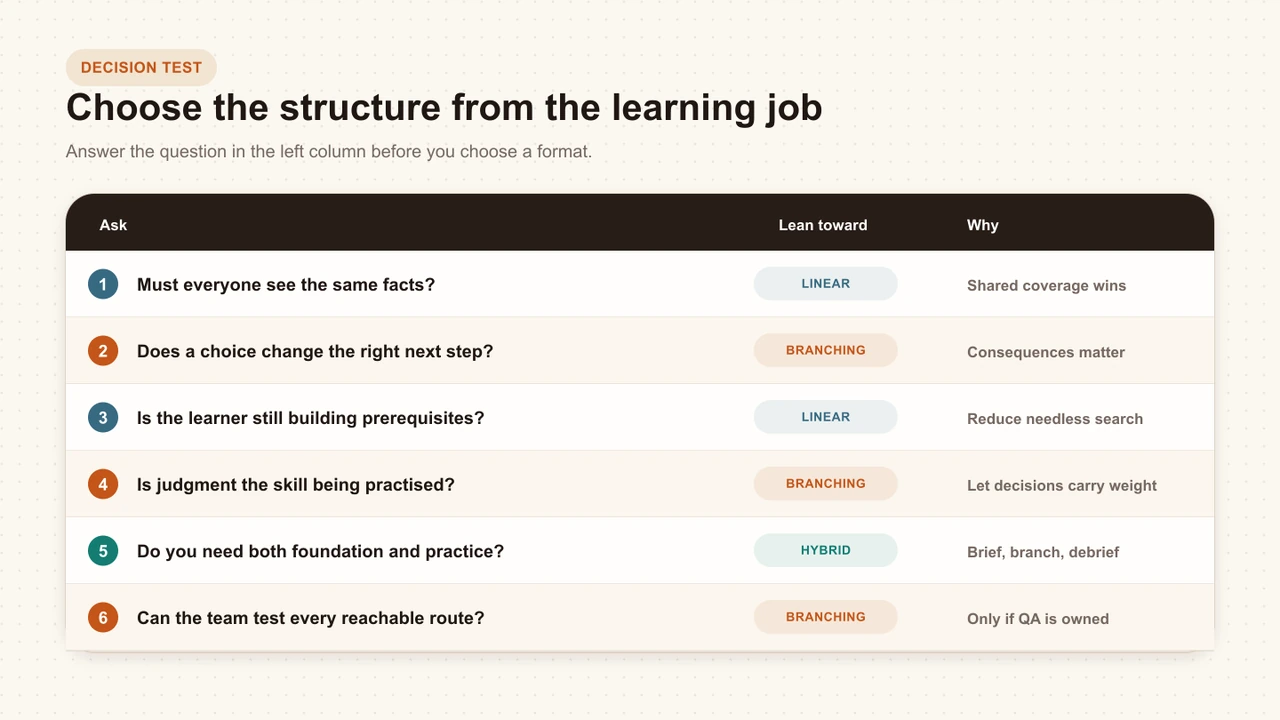
Use the six-question decision test
Answer these questions with the subject expert, writer, media producer, accessibility reviewer, and person responsible for post-launch updates. The table is a design aid, not a score. One strong fixed-sequence need can outweigh several weaker reasons to branch.
Ask this before choosing a format
Linear signal
Branch signal
1Must every learner receive the same information?
Linear signalYes, coverage is mandatory.
Branch signalNo, route-specific context is useful.
2Is a fixed order part of correct or safe performance?
Linear signalYes, sequence is part of the skill.
Branch signalNo, judgment changes what should happen next.
3Does the choice create a consequence worth showing?
Linear signalNo, the next lesson would be the same.
Branch signalYes, the situation should respond differently.
4Do learners have enough knowledge to interpret the options?
Linear signalNot yet, build the mental model first.
Branch signalYes, or the scenario provides tight scaffolding.
5Can the team build and test every reachable route?
Linear signalNo, route quality would be fragile.
Branch signalYes, owners and review time are assigned.
6Will route evidence answer a useful design question?
Linear signalNo, completion and response evidence are enough.
Branch signalYes, route choices help evaluate the experience.
Match structure to learner readiness
Choice is useful only when learners can interpret the options. A novice who lacks the vocabulary, cues, or process model may spend attention on guessing the route rather than learning the domain. Give beginners a clear foundation and tightly framed decisions. Reduce guidance as their knowledge becomes more stable.
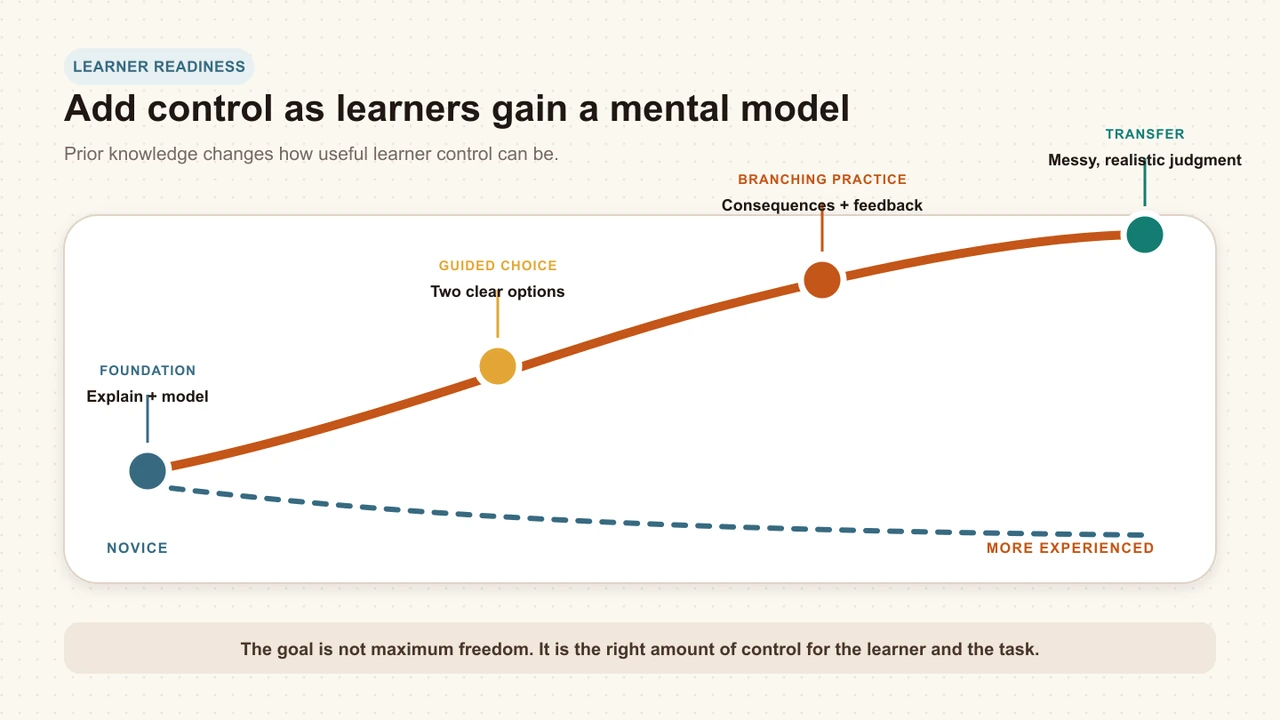
Reviews of learner control distinguish control over pace from control over instructional decisions. Pace control can help in some settings, while poorly supported pedagogical control can increase burden or reduce learning. Broader work on expertise and cognitive load also supports more structured guidance for novices and greater learner management after relevant knowledge develops. Applying that principle to branching is a design inference, not proof that every expert needs branches or every beginner needs a linear lesson.
- New learner: teach the shared model, demonstrate one worked example, then offer a limited choice with explanatory feedback.
- Developing learner: branch on a familiar decision, keep the context visible, and let routes rejoin for a common debrief.
- Experienced learner: remove obvious cues, combine competing constraints, and let consequences create the next decision.
Use linear when sequence is part of the skill
Some outcomes are ordered by nature. A lockout procedure, medication check, equipment startup, evidence-handling process, or foundational proof can become unsafe or unintelligible if the learner skips ahead. Keep the model linear when the order itself is part of the required performance.
Show the purpose and risk
Explain what the process protects and what failure looks like before presenting the steps.
Demonstrate the complete sequence
Keep prerequisites and dependent steps in the order in which competent performance requires them.
Pause for prediction or retrieval
Ask what should happen next or why a step matters without changing the required sequence.
Give explanatory feedback
Connect the response to the process logic instead of showing only correct or incorrect.
Check the complete performance
Use a final task that preserves the order and standards the learner is expected to apply.
Knowledge Check vs Quiz
Choose a low-stakes checkpoint or a formal assessment when the lesson needs practice and evidence without a branching route.
Use branching when consequences change the context
In a true decision task, the learner's action changes the world. A rushed promise may narrow the available remedies. A clarifying question may reveal a deadline. A failure to escalate may increase risk. Those changes create the next learning context.
- Present sufficient evidence. Give the role, goal, constraints, and observable cues needed for a fair decision.
- Offer credible alternatives. Each choice should express reasoning a real person might use, not one correct answer beside jokes.
- Show a natural consequence. Let the customer, system, patient, colleague, or environment respond to the choice.
- Explain the evidence. Name what the learner noticed, missed, or prioritized, then give another opportunity when useful.
Write credible alternatives without false choice
Separate the learner-facing action from the author-only rationale and tradeoff, then audit the set for accidental clues.
Build a hybrid when both are needed
Hybrid structure is often the most practical answer. It protects shared coverage, reserves branching for decisions that deserve it, and brings learners back together for synthesis. The pattern also makes production and review easier than a fully divergent course.
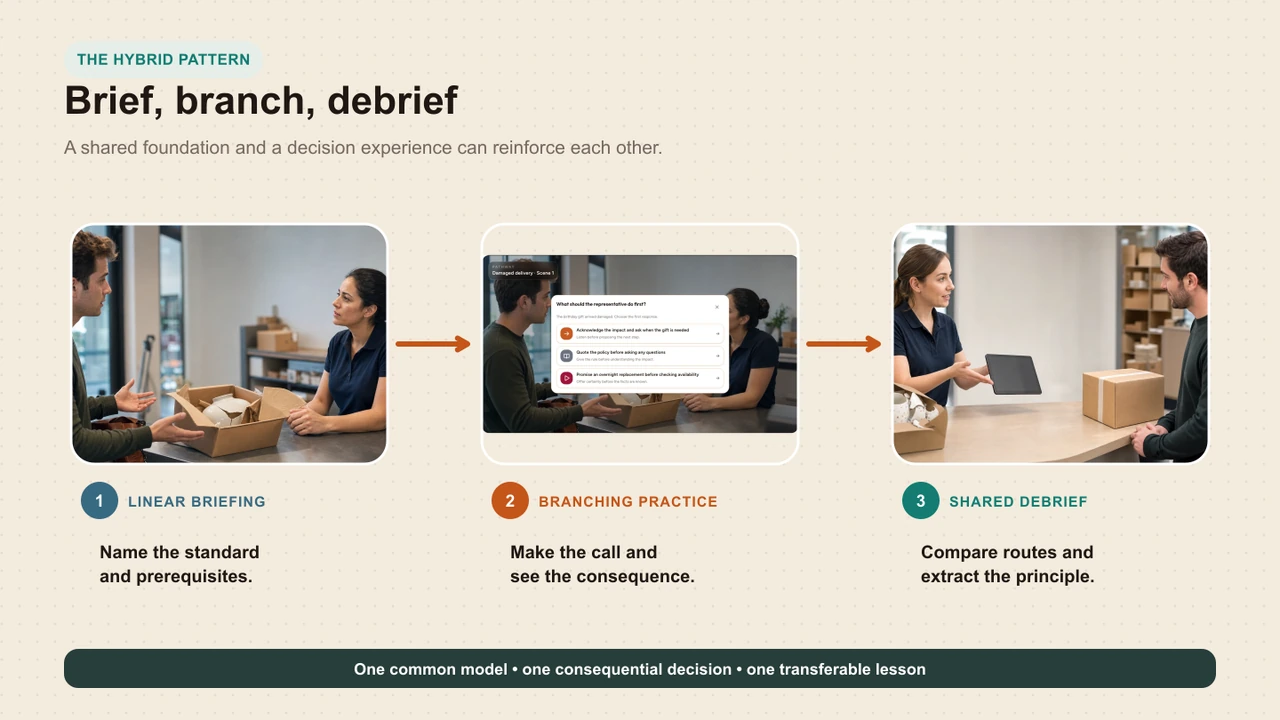
Linear briefing
Shared model, limits, and example
Branching practice
Decision, consequence, and follow-up
Linear debrief
Shared explanation and transfer task
The rejoin is instructional, not merely technical. Use it when the route differences have done their teaching and the next explanation or task is genuinely shared. Do not force a rejoin while learners still face different risks, information, or responsibilities.
Control route complexity and production cost
Every additional route creates more than another box on a map. It can add script, media, captions, translations, accessibility review, scoring logic, analytics interpretation, QA routes, and future updates. Count reachable learner experiences, not only visible nodes.
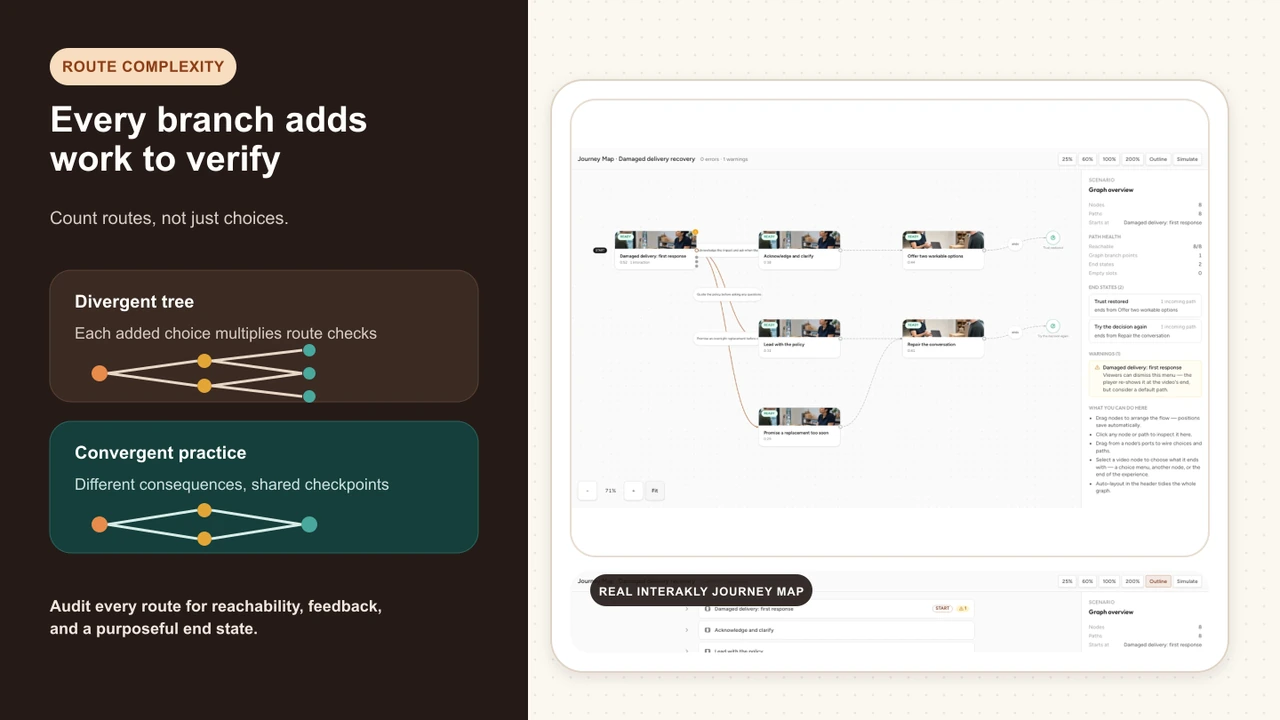
- Start with one decision and two or three credible choices.
- Give each choice one consequence that matters to the objective.
- Rejoin routes when later content is shared.
- Reuse instruction, not consequences that should remain different.
- Assign a route owner and a test case to every reachable ending.
- Remove a branch if it teaches nothing the other routes cannot.
The NATO Advanced Distributed Learning handbook makes a similar practical point: a complicated tree is not automatically better than a linear course, too many alternatives can burden the design, and optional material should be labeled clearly. Treat simplicity as a quality tool, not a lack of ambition.
Decide what every learner must see
Before writing routes, make a coverage inventory. Put each item into one of three groups:
Required before choice
Information, boundaries, and cues every learner needs to make a fair decision.
Route-specific
Consequences and evidence that should appear only because of a particular decision.
Required after routes
The shared explanation, standard, or transfer task every learner needs before completion.
This inventory protects learners from missing critical information while preserving route differences. It also answers a common learner concern: “Did I miss something important because I chose this path?” If content is optional enrichment, label it. If it is required, do not hide it behind a route the learner may never reach.
Design feedback for the chosen structure
Feedback has a different job in each structure. In linear learning, it can correct a misconception and reconnect the learner to the shared sequence. In branching, the simulated consequence should respond first, then explanatory feedback can help the learner interpret why the route changed.
Linear feedback
Explain the evidence, correct the misconception, and prepare the learner for the next shared step.
Branching feedback
Show what changed because of the decision, then explain the reasoning and offer another judgment when useful.
Scenario-based e-simulation guidance published in JMIR emphasizes clear objectives, realistic tasks, guidance rather than unsupported discovery, and explanatory feedback rather than simple right or wrong messages. That guidance supports both structures: the format never replaces the need to explain the evidence and expected performance.
How to Write Useful Feedback for Video Questions
Write feedback that explains the evidence, addresses reasoning, and prepares the learner for the next attempt or decision.
Build and test the experience in Interakly
A linear Interakly video can keep one shared timeline while using questions, information cards, forms, hotspots, and other interactions. For a complete branch, create a Pathway with uploaded video Scenes, place a Choice Moment at the decision, connect every option to a Scene or Outcome, and test every route in Preview.
Build the shared foundation
Keep required instruction in one clear sequence and add practice where it supports the objective.
Create uploaded-video Scenes
Use separate Scenes for contexts or consequences that truly need a different route.
Add the Choice Moment
Place it after enough evidence is visible and before the simulated action happens.
Wire every destination
Connect each option to an intentional Scene or Outcome and name Routes so the map remains understandable.
Preview every complete route
Check choices, transitions, consequences, feedback, captions, scoring, phone presentation, and endings.
Run Launch Check
Resolve missing content, unwired options, unreachable destinations, and other release blockers before publishing.
How to Create a Branching Video
Follow the current Interakly workflow from Pathway setup through Scenes, Choice Moments, routes, Preview, Launch Check, and release.
A practical planning template
Complete this brief before recording media or building a Journey Map. It keeps the format decision traceable and gives reviewers a shared standard for approving or removing routes.
One-page structure brief
Decide the learning logic before the route map
1Required outcome
What should learners know, do in order, or decide better?
Do not name the format yet.
2Shared foundation
What must everyone see and understand?
Keep this common unless skipping it is genuinely safe.
3Decision point
Which judgment could create a different next situation?
Branch only if the difference matters to the objective.
4Consequence
What changes in the world after each plausible choice?
Show the result before explaining it when possible.
5Rejoin rule
When does later instruction become shared again?
Converge routes to control repetition and maintenance.
6Evidence plan
Which responses, routes, or outcomes will you inspect?
State what the evidence can and cannot support.
7Quality owner
Who tests every route, device, source, and revision?
No branch is ready until its full route is reviewed.
End with a plain-language rationale: “This experience uses a five-minute linear foundation because every learner needs the same policy limits. It branches at the recovery conversation because the response changes the customer's information and trust. Routes rejoin for the shared escalation standard and transfer task.”
Common mistakes
Branching because it looks interactive
The map grows, but each route teaches the same information and returns to the same next step.
Calling pace control branching
Pause and replay are useful controls, but they do not create decision consequences or a changed context.
Making shared foundations optional
Learners reach a decision without the vocabulary, evidence, policy, or process model needed to choose fairly.
Turning the linear route into a lecture
One sequence becomes an excuse to remove practice, prediction, retrieval, and explanatory feedback.
Letting every route diverge forever
The experience becomes difficult to update, localize, test, and explain even after the meaningful differences have ended.
Treating enjoyment as proof of learning
Preference and engagement are useful signals, but they are not interchangeable with knowledge, transfer, or job performance.
Ignoring source boundaries
A YouTube Choice Moment is planned as if it can provide the complete uploaded-video segment workflow, so the promised route cannot be delivered.
Testing only the preferred route
Unclear consequences, unwired destinations, unequal coverage, and mobile problems remain hidden on less obvious paths.
FAQ
Is branching learning always more engaging than linear learning?
No. A meaningful decision with a believable consequence can be engaging, but extra routes do not create value by themselves. Research comparing branched and linear video found a more qualified picture: learners often liked the autonomy of branching, while many still found linear delivery more logically structured for core content. Branching became more useful when it was clearly scaffolded around problem solving.
When is linear learning the better choice?
Choose linear learning when everyone needs the same foundation, the order of steps is part of safe or correct performance, or skipping material would undermine the objective. Linear does not have to mean passive. It can include questions, practice, reflection, feedback, and replay while keeping one shared sequence.
When is branching learning worth the extra work?
Use branching when the learner must make a judgment and that choice should change the information, risk, relationship, or action that follows. The branch earns its production cost when the consequence helps the learner understand why one line of reasoning produces a different situation from another.
Can one lesson combine linear and branching learning?
Yes. A strong hybrid often starts with a short linear briefing, moves into a branching decision practice, and ends with a shared linear debrief. This protects essential coverage while still giving learners a safe place to test judgment and see consequences.
Is learner-controlled pace the same as branching?
No. Pace control lets a learner pause, replay, or decide when to continue. Nonlinear navigation lets a learner choose which content to visit. Branching changes the next context because of a decision. These forms of control can coexist, but evidence about one should not be presented as proof about another.
How many branches should a learning scenario have?
Use the fewest branches needed to expose the important differences between decisions. Start with one decision, two or three credible choices, and a meaningful consequence for each. Rejoin routes when later instruction is genuinely shared, and keep them separate when the earlier decision changes what the learner must handle next.
Should beginners use branching learning?
Beginners can use branching when the task is tightly framed, the choices are limited, and feedback explains the relevant evidence. Do not make a new learner discover both the domain and the route logic at the same time. Give the shared foundation first, then increase choice as learners gain a usable mental model.
Can I build complete branching with a YouTube video in Interakly?
A YouTube Scene can show compatible contained Choice Moments in Interakly, but uploaded video is required for the complete segment-based Pathway branching workflow. Use uploaded video when choices must move learners between authored video segments, and verify the exact route in Preview before release.
Sources
These sources support the comparison and design principles above. The article separates direct findings from broader design inferences and does not treat studies of pace control or nonlinear navigation as direct tests of branching scenarios.
- Lacey, Francis, and Smith, “Redefining online biology education: a study on interactive branched video utilisation and student learning experiences,” FEBS Open Bio, 2024. The study directly compared branched decision-based and linear passive biology videos. Read the peer-reviewed article.
- Martin, “Effects of Practice in a Linear and Non-Linear Web-Based Learning Environment,” Educational Technology & Society, 2008. The study separated navigation type from the effect of practice. Read the ERIC record.
- Woodham and colleagues, “Virtual patients designed for training against medical error: Exploring the impact of decision-making on learner motivation,” PLOS ONE, 2019. The study compared linear and branched virtual patients over six weeks. Read the open-access article.
- Bahattab and colleagues, “Scenario-Based e-Simulation Design for Global Health Education: Theoretical Foundation and Practical Recommendations,” Journal of Medical Internet Research, 2023. The article covers objectives, realistic tasks, linear and branching structures, guidance, and explanatory feedback. Read the open-access article.
- Cavanagh and Kiersch, “Using commonly-available technologies to create online multimedia lessons through the application of the Cognitive Theory of Multimedia Learning,” Educational Technology Research and Development, 2023. Its learner-control section distinguishes forms of control and discusses prior knowledge, pacing, and instructional decisions. Read the peer-reviewed article.
- Castro-Alonso, de Koning, Fiorella, and Paas, “Five Strategies for Optimizing Instructional Materials: Instructor- and Learner-Managed Cognitive Load,” Educational Psychology Review, 2021. The review informs the qualified discussion of guidance and learner-managed strategies. Read the review.
- NATO Advanced Distributed Learning, ADL Handbook, January 2023. The practical storyboard guidance warns that a complicated tree is not automatically better than a linear course and recommends limiting and labeling alternatives clearly. Read the handbook.
- Vanderbilt Center for Digital Education, “Branching Out With Interactive Scenarios.” The instructional design resource notes that branching is a poor fit when information must be delivered in a fixed linear sequence. Read the design resource.
Interactive Video Best Practices
Review timing, feedback, responsive presentation, accessibility, source limits, Preview, and release checks across the full learner experience.
How to Create Interactive Video
Build a focused linear interactive video before adding route complexity that the learning objective may not need.
Choose the structure your learning decision deserves
Protect shared foundations, branch only where a decision changes the context, and test every route as a complete learner experience before release.
Explore Choice Moment